

1.3.2 Peatland Formation in Amazonia
In the Amazon Basin, the chemistry of the surface waters within a catchment is
mainly controlled by substrate lithology and the erosional regime (Fig. 1.6).
River (Rio Negro) sediments from the Negro Basin (Upper Tertiary sediments)
contain 0< total cation charge (TZ+) <200 μeq/l, showing high levels of Fe, Al, H
+
,
and enriched Si.
River (Rio Solimoes) sediments from siliceous terrain such as the Peruvian Andes
and Bolivian Andes (Rio Solimoes) contain 200 < TZ+ <450 μeq/l and are enriched
in Na more than K and Ca more than Mg.
River (Amazon) sediments from marine sediments or red beds contain 450 < TZ
+ <3000 μeq/l, showing high levels of Ca, Mg, alkalinity, and SO 4 .
Thus, as Rio Negro (nutrient-poor) peat shows a humic acid color similar to peat
water, but Rio Solimoes (nutrient-rich) peat shows a siliceous clay color, peat
formation not only depends on water but also depends strongly on nutrient conditions. Peatland formation surrounding the Amazon River near Manaus is poor, even
in high water level conditions; nutrients and clay in this area are supplied from the
Peruvian Andes and Bolivian Andes and from the sea by tidal bores, such as the
Pororoca, which has waves up to 4 m high that travel as much as 800 km inland
upstream (Freitas et al. 2012).
Inland Peat
Coastal Peat
Sandy Podzolic
Subsoil
Acid Sulfate
Subsoil
Intermediate
Peat
Alluvial
Subsoil
Mineral Soil
Saline
Soil
Mangrove
Sago
Coconuts
Melaluca
Sea
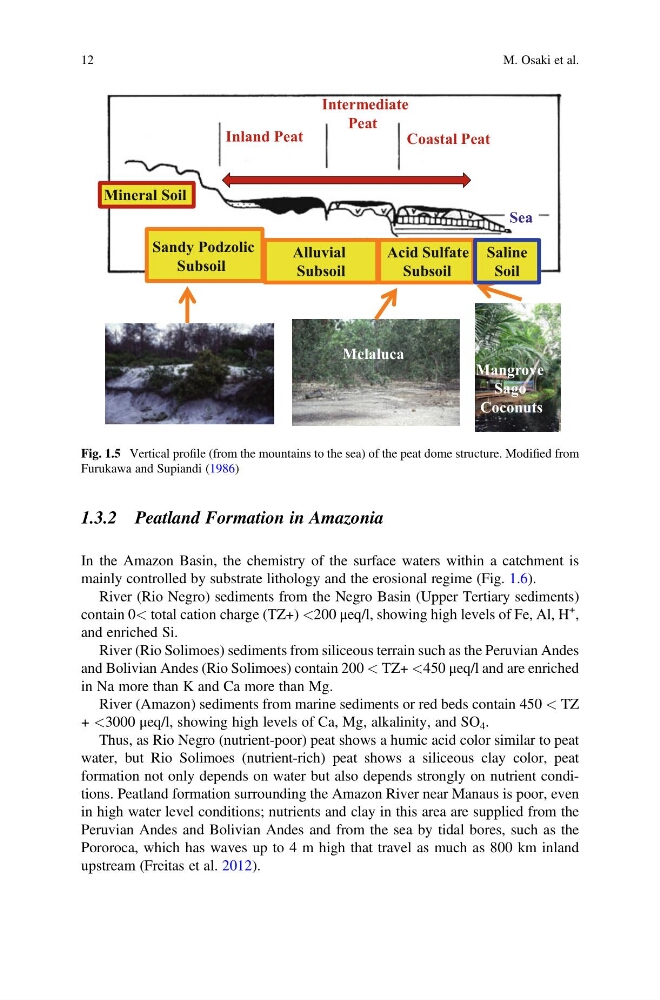
Fig. 1.5 Vertical profile (from the mountains to the sea) of the peat dome structure. Modified from
Furukawa and Supiandi (1986)
12
M. Osaki et al.
In the Amazon Basin, the chemistry of the surface waters within a catchment is
mainly controlled by substrate lithology and the erosional regime (Fig. 1.6).
River (Rio Negro) sediments from the Negro Basin (Upper Tertiary sediments)
contain 0< total cation charge (TZ+) <200 μeq/l, showing high levels of Fe, Al, H
+
,
and enriched Si.
River (Rio Solimoes) sediments from siliceous terrain such as the Peruvian Andes
and Bolivian Andes (Rio Solimoes) contain 200 < TZ+ <450 μeq/l and are enriched
in Na more than K and Ca more than Mg.
River (Amazon) sediments from marine sediments or red beds contain 450 < TZ
+ <3000 μeq/l, showing high levels of Ca, Mg, alkalinity, and SO 4 .
Thus, as Rio Negro (nutrient-poor) peat shows a humic acid color similar to peat
water, but Rio Solimoes (nutrient-rich) peat shows a siliceous clay color, peat
formation not only depends on water but also depends strongly on nutrient conditions. Peatland formation surrounding the Amazon River near Manaus is poor, even
in high water level conditions; nutrients and clay in this area are supplied from the
Peruvian Andes and Bolivian Andes and from the sea by tidal bores, such as the
Pororoca, which has waves up to 4 m high that travel as much as 800 km inland
upstream (Freitas et al. 2012).
Inland Peat
Coastal Peat
Sandy Podzolic
Subsoil
Acid Sulfate
Subsoil
Intermediate
Peat
Alluvial
Subsoil
Mineral Soil
Saline
Soil
Mangrove
Sago
Coconuts
Melaluca
Sea
Fig. 1.5 Vertical profile (from the mountains to the sea) of the peat dome structure. Modified from
Furukawa and Supiandi (1986)
12
M. Osaki et al.