

the heterogeneity of natural capital with high accuracy and real-time monitoring
systems to observe changes are essential (see Chap. 5).
Carbon negative does not mean that peatlands should simply be actively used
without consideration. A management system is proposed in Chap. 3.
Here, the “large-scale eco-management of tropical peatland” is described and
proposed with (1) “Stock-based WM,” (2) a (semi-)real-time “integrated MRV
system,” and (3) compatibility of “economy-based VCs” and “ecology-based
VCs,” which will lead to a carbon-negative society for the first time in the world’s
history.
4.7.4 Carbon Strategies for Mitigation and Adaptation
of Climate Change
Here, carbon strategies can be applied not only for tropical peatlands but also for all
tropical regions.
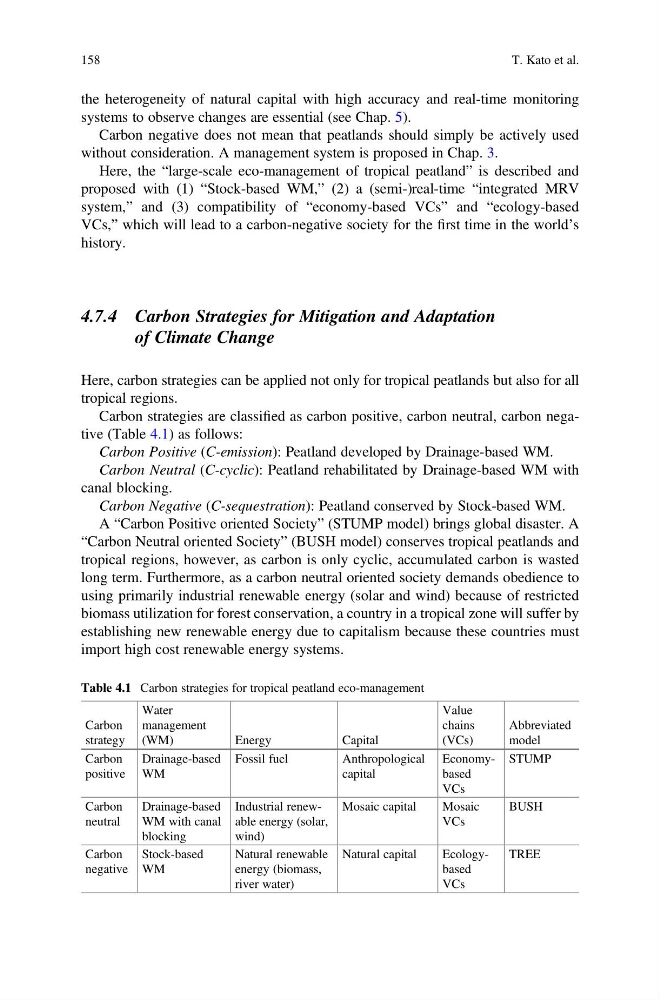
Carbon strategies are classified as carbon positive, carbon neutral, carbon negative (Table 4.1) as follows:
Carbon Positive (C-emission): Peatland developed by Drainage-based WM.
Carbon Neutral (C-cyclic): Peatland rehabilitated by Drainage-based WM with
canal blocking.
Carbon Negative (C-sequestration): Peatland conserved by Stock-based WM.
A “Carbon Positive oriented Society” (STUMP model) brings global disaster. A
“Carbon Neutral oriented Society” (BUSH model) conserves tropical peatlands and
tropical regions, however, as carbon is only cyclic, accumulated carbon is wasted
long term. Furthermore, as a carbon neutral oriented society demands obedience to
using primarily industrial renewable energy (solar and wind) because of restricted
biomass utilization for forest conservation, a country in a tropical zone will suffer by
establishing new renewable energy due to capitalism because these countries must
import high cost renewable energy systems.
Table 4.1 Carbon strategies for tropical peatland eco-management
Carbon
strategy
Water
management
(WM)
Energy
Capital
Value
chains
(VCs)
Abbreviated
model
Carbon
positive
Drainage-based
WM
Fossil fuel
Anthropological
capital
Economybased
VCs
STUMP
Carbon
neutral
Drainage-based
WM with canal
blocking
Industrial renewable energy (solar,
wind)
Mosaic capital
Mosaic
VCs
BUSH
Carbon
negative
Stock-based
WM
Natural renewable
energy (biomass,
river water)
Natural capital
Ecologybased
VCs
TREE
158
T. Kato et al.
systems to observe changes are essential (see Chap. 5).
Carbon negative does not mean that peatlands should simply be actively used
without consideration. A management system is proposed in Chap. 3.
Here, the “large-scale eco-management of tropical peatland” is described and
proposed with (1) “Stock-based WM,” (2) a (semi-)real-time “integrated MRV
system,” and (3) compatibility of “economy-based VCs” and “ecology-based
VCs,” which will lead to a carbon-negative society for the first time in the world’s
history.
4.7.4 Carbon Strategies for Mitigation and Adaptation
of Climate Change
Here, carbon strategies can be applied not only for tropical peatlands but also for all
tropical regions.
Carbon strategies are classified as carbon positive, carbon neutral, carbon negative (Table 4.1) as follows:
Carbon Positive (C-emission): Peatland developed by Drainage-based WM.
Carbon Neutral (C-cyclic): Peatland rehabilitated by Drainage-based WM with
canal blocking.
Carbon Negative (C-sequestration): Peatland conserved by Stock-based WM.
A “Carbon Positive oriented Society” (STUMP model) brings global disaster. A
“Carbon Neutral oriented Society” (BUSH model) conserves tropical peatlands and
tropical regions, however, as carbon is only cyclic, accumulated carbon is wasted
long term. Furthermore, as a carbon neutral oriented society demands obedience to
using primarily industrial renewable energy (solar and wind) because of restricted
biomass utilization for forest conservation, a country in a tropical zone will suffer by
establishing new renewable energy due to capitalism because these countries must
import high cost renewable energy systems.
Table 4.1 Carbon strategies for tropical peatland eco-management
Carbon
strategy
Water
management
(WM)
Energy
Capital
Value
chains
(VCs)
Abbreviated
model
Carbon
positive
Drainage-based
WM
Fossil fuel
Anthropological
capital
Economybased
VCs
STUMP
Carbon
neutral
Drainage-based
WM with canal
blocking
Industrial renewable energy (solar,
wind)
Mosaic capital
Mosaic
VCs
BUSH
Carbon
negative
Stock-based
WM
Natural renewable
energy (biomass,
river water)
Natural capital
Ecologybased
VCs
TREE
158
T. Kato et al.