

timber led to the construction of roads into the forest and the arrival of a money
economy to indigenous peoples. Originally, agriculture was established over the
extremely long history of humankind, with methods that are specific to the climate
and nature of the region. However, looking at Kalimantan as a whole, the forests’
full-scale development began a mere 50 years ago. Unsurprisingly, there had been
no agricultural technology on the peatlands. Local people living near the peatlands
have been burning the land and planting upland rice and maize. However, the
land was abandoned after only 1 year due to a significant loss of productivity
(pers. observation). Therefore, it is essential to create a business model and new
values that enable local people to live independently. As a means of earning a
livelihood, land use in line with the peatland management system was proposed
(see Chap. 3) and an ideal added value will be considered to maximize the value of
commodity crops.
4.4.1 A Case Study: Ethnic and Cultural Diversity
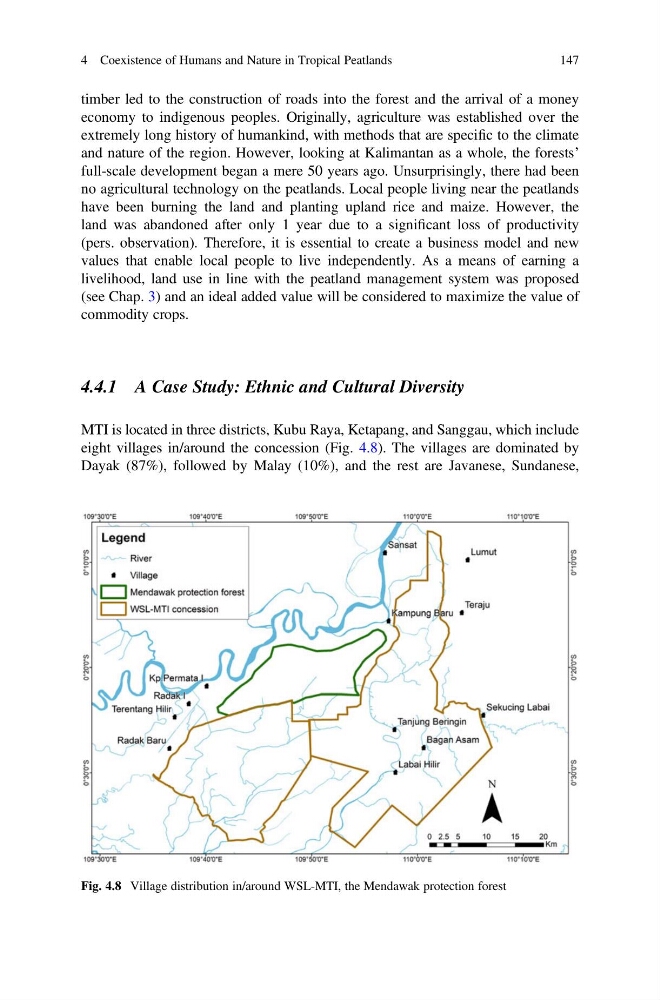
MTI is located in three districts, Kubu Raya, Ketapang, and Sanggau, which include
eight villages in/around the concession (Fig. 4.8). The villages are dominated by
Dayak (87%), followed by Malay (10%), and the rest are Javanese, Sundanese,
Fig. 4.8 Village distribution in/around WSL-MTI, the Mendawak protection forest
4 Coexistence of Humans and Nature in Tropical Peatlands
147
economy to indigenous peoples. Originally, agriculture was established over the
extremely long history of humankind, with methods that are specific to the climate
and nature of the region. However, looking at Kalimantan as a whole, the forests’
full-scale development began a mere 50 years ago. Unsurprisingly, there had been
no agricultural technology on the peatlands. Local people living near the peatlands
have been burning the land and planting upland rice and maize. However, the
land was abandoned after only 1 year due to a significant loss of productivity
(pers. observation). Therefore, it is essential to create a business model and new
values that enable local people to live independently. As a means of earning a
livelihood, land use in line with the peatland management system was proposed
(see Chap. 3) and an ideal added value will be considered to maximize the value of
commodity crops.
4.4.1 A Case Study: Ethnic and Cultural Diversity
MTI is located in three districts, Kubu Raya, Ketapang, and Sanggau, which include
eight villages in/around the concession (Fig. 4.8). The villages are dominated by
Dayak (87%), followed by Malay (10%), and the rest are Javanese, Sundanese,
Fig. 4.8 Village distribution in/around WSL-MTI, the Mendawak protection forest
4 Coexistence of Humans and Nature in Tropical Peatlands
147