

orangutans, which cannot swim, have been unable to expand their habitat beyond
these rivers rather than diminished by past development.
MTI conducts population surveys with experts every 2 years for confirmed
orangutan habitats. Over the past decade, experts estimated that orangutan
populations in the conservation area of MTI had been increasing, but MTI had not
made much of a public appeal. This is because MTI thought that even if the method
of estimating population from the number of nests, which is scientifically correct, it
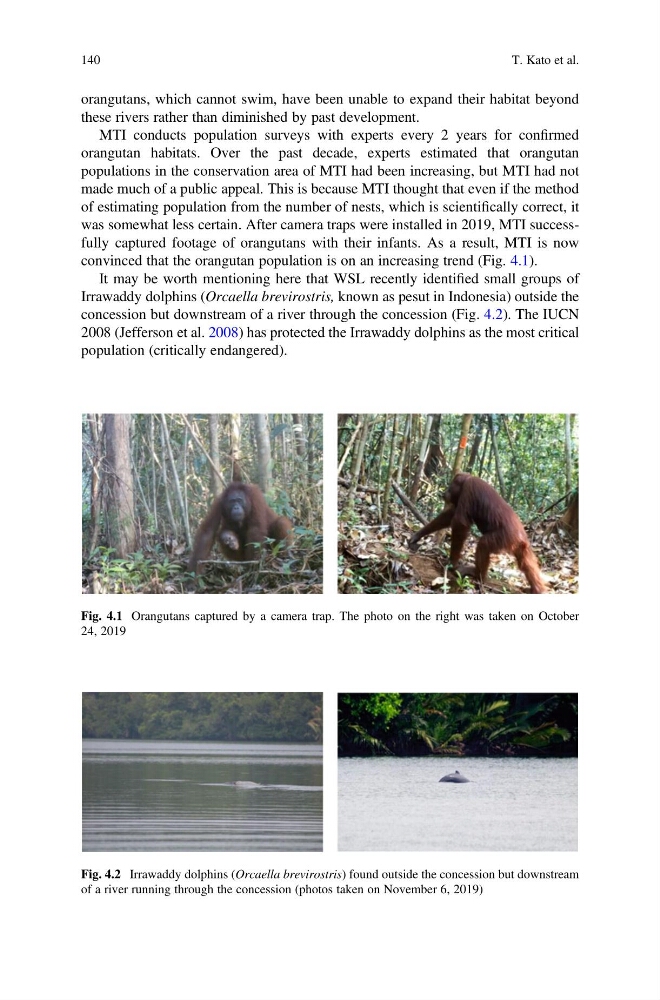
was somewhat less certain. After camera traps were installed in 2019, MTI successfully captured footage of orangutans with their infants. As a result, MTI is now
convinced that the orangutan population is on an increasing trend (Fig. 4.1).
It may be worth mentioning here that WSL recently identified small groups of
Irrawaddy dolphins (Orcaella brevirostris, known as pesut in Indonesia) outside the
concession but downstream of a river through the concession (Fig. 4.2). The IUCN
2008 (Jefferson et al. 2008) has protected the Irrawaddy dolphins as the most critical
population (critically endangered).
Fig. 4.1 Orangutans captured by a camera trap. The photo on the right was taken on October
24, 2019
Fig. 4.2 Irrawaddy dolphins (Orcaella brevirostris) found outside the concession but downstream
of a river running through the concession (photos taken on November 6, 2019)
140
T. Kato et al.
these rivers rather than diminished by past development.
MTI conducts population surveys with experts every 2 years for confirmed
orangutan habitats. Over the past decade, experts estimated that orangutan
populations in the conservation area of MTI had been increasing, but MTI had not
made much of a public appeal. This is because MTI thought that even if the method
of estimating population from the number of nests, which is scientifically correct, it
was somewhat less certain. After camera traps were installed in 2019, MTI successfully captured footage of orangutans with their infants. As a result, MTI is now
convinced that the orangutan population is on an increasing trend (Fig. 4.1).
It may be worth mentioning here that WSL recently identified small groups of
Irrawaddy dolphins (Orcaella brevirostris, known as pesut in Indonesia) outside the
concession but downstream of a river through the concession (Fig. 4.2). The IUCN
2008 (Jefferson et al. 2008) has protected the Irrawaddy dolphins as the most critical
population (critically endangered).
Fig. 4.1 Orangutans captured by a camera trap. The photo on the right was taken on October
24, 2019
Fig. 4.2 Irrawaddy dolphins (Orcaella brevirostris) found outside the concession but downstream
of a river running through the concession (photos taken on November 6, 2019)
140
T. Kato et al.