

and biofuels. However, at least short-term successes have also been achieved with
tree corps, such as Acacia crassicarpa for pulp and oil palm. However, tree
plantations on peat soils have always been far from a complete success and consistently problematic, with an extremely low pH, poor nutrition, anaerobic nature,
instability, and spongy soils. A critical issue, especially affecting productivity, is
the likelihood of falling trees after several year growths, likely because of (1) the soft
medium of peat and (2) poor growth of the primary and lateral roots. The reduction
of fallen trees on peatland is being investigated.
The case of industrial forest plantations is explained in detail. The history of tree
plantation projects in tropical peatlands was started based on rapidly growing tree
species for pulp use. It has a relatively short history, with the first project starting in
Riau province in 1995 (Suwardi et al. 2005). Conversely, plantation companies have
been faced with another problem: as trees grow, they become more prone to falling.
For example, the 6-year harvesting period for Acacia crassicarpa, a suitable species
for planting on peatlands, was initially optimal, but usually after 5 years, fallen trees
tended to occur and yield to decrease. As a result, a 4-year harvesting period has
recently been adopted.
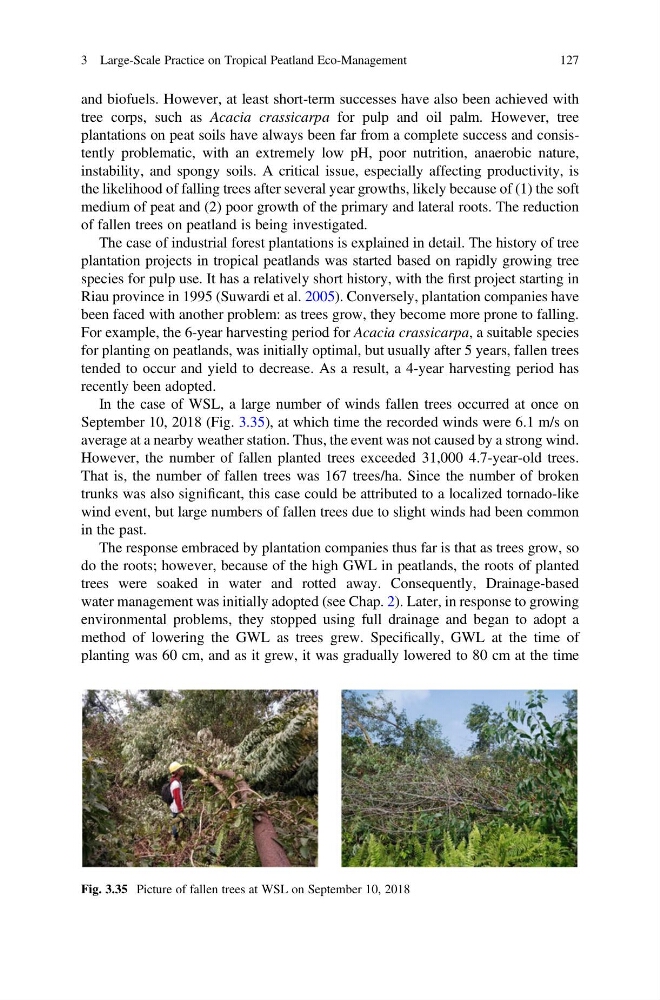
In the case of WSL, a large number of winds fallen trees occurred at once on
September 10, 2018 (Fig. 3.35), at which time the recorded winds were 6.1 m/s on
average at a nearby weather station. Thus, the event was not caused by a strong wind.
However, the number of fallen planted trees exceeded 31,000 4.7-year-old trees.
That is, the number of fallen trees was 167 trees/ha. Since the number of broken
trunks was also significant, this case could be attributed to a localized tornado-like
wind event, but large numbers of fallen trees due to slight winds had been common
in the past.
The response embraced by plantation companies thus far is that as trees grow, so
do the roots; however, because of the high GWL in peatlands, the roots of planted
trees were soaked in water and rotted away. Consequently, Drainage-based
water management was initially adopted (see Chap. 2). Later, in response to growing
environmental problems, they stopped using full drainage and began to adopt a
method of lowering the GWL as trees grew. Specifically, GWL at the time of
planting was 60 cm, and as it grew, it was gradually lowered to 80 cm at the time
Fig. 3.35 Picture of fallen trees at WSL on September 10, 2018
3 Large-Scale Practice on Tropical Peatland Eco-Management
127
tree corps, such as Acacia crassicarpa for pulp and oil palm. However, tree
plantations on peat soils have always been far from a complete success and consistently problematic, with an extremely low pH, poor nutrition, anaerobic nature,
instability, and spongy soils. A critical issue, especially affecting productivity, is
the likelihood of falling trees after several year growths, likely because of (1) the soft
medium of peat and (2) poor growth of the primary and lateral roots. The reduction
of fallen trees on peatland is being investigated.
The case of industrial forest plantations is explained in detail. The history of tree
plantation projects in tropical peatlands was started based on rapidly growing tree
species for pulp use. It has a relatively short history, with the first project starting in
Riau province in 1995 (Suwardi et al. 2005). Conversely, plantation companies have
been faced with another problem: as trees grow, they become more prone to falling.
For example, the 6-year harvesting period for Acacia crassicarpa, a suitable species
for planting on peatlands, was initially optimal, but usually after 5 years, fallen trees
tended to occur and yield to decrease. As a result, a 4-year harvesting period has
recently been adopted.
In the case of WSL, a large number of winds fallen trees occurred at once on
September 10, 2018 (Fig. 3.35), at which time the recorded winds were 6.1 m/s on
average at a nearby weather station. Thus, the event was not caused by a strong wind.
However, the number of fallen planted trees exceeded 31,000 4.7-year-old trees.
That is, the number of fallen trees was 167 trees/ha. Since the number of broken
trunks was also significant, this case could be attributed to a localized tornado-like
wind event, but large numbers of fallen trees due to slight winds had been common
in the past.
The response embraced by plantation companies thus far is that as trees grow, so
do the roots; however, because of the high GWL in peatlands, the roots of planted
trees were soaked in water and rotted away. Consequently, Drainage-based
water management was initially adopted (see Chap. 2). Later, in response to growing
environmental problems, they stopped using full drainage and began to adopt a
method of lowering the GWL as trees grew. Specifically, GWL at the time of
planting was 60 cm, and as it grew, it was gradually lowered to 80 cm at the time
Fig. 3.35 Picture of fallen trees at WSL on September 10, 2018
3 Large-Scale Practice on Tropical Peatland Eco-Management
127