

techniques, planting and oil palm projects cannot be undertaken. Furthermore,
restoration with native species is even more difficult. Therefore, it is necessary to
once again consider why peat swamp forests are established in nutrient-poor, fragile
soils with high groundwater levels.
3.11.1 Local Species Culture
The high level of biodiversity in peatlands must be conserved to preserve the rich
biodiversity. The WSL-MTI have been conducting daily patrols, regularly surveying
the flora and fauna, and developing nurseries for local tree species to plant in areas
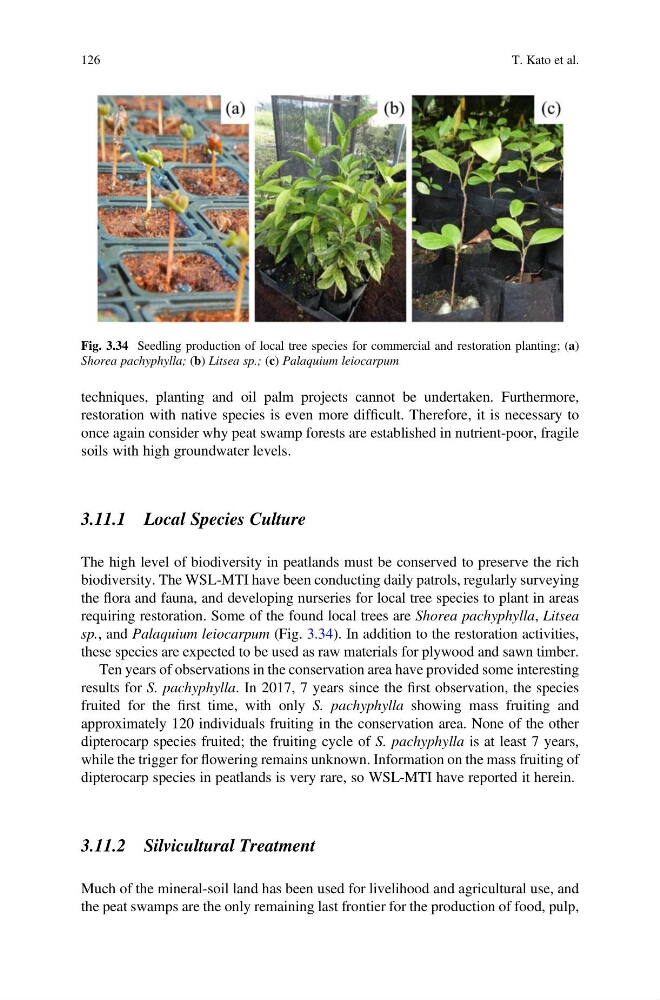
requiring restoration. Some of the found local trees are Shorea pachyphylla, Litsea
sp., and Palaquium leiocarpum (Fig. 3.34). In addition to the restoration activities,
these species are expected to be used as raw materials for plywood and sawn timber.
Ten years of observations in the conservation area have provided some interesting
results for S. pachyphylla. In 2017, 7 years since the first observation, the species
fruited for the first time, with only S. pachyphylla showing mass fruiting and
approximately 120 individuals fruiting in the conservation area. None of the other
dipterocarp species fruited; the fruiting cycle of S. pachyphylla is at least 7 years,
while the trigger for flowering remains unknown. Information on the mass fruiting of
dipterocarp species in peatlands is very rare, so WSL-MTI have reported it herein.
3.11.2 Silvicultural Treatment
Much of the mineral-soil land has been used for livelihood and agricultural use, and
the peat swamps are the only remaining last frontier for the production of food, pulp,
Fig. 3.34 Seedling production of local tree species for commercial and restoration planting; (a)
Shorea pachyphylla; (b) Litsea sp.; (c) Palaquium leiocarpum
126
T. Kato et al.
restoration with native species is even more difficult. Therefore, it is necessary to
once again consider why peat swamp forests are established in nutrient-poor, fragile
soils with high groundwater levels.
3.11.1 Local Species Culture
The high level of biodiversity in peatlands must be conserved to preserve the rich
biodiversity. The WSL-MTI have been conducting daily patrols, regularly surveying
the flora and fauna, and developing nurseries for local tree species to plant in areas
requiring restoration. Some of the found local trees are Shorea pachyphylla, Litsea
sp., and Palaquium leiocarpum (Fig. 3.34). In addition to the restoration activities,
these species are expected to be used as raw materials for plywood and sawn timber.
Ten years of observations in the conservation area have provided some interesting
results for S. pachyphylla. In 2017, 7 years since the first observation, the species
fruited for the first time, with only S. pachyphylla showing mass fruiting and
approximately 120 individuals fruiting in the conservation area. None of the other
dipterocarp species fruited; the fruiting cycle of S. pachyphylla is at least 7 years,
while the trigger for flowering remains unknown. Information on the mass fruiting of
dipterocarp species in peatlands is very rare, so WSL-MTI have reported it herein.
3.11.2 Silvicultural Treatment
Much of the mineral-soil land has been used for livelihood and agricultural use, and
the peat swamps are the only remaining last frontier for the production of food, pulp,
Fig. 3.34 Seedling production of local tree species for commercial and restoration planting; (a)
Shorea pachyphylla; (b) Litsea sp.; (c) Palaquium leiocarpum
126
T. Kato et al.