

canals to be essential for lowering the GWL to prevent the negative effects on
commercial plants. Because oxygen solubilization is extremely low in water, and a
high GWL prohibits root growth and nutrient absorbance, conventional culture in
peatland has been applied to lower GWL by drainage. Thus, the water managing
system only supported a water drainage function for the peatlands and did not adjust
the water level, which resulted in accelerated drying of the peat dome, which caused
the past catastrophic peat fires in Indonesia.
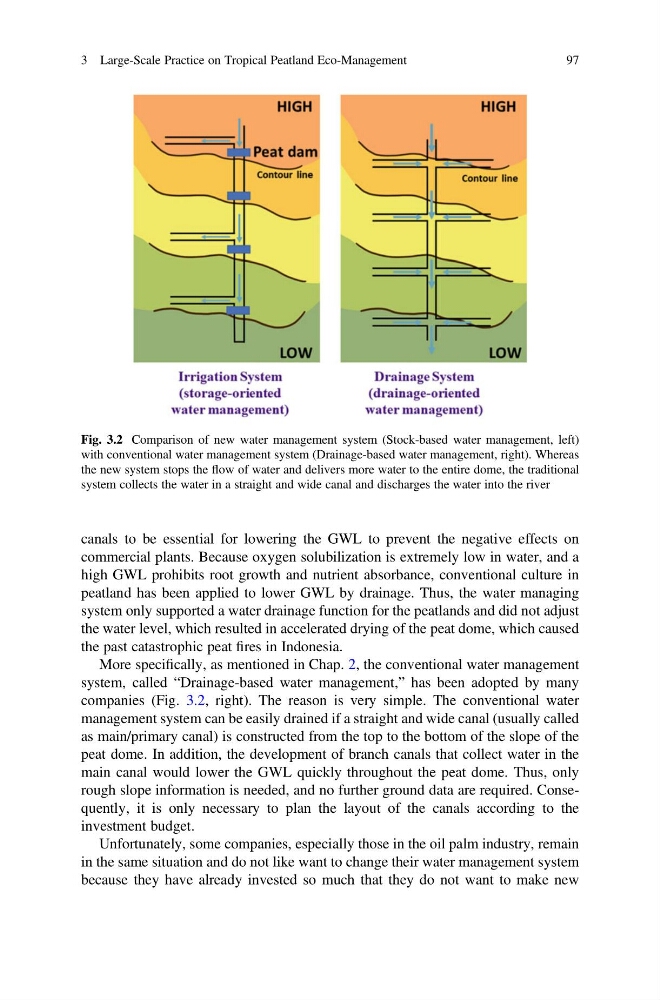
More specifically, as mentioned in Chap. 2, the conventional water management
system, called “Drainage-based water management,” has been adopted by many
companies (Fig. 3.2, right). The reason is very simple. The conventional water
management system can be easily drained if a straight and wide canal (usually called
as main/primary canal) is constructed from the top to the bottom of the slope of the
peat dome. In addition, the development of branch canals that collect water in the
main canal would lower the GWL quickly throughout the peat dome. Thus, only
rough slope information is needed, and no further ground data are required. Consequently, it is only necessary to plan the layout of the canals according to the
investment budget.
Unfortunately, some companies, especially those in the oil palm industry, remain
in the same situation and do not like want to change their water management system
because they have already invested so much that they do not want to make new
Fig. 3.2 Comparison of new water management system (Stock-based water management, left)
with conventional water management system (Drainage-based water management, right). Whereas
the new system stops the flow of water and delivers more water to the entire dome, the traditional
system collects the water in a straight and wide canal and discharges the water into the river
3 Large-Scale Practice on Tropical Peatland Eco-Management
97
commercial plants. Because oxygen solubilization is extremely low in water, and a
high GWL prohibits root growth and nutrient absorbance, conventional culture in
peatland has been applied to lower GWL by drainage. Thus, the water managing
system only supported a water drainage function for the peatlands and did not adjust
the water level, which resulted in accelerated drying of the peat dome, which caused
the past catastrophic peat fires in Indonesia.
More specifically, as mentioned in Chap. 2, the conventional water management
system, called “Drainage-based water management,” has been adopted by many
companies (Fig. 3.2, right). The reason is very simple. The conventional water
management system can be easily drained if a straight and wide canal (usually called
as main/primary canal) is constructed from the top to the bottom of the slope of the
peat dome. In addition, the development of branch canals that collect water in the
main canal would lower the GWL quickly throughout the peat dome. Thus, only
rough slope information is needed, and no further ground data are required. Consequently, it is only necessary to plan the layout of the canals according to the
investment budget.
Unfortunately, some companies, especially those in the oil palm industry, remain
in the same situation and do not like want to change their water management system
because they have already invested so much that they do not want to make new
Fig. 3.2 Comparison of new water management system (Stock-based water management, left)
with conventional water management system (Drainage-based water management, right). Whereas
the new system stops the flow of water and delivers more water to the entire dome, the traditional
system collects the water in a straight and wide canal and discharges the water into the river
3 Large-Scale Practice on Tropical Peatland Eco-Management
97