

94
G. Altarelli and S. Forte
as the scalar function multiplying the vertex tensor, normalised in such a way that it
coincides with e s0 in lowest order). V bare contains the cut-off K but does not know
about μ. Z is a factor that depends both on the cut-off and on μ but not on momenta.
Because of infrared singularities the defining scale μ cannot vanish. The negative
value −μ 2 < 0 is chosen to stay away from physical cuts (a gluon with negative
virtual mass cannot decay). Similarly, in the massless theory, we can define Z −1
g as
the inverse gluon propagator (the 1PI 2-point function) at the same scale −μ 2 (the
vanishing mass of the gluon is guaranteed by gauge invariance).
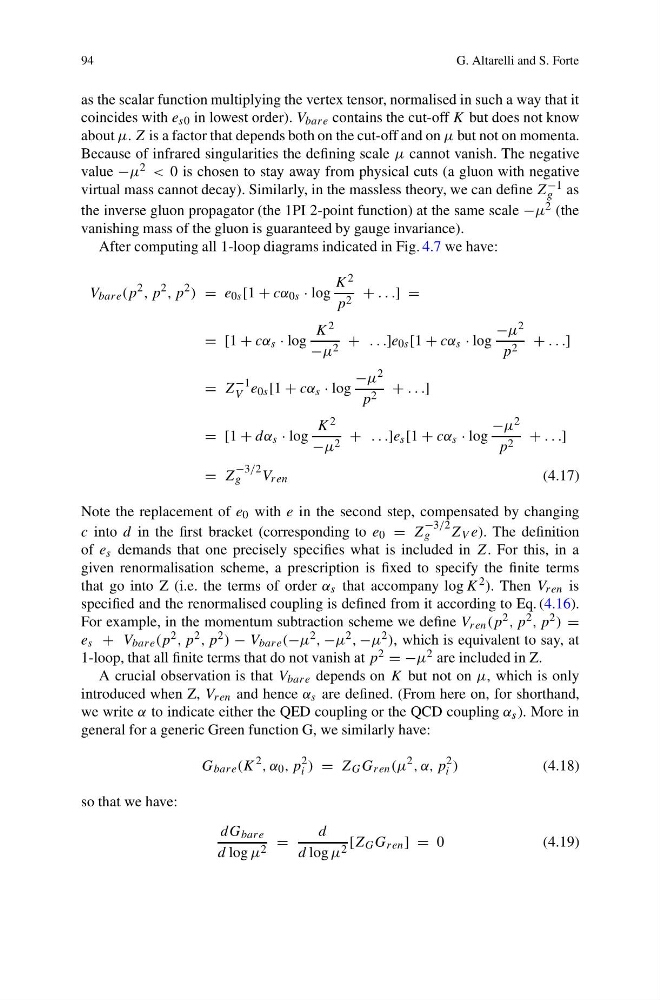
After computing all 1-loop diagrams indicated in Fig. 4.7 we have:
V bare (p
2 , p
2 , p
2 ) = e 0s [1 + cα 0s · log
K 2
p 2 + . . .] =
= [1 + cα s · log
K 2
−μ 2 + . . .]e 0s [1 + cα s · log
−μ 2
p 2 + . . .]
= Z
−1
V e 0s [1 + cα s · log
−μ 2
p 2 + . . .]
= [1 + dα s · log
K 2
−μ 2 + . . .]e s [1 + cα s · log
−μ 2
p 2 + . . .]
= Z
−3/2
g
V ren
(4.17)
Note the replacement of e 0 with e in the second step, compensated by changing
c into d in the first bracket (corresponding to e 0 = Z
−3/2
g
Z V e). The definition
of e s demands that one precisely specifies what is included in Z. For this, in a
given renormalisation scheme, a prescription is fixed to specify the finite terms
that go into Z (i.e. the terms of order α s that accompany log K 2 ). Then V ren is
specified and the renormalised coupling is defined from it according to Eq. (4.16).
For example, in the momentum subtraction scheme we define V ren (p 2 , p 2 , p 2 ) =
e s + V bare (p 2 , p 2 , p 2 ) − V bare (−μ 2 , −μ 2 , −μ 2 ), which is equivalent to say, at
1-loop, that all finite terms that do not vanish at p 2 = −μ 2 are included in Z.
A crucial observation is that V bare depends on K but not on μ, which is only
introduced when Z, V ren and hence α s are defined. (From here on, for shorthand,
we write α to indicate either the QED coupling or the QCD coupling α s ). More in
general for a generic Green function G, we similarly have:
G bare (K
2 , α 0 , p
2
i ) = Z G G ren (μ
2 , α, p
2
i )
(4.18)
so that we have:
dG bare
d log μ 2 =
d
d log μ 2 [Z G G ren ] = 0
(4.19)
G. Altarelli and S. Forte
as the scalar function multiplying the vertex tensor, normalised in such a way that it
coincides with e s0 in lowest order). V bare contains the cut-off K but does not know
about μ. Z is a factor that depends both on the cut-off and on μ but not on momenta.
Because of infrared singularities the defining scale μ cannot vanish. The negative
value −μ 2 < 0 is chosen to stay away from physical cuts (a gluon with negative
virtual mass cannot decay). Similarly, in the massless theory, we can define Z −1
g as
the inverse gluon propagator (the 1PI 2-point function) at the same scale −μ 2 (the
vanishing mass of the gluon is guaranteed by gauge invariance).
After computing all 1-loop diagrams indicated in Fig. 4.7 we have:
V bare (p
2 , p
2 , p
2 ) = e 0s [1 + cα 0s · log
K 2
p 2 + . . .] =
= [1 + cα s · log
K 2
−μ 2 + . . .]e 0s [1 + cα s · log
−μ 2
p 2 + . . .]
= Z
−1
V e 0s [1 + cα s · log
−μ 2
p 2 + . . .]
= [1 + dα s · log
K 2
−μ 2 + . . .]e s [1 + cα s · log
−μ 2
p 2 + . . .]
= Z
−3/2
g
V ren
(4.17)
Note the replacement of e 0 with e in the second step, compensated by changing
c into d in the first bracket (corresponding to e 0 = Z
−3/2
g
Z V e). The definition
of e s demands that one precisely specifies what is included in Z. For this, in a
given renormalisation scheme, a prescription is fixed to specify the finite terms
that go into Z (i.e. the terms of order α s that accompany log K 2 ). Then V ren is
specified and the renormalised coupling is defined from it according to Eq. (4.16).
For example, in the momentum subtraction scheme we define V ren (p 2 , p 2 , p 2 ) =
e s + V bare (p 2 , p 2 , p 2 ) − V bare (−μ 2 , −μ 2 , −μ 2 ), which is equivalent to say, at
1-loop, that all finite terms that do not vanish at p 2 = −μ 2 are included in Z.
A crucial observation is that V bare depends on K but not on μ, which is only
introduced when Z, V ren and hence α s are defined. (From here on, for shorthand,
we write α to indicate either the QED coupling or the QCD coupling α s ). More in
general for a generic Green function G, we similarly have:
G bare (K
2 , α 0 , p
2
i ) = Z G G ren (μ
2 , α, p
2
i )
(4.18)
so that we have:
dG bare
d log μ 2 =
d
d log μ 2 [Z G G ren ] = 0
(4.19)