

4 QCD: The Theory of Strong Interactions
91
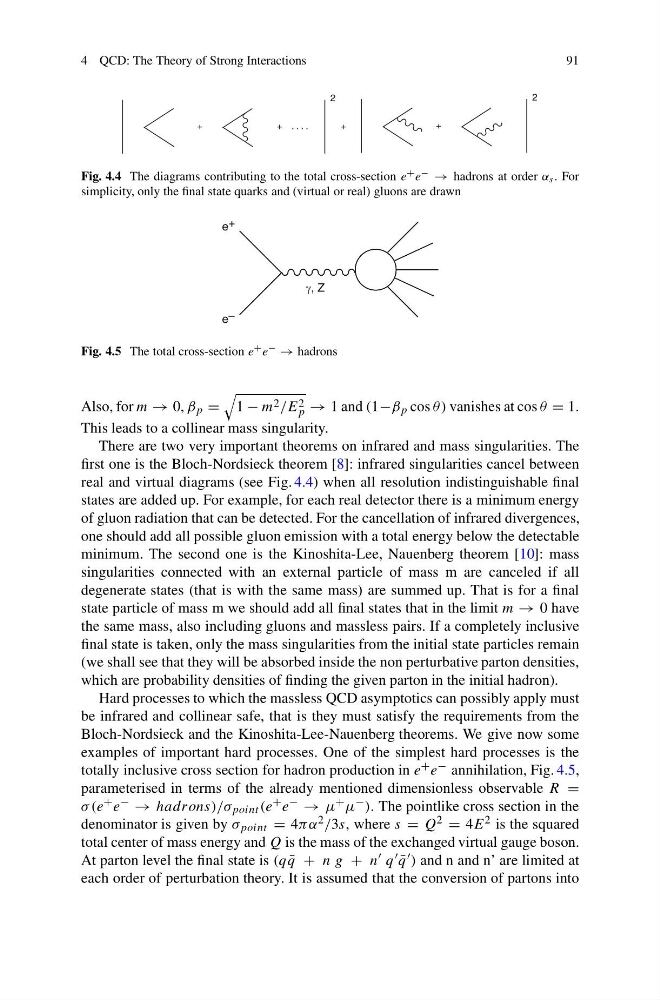
Fig. 4.4 The diagrams contributing to the total cross-section e + e − → hadrons at order α s . For
simplicity, only the final state quarks and (virtual or real) gluons are drawn
e +
e
J, Z
Fig. 4.5 The total cross-section e + e − → hadrons
Also, for m → 0, β p =
1 − m 2 /E 2
p → 1 and (1−β p cos θ) vanishes at cos θ = 1.
This leads to a collinear mass singularity.
There are two very important theorems on infrared and mass singularities. The
first one is the Bloch-Nordsieck theorem [8]: infrared singularities cancel between
real and virtual diagrams (see Fig. 4.4) when all resolution indistinguishable final
states are added up. For example, for each real detector there is a minimum energy
of gluon radiation that can be detected. For the cancellation of infrared divergences,
one should add all possible gluon emission with a total energy below the detectable
minimum. The second one is the Kinoshita-Lee, Nauenberg theorem [10]: mass
singularities connected with an external particle of mass m are canceled if all
degenerate states (that is with the same mass) are summed up. That is for a final
state particle of mass m we should add all final states that in the limit m → 0 have
the same mass, also including gluons and massless pairs. If a completely inclusive
final state is taken, only the mass singularities from the initial state particles remain
(we shall see that they will be absorbed inside the non perturbative parton densities,
which are probability densities of finding the given parton in the initial hadron).
Hard processes to which the massless QCD asymptotics can possibly apply must
be infrared and collinear safe, that is they must satisfy the requirements from the
Bloch-Nordsieck and the Kinoshita-Lee-Nauenberg theorems. We give now some
examples of important hard processes. One of the simplest hard processes is the
totally inclusive cross section for hadron production in e + e − annihilation, Fig. 4.5,
parameterised in terms of the already mentioned dimensionless observable R =
σ (e + e − → hadrons)/σ point (e + e − → μ + μ − ). The pointlike cross section in the
denominator is given by σ point = 4πα 2 /3s, where s = Q 2 = 4E 2 is the squared
total center of mass energy and Q is the mass of the exchanged virtual gauge boson.
At parton level the final state is (q ¯
q + n g + n q ¯
q ) and n and n’ are limited at
each order of perturbation theory. It is assumed that the conversion of partons into
91
Fig. 4.4 The diagrams contributing to the total cross-section e + e − → hadrons at order α s . For
simplicity, only the final state quarks and (virtual or real) gluons are drawn
e +
e
J, Z
Fig. 4.5 The total cross-section e + e − → hadrons
Also, for m → 0, β p =
1 − m 2 /E 2
p → 1 and (1−β p cos θ) vanishes at cos θ = 1.
This leads to a collinear mass singularity.
There are two very important theorems on infrared and mass singularities. The
first one is the Bloch-Nordsieck theorem [8]: infrared singularities cancel between
real and virtual diagrams (see Fig. 4.4) when all resolution indistinguishable final
states are added up. For example, for each real detector there is a minimum energy
of gluon radiation that can be detected. For the cancellation of infrared divergences,
one should add all possible gluon emission with a total energy below the detectable
minimum. The second one is the Kinoshita-Lee, Nauenberg theorem [10]: mass
singularities connected with an external particle of mass m are canceled if all
degenerate states (that is with the same mass) are summed up. That is for a final
state particle of mass m we should add all final states that in the limit m → 0 have
the same mass, also including gluons and massless pairs. If a completely inclusive
final state is taken, only the mass singularities from the initial state particles remain
(we shall see that they will be absorbed inside the non perturbative parton densities,
which are probability densities of finding the given parton in the initial hadron).
Hard processes to which the massless QCD asymptotics can possibly apply must
be infrared and collinear safe, that is they must satisfy the requirements from the
Bloch-Nordsieck and the Kinoshita-Lee-Nauenberg theorems. We give now some
examples of important hard processes. One of the simplest hard processes is the
totally inclusive cross section for hadron production in e + e − annihilation, Fig. 4.5,
parameterised in terms of the already mentioned dimensionless observable R =
σ (e + e − → hadrons)/σ point (e + e − → μ + μ − ). The pointlike cross section in the
denominator is given by σ point = 4πα 2 /3s, where s = Q 2 = 4E 2 is the squared
total center of mass energy and Q is the mass of the exchanged virtual gauge boson.
At parton level the final state is (q ¯
q + n g + n q ¯
q ) and n and n’ are limited at
each order of perturbation theory. It is assumed that the conversion of partons into