

90
G. Altarelli and S. Forte
While massless QCD is finally not scale invariant, the departures from scaling
are asymptotically small, logarithmic and computable. In massive QCD there are
additional mass corrections suppressed by powers of m/E, where E is the energy
scale (for non singular processes in the limit m → 0). At the parton level (q and
g) we can conceive to apply the asymptotics from massless QCD to processes and
observables (we use the word “processes” for both) with the following properties
(“hard processes”). (a) All relevant energy variables must be large:
E i = z i Q,
Q >> m j ;
z i : scaling variables o(1)
(4.11)
(b) There should be no infrared singularities (one talks of “infrared safe” processes).
(c) The processes concerned must be finite for m → 0 (no mass singularities).
To possibly satisfy these criteria processes must be as “inclusive” as possible:
one should include all final states with massless gluon emission and add all mass
degenerate final states (given that quarks are massless also q − ¯
q pairs can be
massless if “collinear”, that is moving together in the same direction at the common
speed of light).
In perturbative QCD one computes inclusive rates for partons (the fields in the
lagrangian, that is, in QCD, quarks and gluons) and takes them as equal to rates
for hadrons. Partons and hadrons are considered as two equivalent sets of complete
states. This is called “global duality” and it is rather safe in the rare instance of a
totally inclusive final state. It is less so for distributions, like distributions in the
invariant mass M (“local duality”) where it can be reliable only if smeared over a
sufficiently wide bin in M.
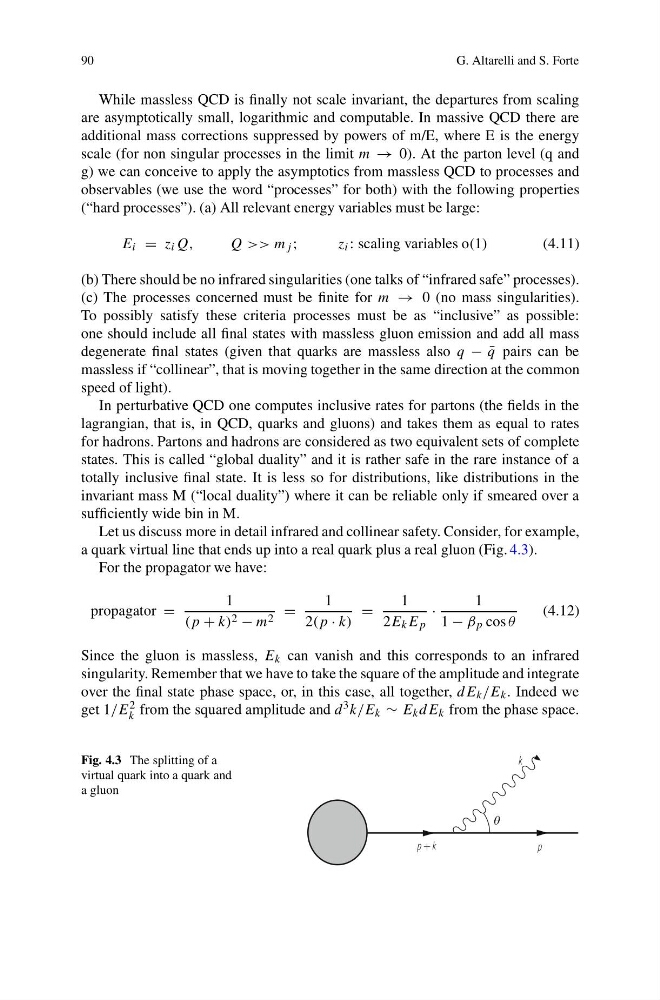
Let us discuss more in detail infrared and collinear safety. Consider, for example,
a quark virtual line that ends up into a real quark plus a real gluon (Fig. 4.3).
For the propagator we have:
propagator =
1
(p + k) 2 − m 2 =
1
2(p · k)
=
1
2E k E p
·
1
1 − β p cos θ
(4.12)
Since the gluon is massless, E k can vanish and this corresponds to an infrared
singularity. Remember that we have to take the square of the amplitude and integrate
over the final state phase space, or, in this case, all together, dE k /E k . Indeed we
get 1/E 2
k from the squared amplitude and d 3 k/E k ∼ E k dE k from the phase space.
Fig. 4.3 The splitting of a
virtual quark into a quark and
a gluon
k
p
p + k
G. Altarelli and S. Forte
While massless QCD is finally not scale invariant, the departures from scaling
are asymptotically small, logarithmic and computable. In massive QCD there are
additional mass corrections suppressed by powers of m/E, where E is the energy
scale (for non singular processes in the limit m → 0). At the parton level (q and
g) we can conceive to apply the asymptotics from massless QCD to processes and
observables (we use the word “processes” for both) with the following properties
(“hard processes”). (a) All relevant energy variables must be large:
E i = z i Q,
Q >> m j ;
z i : scaling variables o(1)
(4.11)
(b) There should be no infrared singularities (one talks of “infrared safe” processes).
(c) The processes concerned must be finite for m → 0 (no mass singularities).
To possibly satisfy these criteria processes must be as “inclusive” as possible:
one should include all final states with massless gluon emission and add all mass
degenerate final states (given that quarks are massless also q − ¯
q pairs can be
massless if “collinear”, that is moving together in the same direction at the common
speed of light).
In perturbative QCD one computes inclusive rates for partons (the fields in the
lagrangian, that is, in QCD, quarks and gluons) and takes them as equal to rates
for hadrons. Partons and hadrons are considered as two equivalent sets of complete
states. This is called “global duality” and it is rather safe in the rare instance of a
totally inclusive final state. It is less so for distributions, like distributions in the
invariant mass M (“local duality”) where it can be reliable only if smeared over a
sufficiently wide bin in M.
Let us discuss more in detail infrared and collinear safety. Consider, for example,
a quark virtual line that ends up into a real quark plus a real gluon (Fig. 4.3).
For the propagator we have:
propagator =
1
(p + k) 2 − m 2 =
1
2(p · k)
=
1
2E k E p
·
1
1 − β p cos θ
(4.12)
Since the gluon is massless, E k can vanish and this corresponds to an infrared
singularity. Remember that we have to take the square of the amplitude and integrate
over the final state phase space, or, in this case, all together, dE k /E k . Indeed we
get 1/E 2
k from the squared amplitude and d 3 k/E k ∼ E k dE k from the phase space.
Fig. 4.3 The splitting of a
virtual quark into a quark and
a gluon
k
p
p + k