

3 The Standard Model of Electroweak Interactions
73
on m H one finds [62]
m H 180 GeV for ∼ M GU T − M P l
m H 0.5 − 0.8 T eV for ∼ 1 T eV .
(3.111)
In conclusion, for m t ∼ 171 GeV, only a small range of values for m H is allowed,
130 < m H < ∼ 200 GeV, if the SM holds up to ∼ M GU T or M P l .
An additional argument indicating that the solution of the Higgs problem cannot
be too far away is the fact that, in the absence of a Higgs particle or of an alternative
mechanism, violations of unitarity appear in some scattering amplitudes at energies
in the few TeV range [63]. In particular, amplitudes involving longitudinal gauge
bosons (those most directly related to the Higgs sector) are affected. For example,
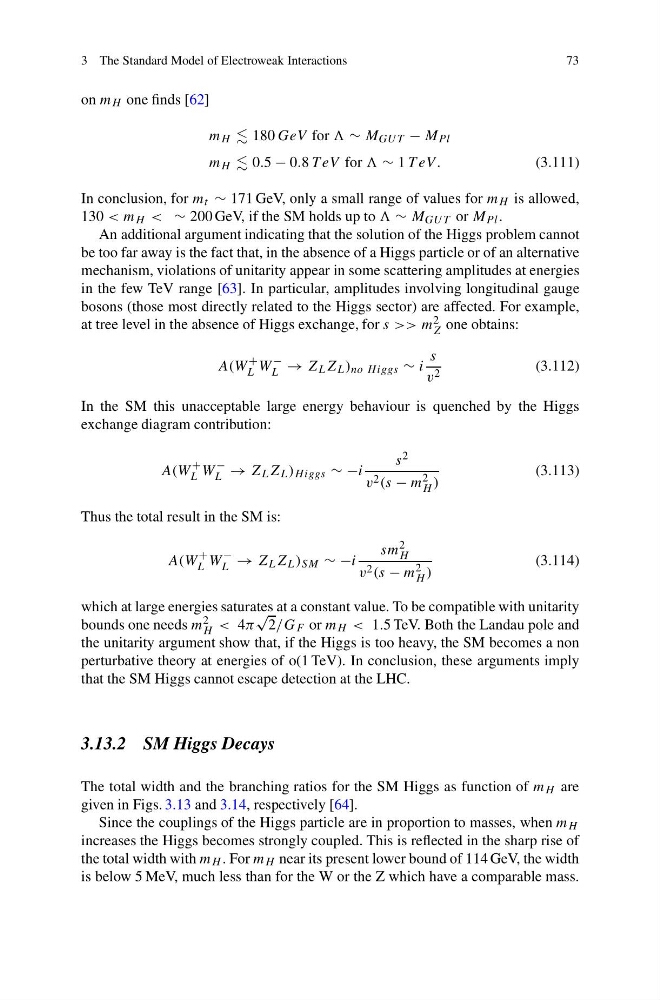
at tree level in the absence of Higgs exchange, for s >> m 2
Z one obtains:
A(W
+
L W
−
L → Z L Z L ) no H iggs ∼ i
s
v 2
(3.112)
In the SM this unacceptable large energy behaviour is quenched by the Higgs
exchange diagram contribution:
A(W
+
L W
−
L → Z L Z L ) H iggs ∼ −i
s 2
v 2 (s − m 2
H )
(3.113)
Thus the total result in the SM is:
A(W
+
L W
−
L → Z L Z L ) SM ∼ −i
sm 2
H
v 2 (s − m 2
H )
(3.114)
which at large energies saturates at a constant value. To be compatible with unitarity
bounds one needs m 2
H < 4π
√
2/G F or m H < 1.5 TeV. Both the Landau pole and
the unitarity argument show that, if the Higgs is too heavy, the SM becomes a non
perturbative theory at energies of o(1 TeV). In conclusion, these arguments imply
that the SM Higgs cannot escape detection at the LHC.
3.13.2 SM Higgs Decays
The total width and the branching ratios for the SM Higgs as function of m H are
given in Figs. 3.13 and 3.14, respectively [64].
Since the couplings of the Higgs particle are in proportion to masses, when m H
increases the Higgs becomes strongly coupled. This is reflected in the sharp rise of
the total width with m H . For m H near its present lower bound of 114 GeV, the width
is below 5 MeV, much less than for the W or the Z which have a comparable mass.
73
on m H one finds [62]
m H 180 GeV for ∼ M GU T − M P l
m H 0.5 − 0.8 T eV for ∼ 1 T eV .
(3.111)
In conclusion, for m t ∼ 171 GeV, only a small range of values for m H is allowed,
130 < m H < ∼ 200 GeV, if the SM holds up to ∼ M GU T or M P l .
An additional argument indicating that the solution of the Higgs problem cannot
be too far away is the fact that, in the absence of a Higgs particle or of an alternative
mechanism, violations of unitarity appear in some scattering amplitudes at energies
in the few TeV range [63]. In particular, amplitudes involving longitudinal gauge
bosons (those most directly related to the Higgs sector) are affected. For example,
at tree level in the absence of Higgs exchange, for s >> m 2
Z one obtains:
A(W
+
L W
−
L → Z L Z L ) no H iggs ∼ i
s
v 2
(3.112)
In the SM this unacceptable large energy behaviour is quenched by the Higgs
exchange diagram contribution:
A(W
+
L W
−
L → Z L Z L ) H iggs ∼ −i
s 2
v 2 (s − m 2
H )
(3.113)
Thus the total result in the SM is:
A(W
+
L W
−
L → Z L Z L ) SM ∼ −i
sm 2
H
v 2 (s − m 2
H )
(3.114)
which at large energies saturates at a constant value. To be compatible with unitarity
bounds one needs m 2
H < 4π
√
2/G F or m H < 1.5 TeV. Both the Landau pole and
the unitarity argument show that, if the Higgs is too heavy, the SM becomes a non
perturbative theory at energies of o(1 TeV). In conclusion, these arguments imply
that the SM Higgs cannot escape detection at the LHC.
3.13.2 SM Higgs Decays
The total width and the branching ratios for the SM Higgs as function of m H are
given in Figs. 3.13 and 3.14, respectively [64].
Since the couplings of the Higgs particle are in proportion to masses, when m H
increases the Higgs becomes strongly coupled. This is reflected in the sharp rise of
the total width with m H . For m H near its present lower bound of 114 GeV, the width
is below 5 MeV, much less than for the W or the Z which have a comparable mass.