

72
G. Altarelli and S. Forte
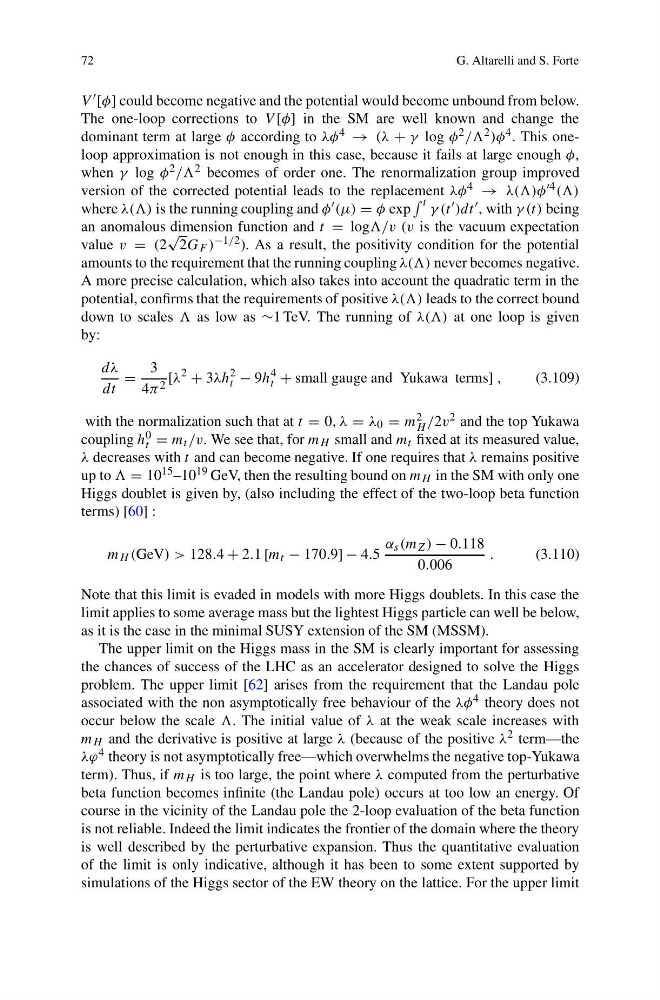
V [φ] could become negative and the potential would become unbound from below.
The one-loop corrections to V [φ] in the SM are well known and change the
dominant term at large φ according to λφ 4 → (λ + γ log φ 2 // 2 )φ 4 . This oneloop approximation is not enough in this case, because it fails at large enough φ,
when γ log φ 2 // 2 becomes of order one. The renormalization group improved
version of the corrected potential leads to the replacement λφ 4 → λ(()φ (()
where λ(() is the running coupling and φ (μ) = φ exp
t γ (t )dt , with γ (t) being
an anomalous dimension function and t = log (v is the vacuum expectation
value v = (2
√
2G F ) −1/2 ). As a result, the positivity condition for the potential
amounts to the requirement that the running coupling λ(() never becomes negative.
A more precise calculation, which also takes into account the quadratic term in the
potential, confirms that the requirements of positive λ(() leads to the correct bound
down to scales as low as ∼1 TeV. The running of λ(() at one loop is given
by:
dλ
dt
=
3
4π 2 [λ
2
+ 3λh
2
t − 9h
4
t + small gauge and Yukawa terms] ,
(3.109)
with the normalization such that at t = 0, λ = λ 0 = m 2
H /2v 2 and the top Yukawa
coupling h 0
t = m t /v. We see that, for m H small and m t fixed at its measured value,
λ decreases with t and can become negative. If one requires that λ remains positive
up to = 10 15 –10 19 GeV, then the resulting bound on m H in the SM with only one
Higgs doublet is given by, (also including the effect of the two-loop beta function
terms) [60] :
m H (GeV) > 128.4 + 2.1 [m t − 170.9] − 4.5
α s (m Z ) − 0.118
0.006
.
(3.110)
Note that this limit is evaded in models with more Higgs doublets. In this case the
limit applies to some average mass but the lightest Higgs particle can well be below,
as it is the case in the minimal SUSY extension of the SM (MSSM).
The upper limit on the Higgs mass in the SM is clearly important for assessing
the chances of success of the LHC as an accelerator designed to solve the Higgs
problem. The upper limit [62] arises from the requirement that the Landau pole
associated with the non asymptotically free behaviour of the λφ 4 theory does not
occur below the scale . The initial value of λ at the weak scale increases with
m H and the derivative is positive at large λ (because of the positive λ 2 term—the
λϕ 4 theory is not asymptotically free—which overwhelms the negative top-Yukawa
term). Thus, if m H is too large, the point where λ computed from the perturbative
beta function becomes infinite (the Landau pole) occurs at too low an energy. Of
course in the vicinity of the Landau pole the 2-loop evaluation of the beta function
is not reliable. Indeed the limit indicates the frontier of the domain where the theory
is well described by the perturbative expansion. Thus the quantitative evaluation
of the limit is only indicative, although it has been to some extent supported by
simulations of the Higgs sector of the EW theory on the lattice. For the upper limit
G. Altarelli and S. Forte
V [φ] could become negative and the potential would become unbound from below.
The one-loop corrections to V [φ] in the SM are well known and change the
dominant term at large φ according to λφ 4 → (λ + γ log φ 2 // 2 )φ 4 . This oneloop approximation is not enough in this case, because it fails at large enough φ,
when γ log φ 2 // 2 becomes of order one. The renormalization group improved
version of the corrected potential leads to the replacement λφ 4 → λ(()φ (()
where λ(() is the running coupling and φ (μ) = φ exp
t γ (t )dt , with γ (t) being
an anomalous dimension function and t = log (v is the vacuum expectation
value v = (2
√
2G F ) −1/2 ). As a result, the positivity condition for the potential
amounts to the requirement that the running coupling λ(() never becomes negative.
A more precise calculation, which also takes into account the quadratic term in the
potential, confirms that the requirements of positive λ(() leads to the correct bound
down to scales as low as ∼1 TeV. The running of λ(() at one loop is given
by:
dλ
dt
=
3
4π 2 [λ
2
+ 3λh
2
t − 9h
4
t + small gauge and Yukawa terms] ,
(3.109)
with the normalization such that at t = 0, λ = λ 0 = m 2
H /2v 2 and the top Yukawa
coupling h 0
t = m t /v. We see that, for m H small and m t fixed at its measured value,
λ decreases with t and can become negative. If one requires that λ remains positive
up to = 10 15 –10 19 GeV, then the resulting bound on m H in the SM with only one
Higgs doublet is given by, (also including the effect of the two-loop beta function
terms) [60] :
m H (GeV) > 128.4 + 2.1 [m t − 170.9] − 4.5
α s (m Z ) − 0.118
0.006
.
(3.110)
Note that this limit is evaded in models with more Higgs doublets. In this case the
limit applies to some average mass but the lightest Higgs particle can well be below,
as it is the case in the minimal SUSY extension of the SM (MSSM).
The upper limit on the Higgs mass in the SM is clearly important for assessing
the chances of success of the LHC as an accelerator designed to solve the Higgs
problem. The upper limit [62] arises from the requirement that the Landau pole
associated with the non asymptotically free behaviour of the λφ 4 theory does not
occur below the scale . The initial value of λ at the weak scale increases with
m H and the derivative is positive at large λ (because of the positive λ 2 term—the
λϕ 4 theory is not asymptotically free—which overwhelms the negative top-Yukawa
term). Thus, if m H is too large, the point where λ computed from the perturbative
beta function becomes infinite (the Landau pole) occurs at too low an energy. Of
course in the vicinity of the Landau pole the 2-loop evaluation of the beta function
is not reliable. Indeed the limit indicates the frontier of the domain where the theory
is well described by the perturbative expansion. Thus the quantitative evaluation
of the limit is only indicative, although it has been to some extent supported by
simulations of the Higgs sector of the EW theory on the lattice. For the upper limit