

70
G. Altarelli and S. Forte
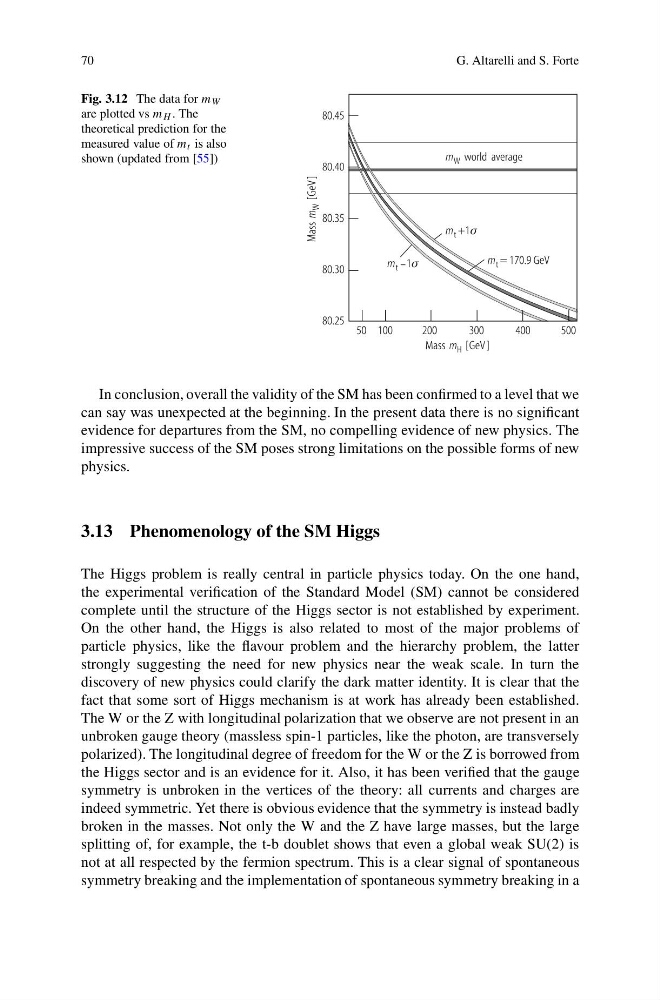
Fig. 3.12 The data for m W
are plotted vs m H . The
theoretical prediction for the
measured value of m t is also
shown (updated from [55])
In conclusion, overall the validity of the SM has been confirmed to a level that we
can say was unexpected at the beginning. In the present data there is no significant
evidence for departures from the SM, no compelling evidence of new physics. The
impressive success of the SM poses strong limitations on the possible forms of new
physics.
3.13 Phenomenology of the SM Higgs
The Higgs problem is really central in particle physics today. On the one hand,
the experimental verification of the Standard Model (SM) cannot be considered
complete until the structure of the Higgs sector is not established by experiment.
On the other hand, the Higgs is also related to most of the major problems of
particle physics, like the flavour problem and the hierarchy problem, the latter
strongly suggesting the need for new physics near the weak scale. In turn the
discovery of new physics could clarify the dark matter identity. It is clear that the
fact that some sort of Higgs mechanism is at work has already been established.
The W or the Z with longitudinal polarization that we observe are not present in an
unbroken gauge theory (massless spin-1 particles, like the photon, are transversely
polarized). The longitudinal degree of freedom for the W or the Z is borrowed from
the Higgs sector and is an evidence for it. Also, it has been verified that the gauge
symmetry is unbroken in the vertices of the theory: all currents and charges are
indeed symmetric. Yet there is obvious evidence that the symmetry is instead badly
broken in the masses. Not only the W and the Z have large masses, but the large
splitting of, for example, the t-b doublet shows that even a global weak SU(2) is
not at all respected by the fermion spectrum. This is a clear signal of spontaneous
symmetry breaking and the implementation of spontaneous symmetry breaking in a
G. Altarelli and S. Forte
Fig. 3.12 The data for m W
are plotted vs m H . The
theoretical prediction for the
measured value of m t is also
shown (updated from [55])
In conclusion, overall the validity of the SM has been confirmed to a level that we
can say was unexpected at the beginning. In the present data there is no significant
evidence for departures from the SM, no compelling evidence of new physics. The
impressive success of the SM poses strong limitations on the possible forms of new
physics.
3.13 Phenomenology of the SM Higgs
The Higgs problem is really central in particle physics today. On the one hand,
the experimental verification of the Standard Model (SM) cannot be considered
complete until the structure of the Higgs sector is not established by experiment.
On the other hand, the Higgs is also related to most of the major problems of
particle physics, like the flavour problem and the hierarchy problem, the latter
strongly suggesting the need for new physics near the weak scale. In turn the
discovery of new physics could clarify the dark matter identity. It is clear that the
fact that some sort of Higgs mechanism is at work has already been established.
The W or the Z with longitudinal polarization that we observe are not present in an
unbroken gauge theory (massless spin-1 particles, like the photon, are transversely
polarized). The longitudinal degree of freedom for the W or the Z is borrowed from
the Higgs sector and is an evidence for it. Also, it has been verified that the gauge
symmetry is unbroken in the vertices of the theory: all currents and charges are
indeed symmetric. Yet there is obvious evidence that the symmetry is instead badly
broken in the masses. Not only the W and the Z have large masses, but the large
splitting of, for example, the t-b doublet shows that even a global weak SU(2) is
not at all respected by the fermion spectrum. This is a clear signal of spontaneous
symmetry breaking and the implementation of spontaneous symmetry breaking in a