

3 The Standard Model of Electroweak Interactions
69
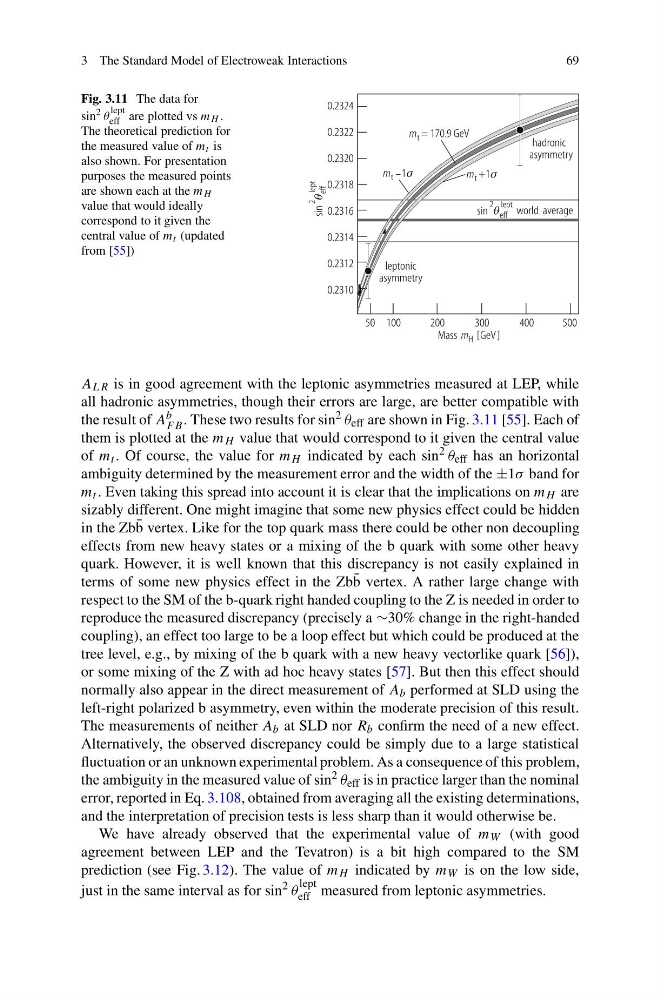
Fig. 3.11 The data for
sin
2 θ
lept
eff are plotted vs m H .
The theoretical prediction for
the measured value of m t is
also shown. For presentation
purposes the measured points
are shown each at the m H
value that would ideally
correspond to it given the
central value of m t (updated
from [55])
A LR is in good agreement with the leptonic asymmetries measured at LEP, while
all hadronic asymmetries, though their errors are large, are better compatible with
the result of A b
FB . These two results for sin 2 θ eff are shown in Fig. 3.11 [55]. Each of
them is plotted at the m H value that would correspond to it given the central value
of m t . Of course, the value for m H indicated by each sin 2 θ eff has an horizontal
ambiguity determined by the measurement error and the width of the ±1σ band for
m t . Even taking this spread into account it is clear that the implications on m H are
sizably different. One might imagine that some new physics effect could be hidden
in the Zb ¯
b vertex. Like for the top quark mass there could be other non decoupling
effects from new heavy states or a mixing of the b quark with some other heavy
quark. However, it is well known that this discrepancy is not easily explained in
terms of some new physics effect in the Zb ¯
b vertex. A rather large change with
respect to the SM of the b-quark right handed coupling to the Z is needed in order to
reproduce the measured discrepancy (precisely a ∼30% change in the right-handed
coupling), an effect too large to be a loop effect but which could be produced at the
tree level, e.g., by mixing of the b quark with a new heavy vectorlike quark [56]),
or some mixing of the Z with ad hoc heavy states [57]. But then this effect should
normally also appear in the direct measurement of A b performed at SLD using the
left-right polarized b asymmetry, even within the moderate precision of this result.
The measurements of neither A b at SLD nor R b confirm the need of a new effect.
Alternatively, the observed discrepancy could be simply due to a large statistical
fluctuation or an unknown experimental problem. As a consequence of this problem,
the ambiguity in the measured value of sin 2 θ eff is in practice larger than the nominal
error, reported in Eq. 3.108, obtained from averaging all the existing determinations,
and the interpretation of precision tests is less sharp than it would otherwise be.
We have already observed that the experimental value of m W (with good
agreement between LEP and the Tevatron) is a bit high compared to the SM
prediction (see Fig. 3.12). The value of m H indicated by m W is on the low side,
just in the same interval as for sin
2 θ
lept
eff measured from leptonic asymmetries.
69
Fig. 3.11 The data for
sin
2 θ
lept
eff are plotted vs m H .
The theoretical prediction for
the measured value of m t is
also shown. For presentation
purposes the measured points
are shown each at the m H
value that would ideally
correspond to it given the
central value of m t (updated
from [55])
A LR is in good agreement with the leptonic asymmetries measured at LEP, while
all hadronic asymmetries, though their errors are large, are better compatible with
the result of A b
FB . These two results for sin 2 θ eff are shown in Fig. 3.11 [55]. Each of
them is plotted at the m H value that would correspond to it given the central value
of m t . Of course, the value for m H indicated by each sin 2 θ eff has an horizontal
ambiguity determined by the measurement error and the width of the ±1σ band for
m t . Even taking this spread into account it is clear that the implications on m H are
sizably different. One might imagine that some new physics effect could be hidden
in the Zb ¯
b vertex. Like for the top quark mass there could be other non decoupling
effects from new heavy states or a mixing of the b quark with some other heavy
quark. However, it is well known that this discrepancy is not easily explained in
terms of some new physics effect in the Zb ¯
b vertex. A rather large change with
respect to the SM of the b-quark right handed coupling to the Z is needed in order to
reproduce the measured discrepancy (precisely a ∼30% change in the right-handed
coupling), an effect too large to be a loop effect but which could be produced at the
tree level, e.g., by mixing of the b quark with a new heavy vectorlike quark [56]),
or some mixing of the Z with ad hoc heavy states [57]. But then this effect should
normally also appear in the direct measurement of A b performed at SLD using the
left-right polarized b asymmetry, even within the moderate precision of this result.
The measurements of neither A b at SLD nor R b confirm the need of a new effect.
Alternatively, the observed discrepancy could be simply due to a large statistical
fluctuation or an unknown experimental problem. As a consequence of this problem,
the ambiguity in the measured value of sin 2 θ eff is in practice larger than the nominal
error, reported in Eq. 3.108, obtained from averaging all the existing determinations,
and the interpretation of precision tests is less sharp than it would otherwise be.
We have already observed that the experimental value of m W (with good
agreement between LEP and the Tevatron) is a bit high compared to the SM
prediction (see Fig. 3.12). The value of m H indicated by m W is on the low side,
just in the same interval as for sin
2 θ
lept
eff measured from leptonic asymmetries.