

10 The Future of Particle Physics: The LHC and Beyond
627
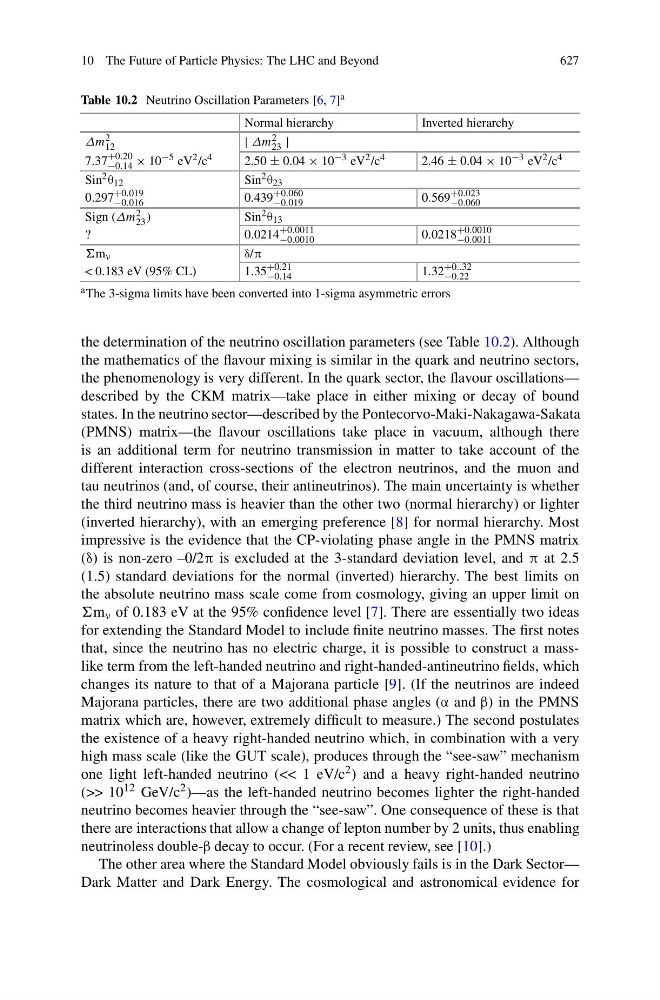
Table 10.2 Neutrino Oscillation Parameters [6, 7] a
Normal hierarchy
Inverted hierarchy
Δm 2
12
| Δm 2
23 |
7.37
+0.20
−0.14 × 10
−5 eV 2 /c 4
2.50 ± 0.04 × 10 −3 eV 2 /c 4
2.46 ± 0.04 × 10 −3 eV 2 /c 4
Sin 2 θ 12
Sin 2 θ 23
0.297
+0.019
−0.016
0.439
+0.060
−0.019
0.569
+0.023
−0.060
Sign (Δm 2
23 )
Sin 2 θ 13
?
0.0214
+0.0011
−0.0010
0.0218
+0.0010
−0.0011
ν
δ/π
< 0.183 eV (95% CL)
1.35
+0.21
−0.14
1.32
+0..32
−0.22
a The 3-sigma limits have been converted into 1-sigma asymmetric errors
the determination of the neutrino oscillation parameters (see Table 10.2). Although
the mathematics of the flavour mixing is similar in the quark and neutrino sectors,
the phenomenology is very different. In the quark sector, the flavour oscillations—
described by the CKM matrix—take place in either mixing or decay of bound
states. In the neutrino sector—described by the Pontecorvo-Maki-Nakagawa-Sakata
(PMNS) matrix—the flavour oscillations take place in vacuum, although there
is an additional term for neutrino transmission in matter to take account of the
different interaction cross-sections of the electron neutrinos, and the muon and
tau neutrinos (and, of course, their antineutrinos). The main uncertainty is whether
the third neutrino mass is heavier than the other two (normal hierarchy) or lighter
(inverted hierarchy), with an emerging preference [8] for normal hierarchy. Most
impressive is the evidence that the CP-violating phase angle in the PMNS matrix
(δ) is non-zero –0/2π is excluded at the 3-standard deviation level, and π at 2.5
(1.5) standard deviations for the normal (inverted) hierarchy. The best limits on
the absolute neutrino mass scale come from cosmology, giving an upper limit on
ν of 0.183 eV at the 95% confidence level [7]. There are essentially two ideas
for extending the Standard Model to include finite neutrino masses. The first notes
that, since the neutrino has no electric charge, it is possible to construct a masslike term from the left-handed neutrino and right-handed-antineutrino fields, which
changes its nature to that of a Majorana particle [9]. (If the neutrinos are indeed
Majorana particles, there are two additional phase angles (α and β) in the PMNS
matrix which are, however, extremely difficult to measure.) The second postulates
the existence of a heavy right-handed neutrino which, in combination with a very
high mass scale (like the GUT scale), produces through the “see-saw” mechanism
one light left-handed neutrino (<< 1 eV/c 2 ) and a heavy right-handed neutrino
(>> 10 12 GeV/c 2 )—as the left-handed neutrino becomes lighter the right-handed
neutrino becomes heavier through the “see-saw”. One consequence of these is that
there are interactions that allow a change of lepton number by 2 units, thus enabling
neutrinoless double-β decay to occur. (For a recent review, see [10].)
The other area where the Standard Model obviously fails is in the Dark Sector—
Dark Matter and Dark Energy. The cosmological and astronomical evidence for