

626
K. Peach
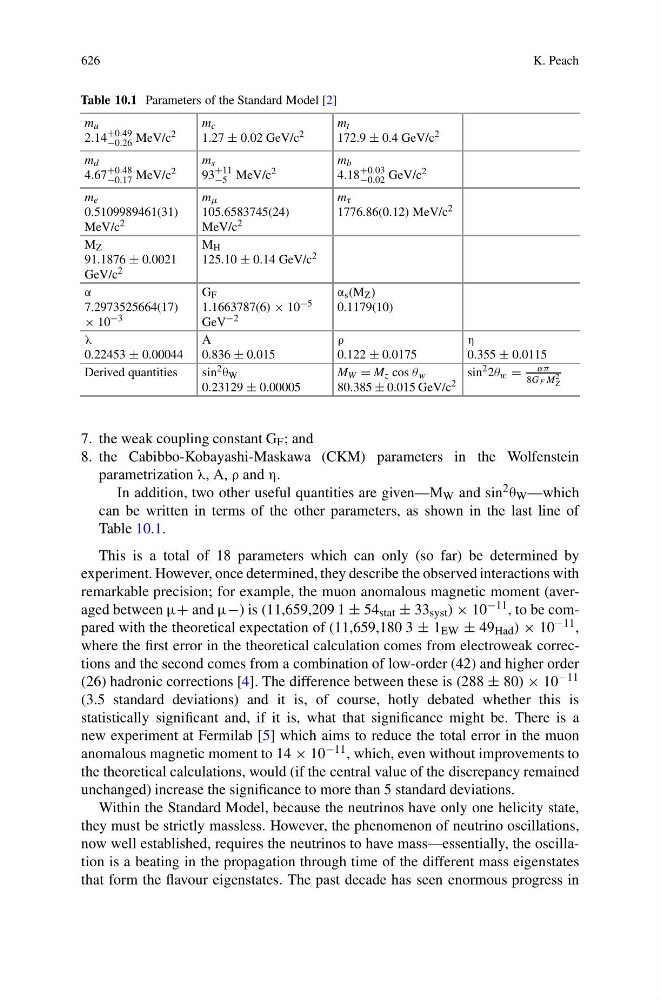
Table 10.1 Parameters of the Standard Model [2]
m u
2.14
+0.49
−0.26 MeV/c 2
m c
1.27 ± 0.02 GeV/c 2
m t
172.9 ± 0.4 GeV/c 2
m d
4.67
+0.48
−0.17 MeV/c 2
m s
93
+11
−5 MeV/c 2
m b
4.18
+0.03
−0.02 GeV/c 2
m e
0.5109989461(31)
MeV/c 2
m μ
105.6583745(24)
MeV/c 2
m τ
1776.86(0.12) MeV/c 2
M Z
91.1876 ± 0.0021
GeV/c 2
M H
125.10 ± 0.14 GeV/c 2
α
7.2973525664(17)
× 10 −3
G F
1.1663787(6) × 10 −5
GeV −2
α s (M Z )
0.1179(10)
λ
0.22453 ± 0.00044
A
0.836 ± 0.015
ρ
0.122 ± 0.0175
η
0.355 ± 0.0115
Derived quantities
sin 2 θ W
0.23129 ± 0.00005
M W = M z cos θ w
80.385 ± 0.015 GeV/c 2
sin
2 2θ w =
απ
8G F M 2
Z
7. the weak coupling constant G F ; and
8. the Cabibbo-Kobayashi-Maskawa (CKM) parameters in the Wolfenstein
parametrization λ, A, ρ and η.
In addition, two other useful quantities are given—M W and sin 2 θ W —which
can be written in terms of the other parameters, as shown in the last line of
Table 10.1.
This is a total of 18 parameters which can only (so far) be determined by
experiment. However, once determined, they describe the observed interactions with
remarkable precision; for example, the muon anomalous magnetic moment (averaged between μ+ and μ−) is (11,659,209 1 ± 54 stat ± 33 syst ) × 10 −11 , to be compared with the theoretical expectation of (11,659,180 3 ± 1 EW ± 49 Had ) × 10 −11 ,
where the first error in the theoretical calculation comes from electroweak corrections and the second comes from a combination of low-order (42) and higher order
(26) hadronic corrections [4]. The difference between these is (288 ± 80) × 10 −11
(3.5 standard deviations) and it is, of course, hotly debated whether this is
statistically significant and, if it is, what that significance might be. There is a
new experiment at Fermilab [5] which aims to reduce the total error in the muon
anomalous magnetic moment to 14 × 10 −11 , which, even without improvements to
the theoretical calculations, would (if the central value of the discrepancy remained
unchanged) increase the significance to more than 5 standard deviations.
Within the Standard Model, because the neutrinos have only one helicity state,
they must be strictly massless. However, the phenomenon of neutrino oscillations,
now well established, requires the neutrinos to have mass—essentially, the oscillation is a beating in the propagation through time of the different mass eigenstates
that form the flavour eigenstates. The past decade has seen enormous progress in