

604
K. Kleinknecht and U. Uwer
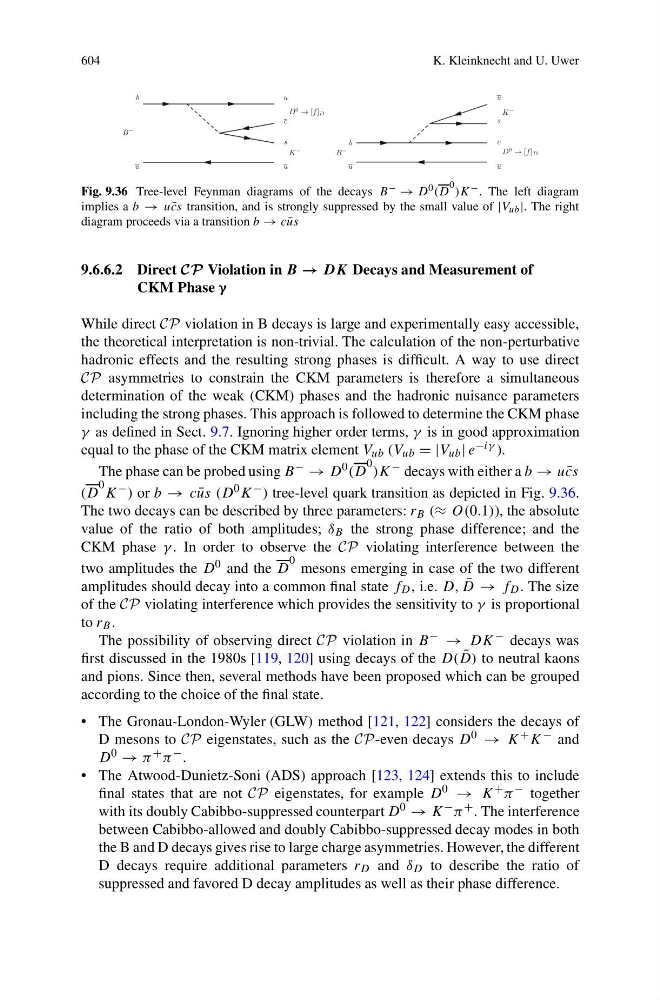
Fig. 9.36 Tree-level Feynman diagrams of the decays B − → D 0 (D
0 )K − . The left diagram
implies a b → u ¯
cs transition, and is strongly suppressed by the small value of |V ub |. The right
diagram proceeds via a transition b → c ¯
us
9.6.6.2 Direct CP Violation in B → DK Decays and Measurement of
CKM Phase γ
While direct CP violation in B decays is large and experimentally easy accessible,
the theoretical interpretation is non-trivial. The calculation of the non-perturbative
hadronic effects and the resulting strong phases is difficult. A way to use direct
CP asymmetries to constrain the CKM parameters is therefore a simultaneous
determination of the weak (CKM) phases and the hadronic nuisance parameters
including the strong phases. This approach is followed to determine the CKM phase
γ as defined in Sect. 9.7. Ignoring higher order terms, γ is in good approximation
equal to the phase of the CKM matrix element V ub (V ub = |V ub | e −iγ ).
The phase can be probed using B − → D 0 (D
0 )K − decays with either a b → u ¯
cs
(D
0 K − ) or b → c ¯
us (D 0 K − ) tree-level quark transition as depicted in Fig. 9.36.
The two decays can be described by three parameters: r B (≈ O(0.1)), the absolute
value of the ratio of both amplitudes; δ B the strong phase difference; and the
CKM phase γ . In order to observe the CP violating interference between the
two amplitudes the D 0 and the D
0 mesons emerging in case of the two different
amplitudes should decay into a common final state f D , i.e. D, ¯
D → f D . The size
of the CP violating interference which provides the sensitivity to γ is proportional
to r B .
The possibility of observing direct CP violation in B − → DK − decays was
first discussed in the 1980s [119, 120] using decays of the D( ¯
D) to neutral kaons
and pions. Since then, several methods have been proposed which can be grouped
according to the choice of the final state.
• The Gronau-London-Wyler (GLW) method [121, 122] considers the decays of
D mesons to CP eigenstates, such as the CP-even decays D 0 → K + K − and
D 0 → π + π − .
• The Atwood-Dunietz-Soni (ADS) approach [123, 124] extends this to include
final states that are not CP eigenstates, for example D 0 → K + π − together
with its doubly Cabibbo-suppressed counterpart D 0 → K − π + . The interference
between Cabibbo-allowed and doubly Cabibbo-suppressed decay modes in both
the B and D decays gives rise to large charge asymmetries. However, the different
D decays require additional parameters r D and δ D to describe the ratio of
suppressed and favored D decay amplitudes as well as their phase difference.
K. Kleinknecht and U. Uwer
Fig. 9.36 Tree-level Feynman diagrams of the decays B − → D 0 (D
0 )K − . The left diagram
implies a b → u ¯
cs transition, and is strongly suppressed by the small value of |V ub |. The right
diagram proceeds via a transition b → c ¯
us
9.6.6.2 Direct CP Violation in B → DK Decays and Measurement of
CKM Phase γ
While direct CP violation in B decays is large and experimentally easy accessible,
the theoretical interpretation is non-trivial. The calculation of the non-perturbative
hadronic effects and the resulting strong phases is difficult. A way to use direct
CP asymmetries to constrain the CKM parameters is therefore a simultaneous
determination of the weak (CKM) phases and the hadronic nuisance parameters
including the strong phases. This approach is followed to determine the CKM phase
γ as defined in Sect. 9.7. Ignoring higher order terms, γ is in good approximation
equal to the phase of the CKM matrix element V ub (V ub = |V ub | e −iγ ).
The phase can be probed using B − → D 0 (D
0 )K − decays with either a b → u ¯
cs
(D
0 K − ) or b → c ¯
us (D 0 K − ) tree-level quark transition as depicted in Fig. 9.36.
The two decays can be described by three parameters: r B (≈ O(0.1)), the absolute
value of the ratio of both amplitudes; δ B the strong phase difference; and the
CKM phase γ . In order to observe the CP violating interference between the
two amplitudes the D 0 and the D
0 mesons emerging in case of the two different
amplitudes should decay into a common final state f D , i.e. D, ¯
D → f D . The size
of the CP violating interference which provides the sensitivity to γ is proportional
to r B .
The possibility of observing direct CP violation in B − → DK − decays was
first discussed in the 1980s [119, 120] using decays of the D( ¯
D) to neutral kaons
and pions. Since then, several methods have been proposed which can be grouped
according to the choice of the final state.
• The Gronau-London-Wyler (GLW) method [121, 122] considers the decays of
D mesons to CP eigenstates, such as the CP-even decays D 0 → K + K − and
D 0 → π + π − .
• The Atwood-Dunietz-Soni (ADS) approach [123, 124] extends this to include
final states that are not CP eigenstates, for example D 0 → K + π − together
with its doubly Cabibbo-suppressed counterpart D 0 → K − π + . The interference
between Cabibbo-allowed and doubly Cabibbo-suppressed decay modes in both
the B and D decays gives rise to large charge asymmetries. However, the different
D decays require additional parameters r D and δ D to describe the ratio of
suppressed and favored D decay amplitudes as well as their phase difference.