

9 Symmetry Violations and Quark Flavour Physics
603
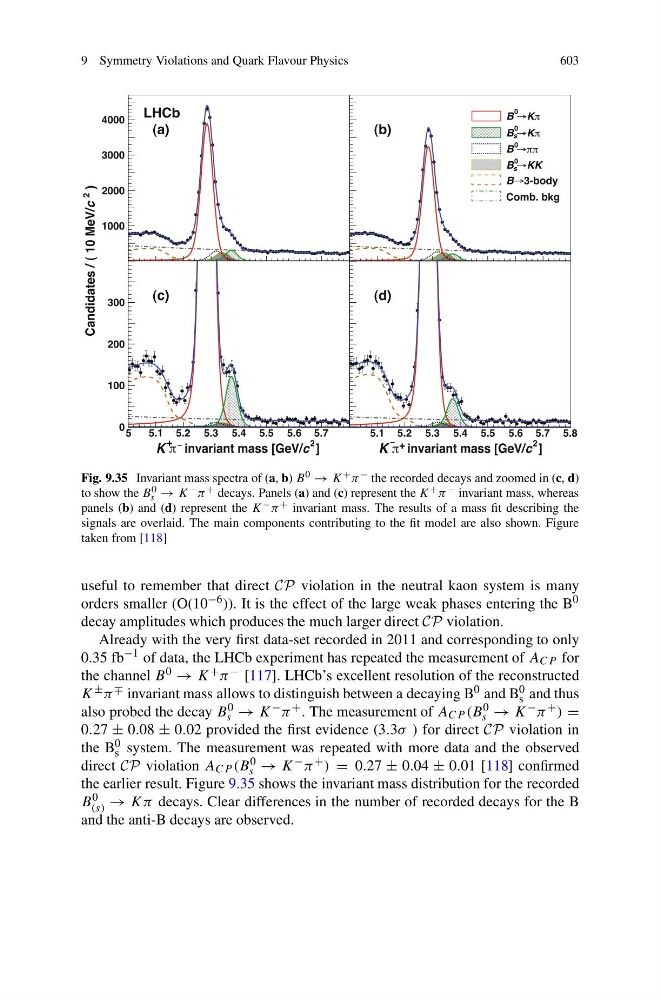
Fig. 9.35 Invariant mass spectra of (a, b) B 0 → K + π − the recorded decays and zoomed in (c, d)
to show the B 0
s → K − π + decays. Panels (a) and (c) represent the K + π − invariant mass, whereas
panels (b) and (d) represent the K − π + invariant mass. The results of a mass fit describing the
signals are overlaid. The main components contributing to the fit model are also shown. Figure
taken from [118]
useful to remember that direct CP violation in the neutral kaon system is many
orders smaller (O(10 −6 )). It is the effect of the large weak phases entering the B 0
decay amplitudes which produces the much larger direct CP violation.
Already with the very first data-set recorded in 2011 and corresponding to only
0.35 fb −1 of data, the LHCb experiment has repeated the measurement of A CP for
the channel B 0 → K + π − [117]. LHCb’s excellent resolution of the reconstructed
K ± π ∓ invariant mass allows to distinguish between a decaying B 0 and B 0
s and thus
also probed the decay B 0
s → K − π + . The measurement of A CP (B 0
s → K − π + ) =
0.27 ± 0.08 ± 0.02 provided the first evidence (3.3σ ) for direct CP violation in
the B 0
s system. The measurement was repeated with more data and the observed
direct CP violation A CP (B 0
s → K − π + ) = 0.27 ± 0.04 ± 0.01 [118] confirmed
the earlier result. Figure 9.35 shows the invariant mass distribution for the recorded
B 0
(s) → Kπ decays. Clear differences in the number of recorded decays for the B
and the anti-B decays are observed.
603
Fig. 9.35 Invariant mass spectra of (a, b) B 0 → K + π − the recorded decays and zoomed in (c, d)
to show the B 0
s → K − π + decays. Panels (a) and (c) represent the K + π − invariant mass, whereas
panels (b) and (d) represent the K − π + invariant mass. The results of a mass fit describing the
signals are overlaid. The main components contributing to the fit model are also shown. Figure
taken from [118]
useful to remember that direct CP violation in the neutral kaon system is many
orders smaller (O(10 −6 )). It is the effect of the large weak phases entering the B 0
decay amplitudes which produces the much larger direct CP violation.
Already with the very first data-set recorded in 2011 and corresponding to only
0.35 fb −1 of data, the LHCb experiment has repeated the measurement of A CP for
the channel B 0 → K + π − [117]. LHCb’s excellent resolution of the reconstructed
K ± π ∓ invariant mass allows to distinguish between a decaying B 0 and B 0
s and thus
also probed the decay B 0
s → K − π + . The measurement of A CP (B 0
s → K − π + ) =
0.27 ± 0.08 ± 0.02 provided the first evidence (3.3σ ) for direct CP violation in
the B 0
s system. The measurement was repeated with more data and the observed
direct CP violation A CP (B 0
s → K − π + ) = 0.27 ± 0.04 ± 0.01 [118] confirmed
the earlier result. Figure 9.35 shows the invariant mass distribution for the recorded
B 0
(s) → Kπ decays. Clear differences in the number of recorded decays for the B
and the anti-B decays are observed.