

9 Symmetry Violations and Quark Flavour Physics
601
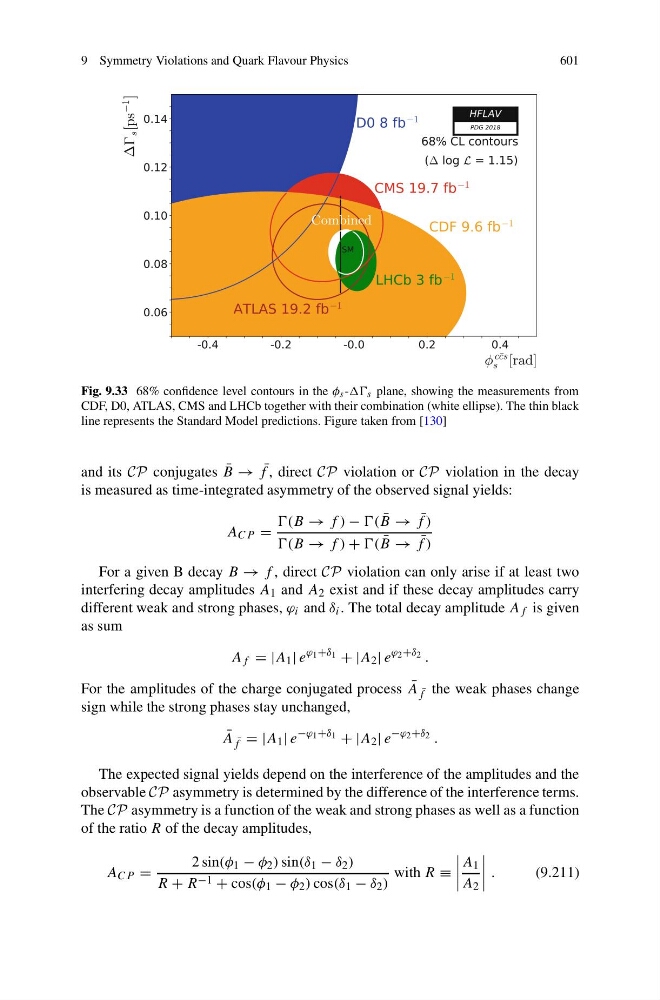
Fig. 9.33 68% confidence level contours in the φ s - s plane, showing the measurements from
CDF, D0, ATLAS, CMS and LHCb together with their combination (white ellipse). The thin black
line represents the Standard Model predictions. Figure taken from [130]
and its CP conjugates ¯
B → ¯
f , direct CP violation or CP violation in the decay
is measured as time-integrated asymmetry of the observed signal yields:
A CP =
(B → f ) − ¯
B → ¯
f )
(B → f ) + ¯
B → ¯
f )
For a given B decay B → f , direct CP violation can only arise if at least two
interfering decay amplitudes A 1 and A 2 exist and if these decay amplitudes carry
different weak and strong phases, ϕ i and δ i . The total decay amplitude A f is given
as sum
A f = |A 1 | e
ϕ 1 +δ 1 + |A 2 | e
ϕ 2 +δ 2 .
For the amplitudes of the charge conjugated process ¯
A ¯
f the weak phases change
sign while the strong phases stay unchanged,
¯
A ¯
f = |A 1 | e
−ϕ 1 +δ 1 + |A 2 | e
−ϕ 2 +δ 2 .
The expected signal yields depend on the interference of the amplitudes and the
observable CP asymmetry is determined by the difference of the interference terms.
The CP asymmetry is a function of the weak and strong phases as well as a function
of the ratio R of the decay amplitudes,
A CP =
2 sin(φ 1 − φ 2 ) sin(δ 1 − δ 2 )
R + R −1 + cos(φ 1 − φ 2 ) cos(δ 1 − δ 2 )
with R ≡
A 1
A 2
.
(9.211)
601
Fig. 9.33 68% confidence level contours in the φ s - s plane, showing the measurements from
CDF, D0, ATLAS, CMS and LHCb together with their combination (white ellipse). The thin black
line represents the Standard Model predictions. Figure taken from [130]
and its CP conjugates ¯
B → ¯
f , direct CP violation or CP violation in the decay
is measured as time-integrated asymmetry of the observed signal yields:
A CP =
(B → f ) − ¯
B → ¯
f )
(B → f ) + ¯
B → ¯
f )
For a given B decay B → f , direct CP violation can only arise if at least two
interfering decay amplitudes A 1 and A 2 exist and if these decay amplitudes carry
different weak and strong phases, ϕ i and δ i . The total decay amplitude A f is given
as sum
A f = |A 1 | e
ϕ 1 +δ 1 + |A 2 | e
ϕ 2 +δ 2 .
For the amplitudes of the charge conjugated process ¯
A ¯
f the weak phases change
sign while the strong phases stay unchanged,
¯
A ¯
f = |A 1 | e
−ϕ 1 +δ 1 + |A 2 | e
−ϕ 2 +δ 2 .
The expected signal yields depend on the interference of the amplitudes and the
observable CP asymmetry is determined by the difference of the interference terms.
The CP asymmetry is a function of the weak and strong phases as well as a function
of the ratio R of the decay amplitudes,
A CP =
2 sin(φ 1 − φ 2 ) sin(δ 1 − δ 2 )
R + R −1 + cos(φ 1 − φ 2 ) cos(δ 1 − δ 2 )
with R ≡
A 1
A 2
.
(9.211)