

9 Symmetry Violations and Quark Flavour Physics
575
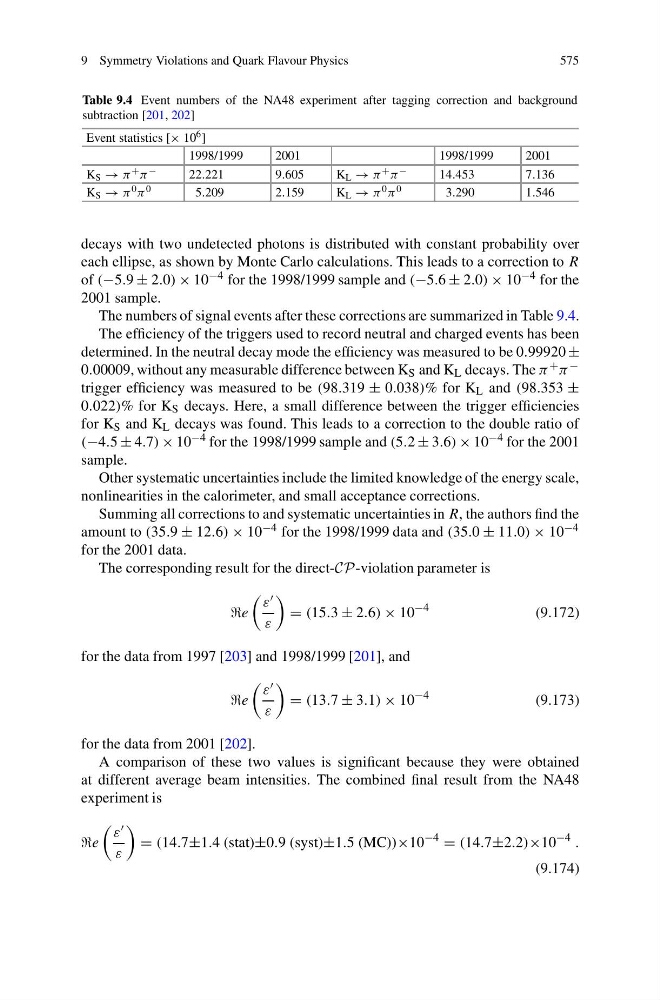
Table 9.4 Event numbers of the NA48 experiment after tagging correction and background
subtraction [201, 202]
Event statistics [× 10 6 ]
1998/1999
2001
1998/1999
2001
K S → π + π −
22.221
9.605
K L → π + π −
14.453
7.136
K S → π 0 π 0
5.209
2.159
K L → π 0 π 0
3.290
1.546
decays with two undetected photons is distributed with constant probability over
each ellipse, as shown by Monte Carlo calculations. This leads to a correction to R
of (−5.9 ± 2.0) × 10 −4 for the 1998/1999 sample and (−5.6 ± 2.0) × 10 −4 for the
2001 sample.
The numbers of signal events after these corrections are summarized in Table 9.4.
The efficiency of the triggers used to record neutral and charged events has been
determined. In the neutral decay mode the efficiency was measured to be 0.99920 ±
0.00009, without any measurable difference between K S and K L decays. The π + π −
trigger efficiency was measured to be (98.319 ± 0.038)% for K L and (98.353 ±
0.022)% for K S decays. Here, a small difference between the trigger efficiencies
for K S and K L decays was found. This leads to a correction to the double ratio of
(−4.5 ± 4.7) × 10 −4 for the 1998/1999 sample and (5.2 ± 3.6) × 10 −4 for the 2001
sample.
Other systematic uncertainties include the limited knowledge of the energy scale,
nonlinearities in the calorimeter, and small acceptance corrections.
Summing all corrections to and systematic uncertainties in R, the authors find the
amount to (35.9 ± 12.6) × 10 −4 for the 1998/1999 data and (35.0 ± 11.0) × 10 −4
for the 2001 data.
The corresponding result for the direct-CP-violation parameter is
ε
ε
= (15.3 ± 2.6) × 10
−4
(9.172)
for the data from 1997 [203] and 1998/1999 [201], and
ε
ε
= (13.7 ± 3.1) × 10
−4
(9.173)
for the data from 2001 [202].
A comparison of these two values is significant because they were obtained
at different average beam intensities. The combined final result from the NA48
experiment is
ε
ε
= (14.7±1.4 (stat)±0.9 (syst)±1.5 (MC))×10
−4
= (14.7±2.2)×10
−4 .
(9.174)
575
Table 9.4 Event numbers of the NA48 experiment after tagging correction and background
subtraction [201, 202]
Event statistics [× 10 6 ]
1998/1999
2001
1998/1999
2001
K S → π + π −
22.221
9.605
K L → π + π −
14.453
7.136
K S → π 0 π 0
5.209
2.159
K L → π 0 π 0
3.290
1.546
decays with two undetected photons is distributed with constant probability over
each ellipse, as shown by Monte Carlo calculations. This leads to a correction to R
of (−5.9 ± 2.0) × 10 −4 for the 1998/1999 sample and (−5.6 ± 2.0) × 10 −4 for the
2001 sample.
The numbers of signal events after these corrections are summarized in Table 9.4.
The efficiency of the triggers used to record neutral and charged events has been
determined. In the neutral decay mode the efficiency was measured to be 0.99920 ±
0.00009, without any measurable difference between K S and K L decays. The π + π −
trigger efficiency was measured to be (98.319 ± 0.038)% for K L and (98.353 ±
0.022)% for K S decays. Here, a small difference between the trigger efficiencies
for K S and K L decays was found. This leads to a correction to the double ratio of
(−4.5 ± 4.7) × 10 −4 for the 1998/1999 sample and (5.2 ± 3.6) × 10 −4 for the 2001
sample.
Other systematic uncertainties include the limited knowledge of the energy scale,
nonlinearities in the calorimeter, and small acceptance corrections.
Summing all corrections to and systematic uncertainties in R, the authors find the
amount to (35.9 ± 12.6) × 10 −4 for the 1998/1999 data and (35.0 ± 11.0) × 10 −4
for the 2001 data.
The corresponding result for the direct-CP-violation parameter is
ε
ε
= (15.3 ± 2.6) × 10
−4
(9.172)
for the data from 1997 [203] and 1998/1999 [201], and
ε
ε
= (13.7 ± 3.1) × 10
−4
(9.173)
for the data from 2001 [202].
A comparison of these two values is significant because they were obtained
at different average beam intensities. The combined final result from the NA48
experiment is
ε
ε
= (14.7±1.4 (stat)±0.9 (syst)±1.5 (MC))×10
−4
= (14.7±2.2)×10
−4 .
(9.174)