

9 Symmetry Violations and Quark Flavour Physics
567
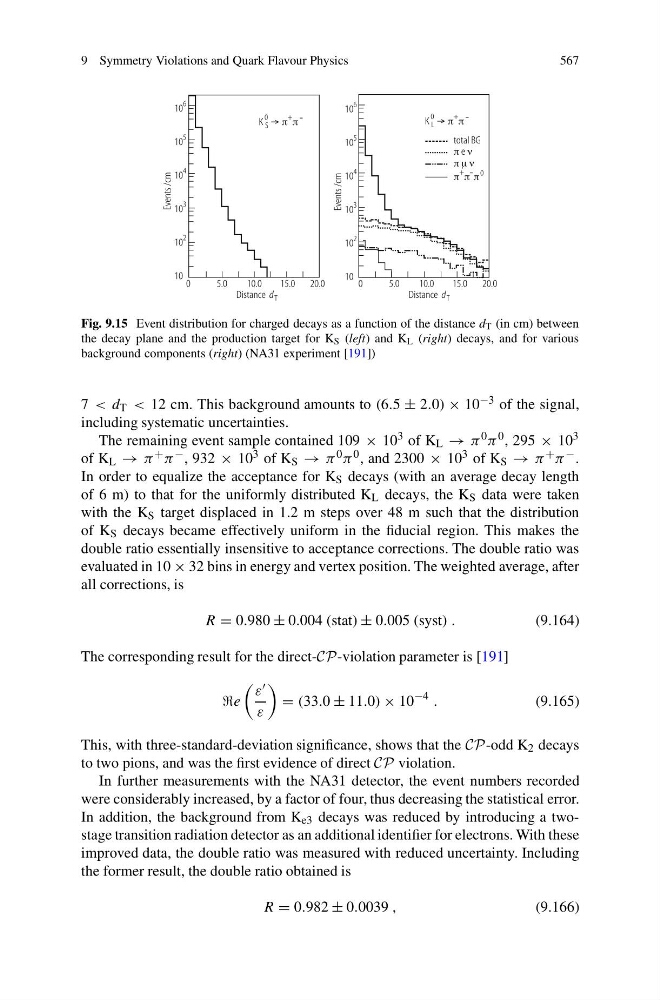
Fig. 9.15 Event distribution for charged decays as a function of the distance d T (in cm) between
the decay plane and the production target for K S (left) and K L (right) decays, and for various
background components (right) (NA31 experiment [191])
7 < d T < 12 cm. This background amounts to (6.5 ± 2.0) × 10 −3 of the signal,
including systematic uncertainties.
The remaining event sample contained 109 × 10 3 of K L → π 0 π 0 , 295 × 10 3
of K L → π + π − , 932 × 10 3 of K S → π 0 π 0 , and 2300 × 10 3 of K S → π + π − .
In order to equalize the acceptance for K S decays (with an average decay length
of 6 m) to that for the uniformly distributed K L decays, the K S data were taken
with the K S target displaced in 1.2 m steps over 48 m such that the distribution
of K S decays became effectively uniform in the fiducial region. This makes the
double ratio essentially insensitive to acceptance corrections. The double ratio was
evaluated in 10 × 32 bins in energy and vertex position. The weighted average, after
all corrections, is
R = 0.980 ± 0.004 (stat) ± 0.005 (syst) .
(9.164)
The corresponding result for the direct-CP-violation parameter is [191]
ε
ε
= (33.0 ± 11.0) × 10
−4 .
(9.165)
This, with three-standard-deviation significance, shows that the CP-odd K 2 decays
to two pions, and was the first evidence of direct CP violation.
In further measurements with the NA31 detector, the event numbers recorded
were considerably increased, by a factor of four, thus decreasing the statistical error.
In addition, the background from K e3 decays was reduced by introducing a twostage transition radiation detector as an additional identifier for electrons. With these
improved data, the double ratio was measured with reduced uncertainty. Including
the former result, the double ratio obtained is
R = 0.982 ± 0.0039 ,
(9.166)
567
Fig. 9.15 Event distribution for charged decays as a function of the distance d T (in cm) between
the decay plane and the production target for K S (left) and K L (right) decays, and for various
background components (right) (NA31 experiment [191])
7 < d T < 12 cm. This background amounts to (6.5 ± 2.0) × 10 −3 of the signal,
including systematic uncertainties.
The remaining event sample contained 109 × 10 3 of K L → π 0 π 0 , 295 × 10 3
of K L → π + π − , 932 × 10 3 of K S → π 0 π 0 , and 2300 × 10 3 of K S → π + π − .
In order to equalize the acceptance for K S decays (with an average decay length
of 6 m) to that for the uniformly distributed K L decays, the K S data were taken
with the K S target displaced in 1.2 m steps over 48 m such that the distribution
of K S decays became effectively uniform in the fiducial region. This makes the
double ratio essentially insensitive to acceptance corrections. The double ratio was
evaluated in 10 × 32 bins in energy and vertex position. The weighted average, after
all corrections, is
R = 0.980 ± 0.004 (stat) ± 0.005 (syst) .
(9.164)
The corresponding result for the direct-CP-violation parameter is [191]
ε
ε
= (33.0 ± 11.0) × 10
−4 .
(9.165)
This, with three-standard-deviation significance, shows that the CP-odd K 2 decays
to two pions, and was the first evidence of direct CP violation.
In further measurements with the NA31 detector, the event numbers recorded
were considerably increased, by a factor of four, thus decreasing the statistical error.
In addition, the background from K e3 decays was reduced by introducing a twostage transition radiation detector as an additional identifier for electrons. With these
improved data, the double ratio was measured with reduced uncertainty. Including
the former result, the double ratio obtained is
R = 0.982 ± 0.0039 ,
(9.166)