

558
K. Kleinknecht and U. Uwer
10
3
10
4
10
5
125
130
135
140
145
150
z vertex (m)
Events per 0.5 m
S
+ S
data
Prediction without interference
(40 p K 50 GeV/c)
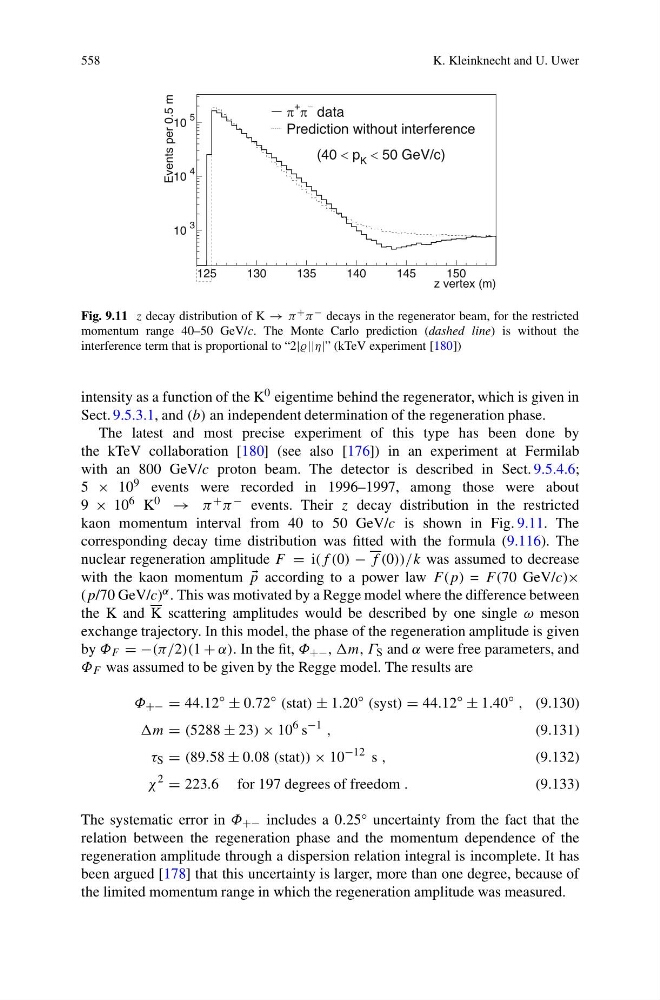
Fig. 9.11 z decay distribution of K → π + π − decays in the regenerator beam, for the restricted
momentum range 40–50 GeV/c. The Monte Carlo prediction (dashed line) is without the
interference term that is proportional to “2|||η|” (kTeV experiment [180])
intensity as a function of the K 0 eigentime behind the regenerator, which is given in
Sect. 9.5.3.1, and (b) an independent determination of the regeneration phase.
The latest and most precise experiment of this type has been done by
the kTeV collaboration [180] (see also [176]) in an experiment at Fermilab
with an 800 GeV/c proton beam. The detector is described in Sect. 9.5.4.6;
5 × 10 9 events were recorded in 1996–1997, among those were about
9 × 10 6 K 0 → π + π − events. Their z decay distribution in the restricted
kaon momentum interval from 40 to 50 GeV/c is shown in Fig. 9.11. The
corresponding decay time distribution was fitted with the formula (9.116). The
nuclear regeneration amplitude F = i(f (0) − f (0))/k was assumed to decrease
with the kaon momentum
p according to a power law F (p) = F (70 GeV/c)×
(p/70 GeV/c) α . This was motivated by a Regge model where the difference between
the K and K scattering amplitudes would be described by one single ω meson
exchange trajectory. In this model, the phase of the regeneration amplitude is given
by Φ F = −(π/2)(1 + α). In the fit, Φ +− , Γ S and α were free parameters, and
Φ F was assumed to be given by the Regge model. The results are
Φ +− = 44.12
◦
± 0.72
◦ (stat) ± 1.20
◦ (syst) = 44.12
◦
± 1.40
◦ , (9.130)
= (5288 ± 23) × 10
6 s
−1 ,
(9.131)
τ S = (89.58 ± 0.08 (stat)) × 10
−12 s ,
(9.132)
χ
2
= 223.6 for 197 degrees of freedom .
(9.133)
The systematic error in Φ +− includes a 0.25 ◦ uncertainty from the fact that the
relation between the regeneration phase and the momentum dependence of the
regeneration amplitude through a dispersion relation integral is incomplete. It has
been argued [178] that this uncertainty is larger, more than one degree, because of
the limited momentum range in which the regeneration amplitude was measured.
K. Kleinknecht and U. Uwer
10
3
10
4
10
5
125
130
135
140
145
150
z vertex (m)
Events per 0.5 m
S
+ S
data
Prediction without interference
(40 p K 50 GeV/c)
Fig. 9.11 z decay distribution of K → π + π − decays in the regenerator beam, for the restricted
momentum range 40–50 GeV/c. The Monte Carlo prediction (dashed line) is without the
interference term that is proportional to “2|||η|” (kTeV experiment [180])
intensity as a function of the K 0 eigentime behind the regenerator, which is given in
Sect. 9.5.3.1, and (b) an independent determination of the regeneration phase.
The latest and most precise experiment of this type has been done by
the kTeV collaboration [180] (see also [176]) in an experiment at Fermilab
with an 800 GeV/c proton beam. The detector is described in Sect. 9.5.4.6;
5 × 10 9 events were recorded in 1996–1997, among those were about
9 × 10 6 K 0 → π + π − events. Their z decay distribution in the restricted
kaon momentum interval from 40 to 50 GeV/c is shown in Fig. 9.11. The
corresponding decay time distribution was fitted with the formula (9.116). The
nuclear regeneration amplitude F = i(f (0) − f (0))/k was assumed to decrease
with the kaon momentum
p according to a power law F (p) = F (70 GeV/c)×
(p/70 GeV/c) α . This was motivated by a Regge model where the difference between
the K and K scattering amplitudes would be described by one single ω meson
exchange trajectory. In this model, the phase of the regeneration amplitude is given
by Φ F = −(π/2)(1 + α). In the fit, Φ +− , Γ S and α were free parameters, and
Φ F was assumed to be given by the Regge model. The results are
Φ +− = 44.12
◦
± 0.72
◦ (stat) ± 1.20
◦ (syst) = 44.12
◦
± 1.40
◦ , (9.130)
= (5288 ± 23) × 10
6 s
−1 ,
(9.131)
τ S = (89.58 ± 0.08 (stat)) × 10
−12 s ,
(9.132)
χ
2
= 223.6 for 197 degrees of freedom .
(9.133)
The systematic error in Φ +− includes a 0.25 ◦ uncertainty from the fact that the
relation between the regeneration phase and the momentum dependence of the
regeneration amplitude through a dispersion relation integral is incomplete. It has
been argued [178] that this uncertainty is larger, more than one degree, because of
the limited momentum range in which the regeneration amplitude was measured.