

50
G. Altarelli and S. Forte
Here U u and U d are the unitary matrices that operate on left-handed doublets in
the diagonalization of the u and d quarks, respectively (see Eq. (3.44)). Since V
is unitary (i.e. V V † = V † V = 1) and commutes with T 2 , T 3 and Q (because
all d-type quarks have the same isospin and charge), the neutral current couplings
are diagonal both in the primed and unprimed basis (if the down-type quark terms
in the Z current are written in terms of weak isospin eigenvectors as ¯
D ,
then by changing basis we get ¯
DV † V D and V and commute because, as
seen from Eq. (3.23), is made of Dirac matrices and of T 3 and Q generator
matrices). It follows that ¯
D = ¯
DDD. This is the GIM mechanism [13] that
ensures natural flavour conservation of the neutral current couplings at the tree
level.
For N generations of quarks, V is a N×N unitary matrix that depends on N 2
real numbers (N 2 complex entries with N 2 unitarity constraints). However, the 2N
phases of up- and down-type quarks are not observable. Note that an overall phase
drops away from the expression of the current in Eq. (3.67), so that only 2N − 1
phases can affect V. In total, V depends on N 2 − 2N + 1 = (N − 1) 2 real physical
parameters. A similar counting gives N(N − 1)/2 as the number of independent
parameters in an orthogonal N×N matrix. This implies that in V we have N(N −
1)/2 mixing angles and (N − 1) 2 − N(N − 1)/2 = (N − 1)(N − 2)/2 phases: for
N = 2 one mixing angle (the Cabibbo angle θ C ) and no phases, for N = 3 three
angles (θ 12 , θ 13 and θ 23 ) and one phase ϕ etc.
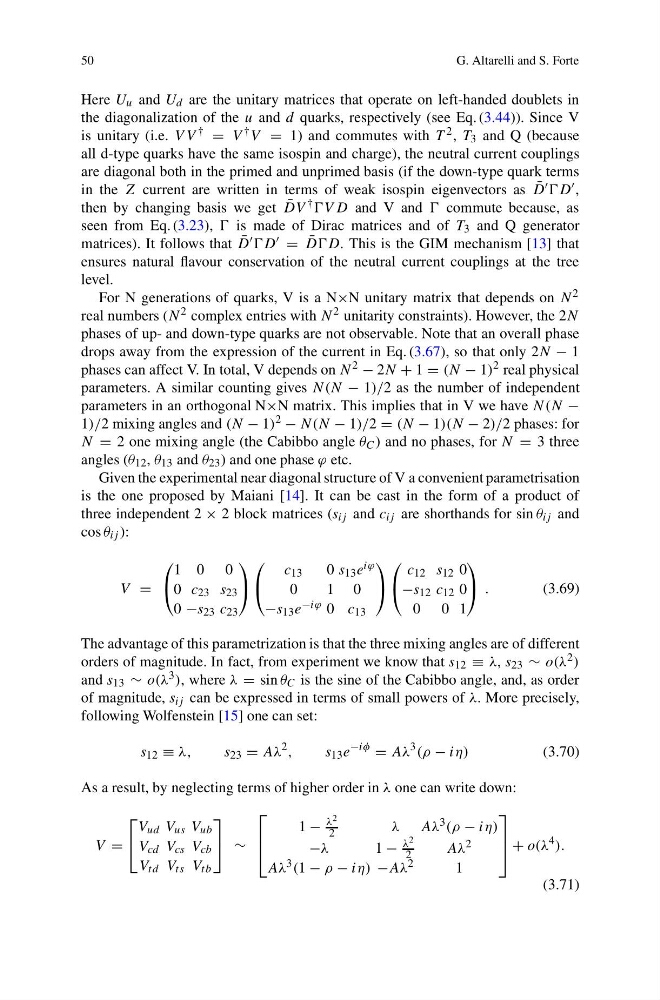
Given the experimental near diagonal structure of V a convenient parametrisation
is the one proposed by Maiani [14]. It can be cast in the form of a product of
three independent 2 × 2 block matrices (s ij and c ij are shorthands for sin θ ij and
cos θ ij ):
V =
⎛
⎝
1 0 0
0 c 23 s 23
0 −s 23 c 23
⎞
⎠
⎛
⎝
c 13
0 s 13 e iϕ
0
1 0
−s 13 e −iϕ 0 c 13
⎞
⎠
⎛
⎝
c 12 s 12 0
−s 12 c 12 0
0 0 1
⎞
⎠ .
(3.69)
The advantage of this parametrization is that the three mixing angles are of different
orders of magnitude. In fact, from experiment we know that s 12 ≡ λ, s 23 ∼ o(λ 2 )
and s 13 ∼ o(λ 3 ), where λ = sin θ C is the sine of the Cabibbo angle, and, as order
of magnitude, s ij can be expressed in terms of small powers of λ. More precisely,
following Wolfenstein [15] one can set:
s 12 ≡ λ,
s 23 = Aλ
2 ,
s 13 e
−iφ
= Aλ
3 (ρ − iη)
(3.70)
As a result, by neglecting terms of higher order in λ one can write down:
V =
⎡
⎣
V ud V us V ub
V cd V cs V cb
V td V ts V tb
⎤
⎦ ∼
⎡
⎢
⎣
1 −
λ 2
2
λ Aλ 3 (ρ − iη)
−λ
1 −
λ 2
2
Aλ 2
Aλ 3 (1 − ρ − iη) −Aλ 2
1
⎤
⎥
⎦ + o(λ
4 ).
(3.71)
G. Altarelli and S. Forte
Here U u and U d are the unitary matrices that operate on left-handed doublets in
the diagonalization of the u and d quarks, respectively (see Eq. (3.44)). Since V
is unitary (i.e. V V † = V † V = 1) and commutes with T 2 , T 3 and Q (because
all d-type quarks have the same isospin and charge), the neutral current couplings
are diagonal both in the primed and unprimed basis (if the down-type quark terms
in the Z current are written in terms of weak isospin eigenvectors as ¯
D ,
then by changing basis we get ¯
DV † V D and V and commute because, as
seen from Eq. (3.23), is made of Dirac matrices and of T 3 and Q generator
matrices). It follows that ¯
D = ¯
DDD. This is the GIM mechanism [13] that
ensures natural flavour conservation of the neutral current couplings at the tree
level.
For N generations of quarks, V is a N×N unitary matrix that depends on N 2
real numbers (N 2 complex entries with N 2 unitarity constraints). However, the 2N
phases of up- and down-type quarks are not observable. Note that an overall phase
drops away from the expression of the current in Eq. (3.67), so that only 2N − 1
phases can affect V. In total, V depends on N 2 − 2N + 1 = (N − 1) 2 real physical
parameters. A similar counting gives N(N − 1)/2 as the number of independent
parameters in an orthogonal N×N matrix. This implies that in V we have N(N −
1)/2 mixing angles and (N − 1) 2 − N(N − 1)/2 = (N − 1)(N − 2)/2 phases: for
N = 2 one mixing angle (the Cabibbo angle θ C ) and no phases, for N = 3 three
angles (θ 12 , θ 13 and θ 23 ) and one phase ϕ etc.
Given the experimental near diagonal structure of V a convenient parametrisation
is the one proposed by Maiani [14]. It can be cast in the form of a product of
three independent 2 × 2 block matrices (s ij and c ij are shorthands for sin θ ij and
cos θ ij ):
V =
⎛
⎝
1 0 0
0 c 23 s 23
0 −s 23 c 23
⎞
⎠
⎛
⎝
c 13
0 s 13 e iϕ
0
1 0
−s 13 e −iϕ 0 c 13
⎞
⎠
⎛
⎝
c 12 s 12 0
−s 12 c 12 0
0 0 1
⎞
⎠ .
(3.69)
The advantage of this parametrization is that the three mixing angles are of different
orders of magnitude. In fact, from experiment we know that s 12 ≡ λ, s 23 ∼ o(λ 2 )
and s 13 ∼ o(λ 3 ), where λ = sin θ C is the sine of the Cabibbo angle, and, as order
of magnitude, s ij can be expressed in terms of small powers of λ. More precisely,
following Wolfenstein [15] one can set:
s 12 ≡ λ,
s 23 = Aλ
2 ,
s 13 e
−iφ
= Aλ
3 (ρ − iη)
(3.70)
As a result, by neglecting terms of higher order in λ one can write down:
V =
⎡
⎣
V ud V us V ub
V cd V cs V cb
V td V ts V tb
⎤
⎦ ∼
⎡
⎢
⎣
1 −
λ 2
2
λ Aλ 3 (ρ − iη)
−λ
1 −
λ 2
2
Aλ 2
Aλ 3 (1 − ρ − iη) −Aλ 2
1
⎤
⎥
⎦ + o(λ
4 ).
(3.71)