

3 The Standard Model of Electroweak Interactions
49
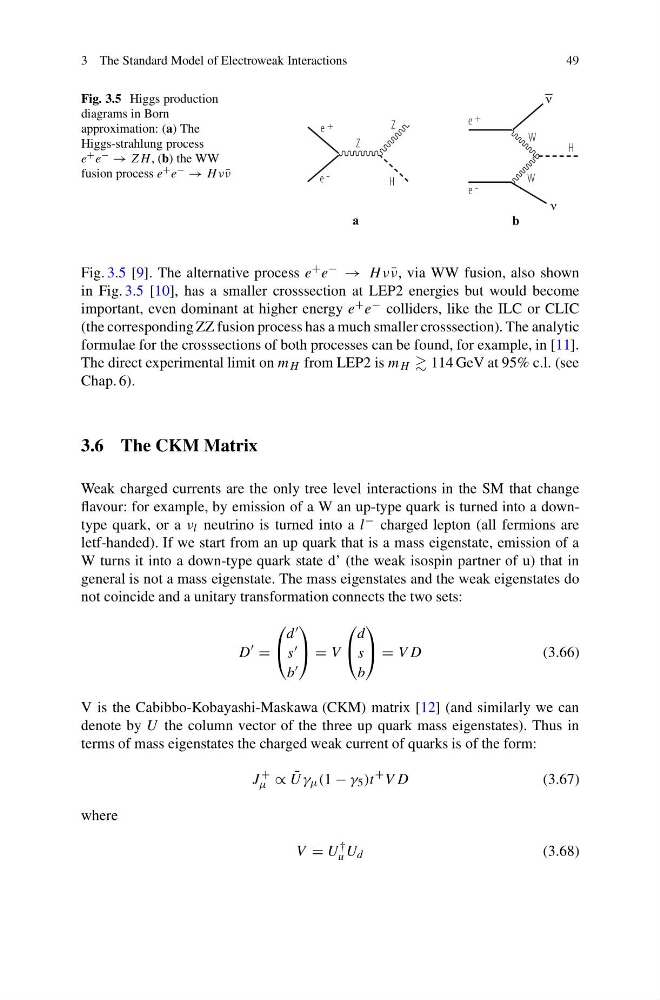
Fig. 3.5 Higgs production
diagrams in Born
approximation: (a) The
Higgs-strahlung process
e + e − → ZH , (b) the WW
fusion process e + e − → H ν ¯
ν
W
W
H
e +
e +
Z
Z
e -
e -
H
a
b
Fig. 3.5 [9]. The alternative process e + e − → H ν ¯
ν, via WW fusion, also shown
in Fig. 3.5 [10], has a smaller crosssection at LEP2 energies but would become
important, even dominant at higher energy e + e − colliders, like the ILC or CLIC
(the corresponding ZZ fusion process has a much smaller crosssection). The analytic
formulae for the crosssections of both processes can be found, for example, in [11].
The direct experimental limit on m H from LEP2 is m H 114 GeV at 95% c.l. (see
Chap. 6).
3.6 The CKM Matrix
Weak charged currents are the only tree level interactions in the SM that change
flavour: for example, by emission of a W an up-type quark is turned into a downtype quark, or a ν l neutrino is turned into a l − charged lepton (all fermions are
letf-handed). If we start from an up quark that is a mass eigenstate, emission of a
W turns it into a down-type quark state d’ (the weak isospin partner of u) that in
general is not a mass eigenstate. The mass eigenstates and the weak eigenstates do
not coincide and a unitary transformation connects the two sets:
D
=
⎛
⎝
d
s
b
⎞
⎠ = V
⎛
⎝
d
s
b
⎞
⎠ = V D
(3.66)
V is the Cabibbo-Kobayashi-Maskawa (CKM) matrix [12] (and similarly we can
denote by U the column vector of the three up quark mass eigenstates). Thus in
terms of mass eigenstates the charged weak current of quarks is of the form:
J
+
μ ∝ ¯
Uγ μ (1 − γ 5 )t
+ V D
(3.67)
where
V = U
†
u U d
(3.68)
49
Fig. 3.5 Higgs production
diagrams in Born
approximation: (a) The
Higgs-strahlung process
e + e − → ZH , (b) the WW
fusion process e + e − → H ν ¯
ν
W
W
H
e +
e +
Z
Z
e -
e -
H
a
b
Fig. 3.5 [9]. The alternative process e + e − → H ν ¯
ν, via WW fusion, also shown
in Fig. 3.5 [10], has a smaller crosssection at LEP2 energies but would become
important, even dominant at higher energy e + e − colliders, like the ILC or CLIC
(the corresponding ZZ fusion process has a much smaller crosssection). The analytic
formulae for the crosssections of both processes can be found, for example, in [11].
The direct experimental limit on m H from LEP2 is m H 114 GeV at 95% c.l. (see
Chap. 6).
3.6 The CKM Matrix
Weak charged currents are the only tree level interactions in the SM that change
flavour: for example, by emission of a W an up-type quark is turned into a downtype quark, or a ν l neutrino is turned into a l − charged lepton (all fermions are
letf-handed). If we start from an up quark that is a mass eigenstate, emission of a
W turns it into a down-type quark state d’ (the weak isospin partner of u) that in
general is not a mass eigenstate. The mass eigenstates and the weak eigenstates do
not coincide and a unitary transformation connects the two sets:
D
=
⎛
⎝
d
s
b
⎞
⎠ = V
⎛
⎝
d
s
b
⎞
⎠ = V D
(3.66)
V is the Cabibbo-Kobayashi-Maskawa (CKM) matrix [12] (and similarly we can
denote by U the column vector of the three up quark mass eigenstates). Thus in
terms of mass eigenstates the charged weak current of quarks is of the form:
J
+
μ ∝ ¯
Uγ μ (1 − γ 5 )t
+ V D
(3.67)
where
V = U
†
u U d
(3.68)