

3 The Standard Model of Electroweak Interactions
45
with
M = · v .
(3.43)
In the MSM, where all left fermions ψ L are doublets and all right fermions ψ R are
singlets, only Higgs doublets can contribute to fermion masses. There are enough
free couplings in , so that one single complex Higgs doublet is indeed sufficient to
generate the most general fermion mass matrix. It is important to observe that by a
suitable change of basis we can always make the matrix M Hermitian and diagonal.
In fact, we can make separate unitary transformations on ψ L and ψ R according to
ψ
L = Uψ L , ψ
R = W ψ R
(3.44)
and consequently
M → M
= U
†
MW .
(3.45)
This transformation does not alter the structure of the fermion couplings in L symm
(because both the kinetic terms and the couplings to gauge bosons do not mix L
and R spinors) except that it leads to the phenomenon of mixing, as we shall see in
Sect. (3.6).
If only one Higgs doublet is present, the change of basis that makes M diagonal
will at the same time diagonalize the fermion–Higgs Yukawa couplings. Thus, in
this case, no flavour-changing neutral Higgs vertices are present. This is not true,
in general, when there are several Higgs doublets. But one Higgs doublet for each
electric charge sector i.e. one doublet coupled only to u-type quarks, one doublet to
d-type quarks, one doublet to charged leptons (and possibly one for neutrino Dirac
masses) would also be all right, because the mass matrices of fermions with different
charges are diagonalized separately. For several Higgs doublets in a given charge
sector it is also possible to generate CP violation by complex phases in the Higgs
couplings. In the presence of six quark flavours, this CP-violation mechanism is not
necessary. In fact, at the moment, the simplest model with only one Higgs doublet
seems adequate for describing all observed phenomena.
We now consider the gauge-boson masses and their couplings to the Higgs. These
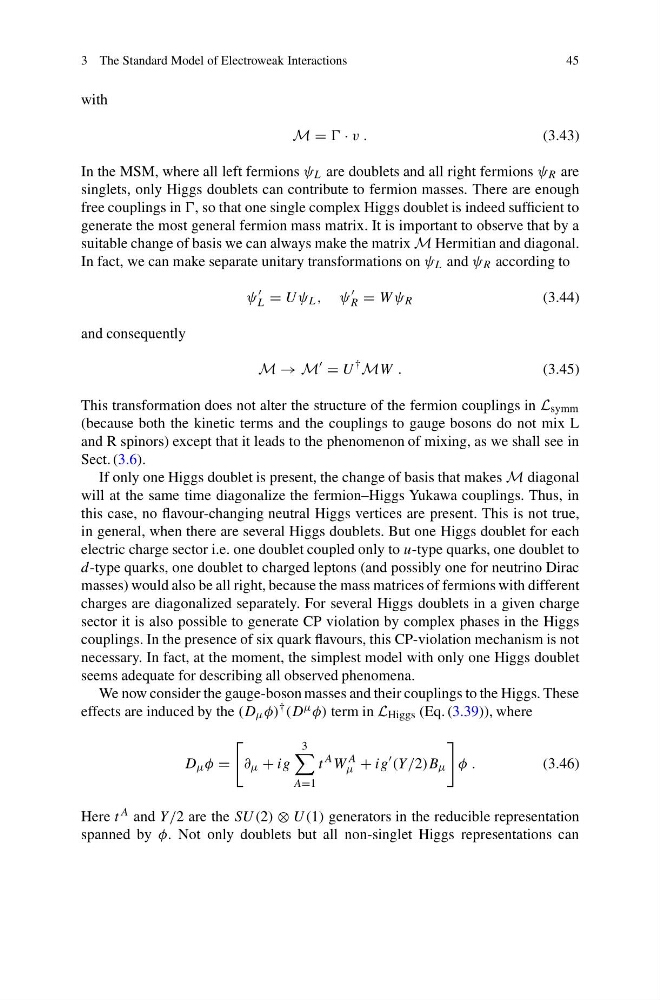
effects are induced by the (D μ φ) † (D μ φ) term in L Higgs (Eq. (3.39)), where
D μ φ =
∂ μ + ig
3
A=1
t
A W
A
μ + ig
(Y/2)B μ
φ .
(3.46)
Here t A and Y/2 are the SU (2) ⊗ U(1) generators in the reducible representation
spanned by φ. Not only doublets but all non-singlet Higgs representations can
45
with
M = · v .
(3.43)
In the MSM, where all left fermions ψ L are doublets and all right fermions ψ R are
singlets, only Higgs doublets can contribute to fermion masses. There are enough
free couplings in , so that one single complex Higgs doublet is indeed sufficient to
generate the most general fermion mass matrix. It is important to observe that by a
suitable change of basis we can always make the matrix M Hermitian and diagonal.
In fact, we can make separate unitary transformations on ψ L and ψ R according to
ψ
L = Uψ L , ψ
R = W ψ R
(3.44)
and consequently
M → M
= U
†
MW .
(3.45)
This transformation does not alter the structure of the fermion couplings in L symm
(because both the kinetic terms and the couplings to gauge bosons do not mix L
and R spinors) except that it leads to the phenomenon of mixing, as we shall see in
Sect. (3.6).
If only one Higgs doublet is present, the change of basis that makes M diagonal
will at the same time diagonalize the fermion–Higgs Yukawa couplings. Thus, in
this case, no flavour-changing neutral Higgs vertices are present. This is not true,
in general, when there are several Higgs doublets. But one Higgs doublet for each
electric charge sector i.e. one doublet coupled only to u-type quarks, one doublet to
d-type quarks, one doublet to charged leptons (and possibly one for neutrino Dirac
masses) would also be all right, because the mass matrices of fermions with different
charges are diagonalized separately. For several Higgs doublets in a given charge
sector it is also possible to generate CP violation by complex phases in the Higgs
couplings. In the presence of six quark flavours, this CP-violation mechanism is not
necessary. In fact, at the moment, the simplest model with only one Higgs doublet
seems adequate for describing all observed phenomena.
We now consider the gauge-boson masses and their couplings to the Higgs. These
effects are induced by the (D μ φ) † (D μ φ) term in L Higgs (Eq. (3.39)), where
D μ φ =
∂ μ + ig
3
A=1
t
A W
A
μ + ig
(Y/2)B μ
φ .
(3.46)
Here t A and Y/2 are the SU (2) ⊗ U(1) generators in the reducible representation
spanned by φ. Not only doublets but all non-singlet Higgs representations can