

44
G. Altarelli and S. Forte
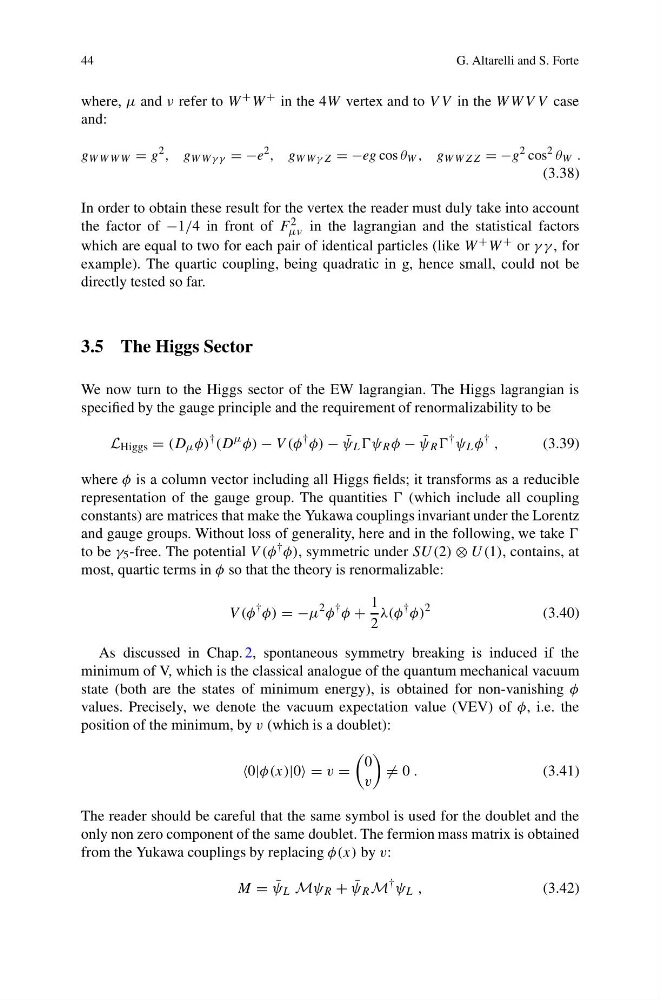
where, μ and ν refer to W + W + in the 4W vertex and to V V in the W W V V case
and:
g W W W W = g
2 , g W W γ γ = −e
2 , g W W γ Z = −eg cos θ W , g W W ZZ = −g
2 cos
2 θ W .
(3.38)
In order to obtain these result for the vertex the reader must duly take into account
the factor of −1/4 in front of F 2
μν in the lagrangian and the statistical factors
which are equal to two for each pair of identical particles (like W + W + or γ γ , for
example). The quartic coupling, being quadratic in g, hence small, could not be
directly tested so far.
3.5 The Higgs Sector
We now turn to the Higgs sector of the EW lagrangian. The Higgs lagrangian is
specified by the gauge principle and the requirement of renormalizability to be
L Higgs = (D μ φ)
† (D
μ φ) − V (φ
† φ) − ¯
ψ L R φ − ¯
ψ R
† ψ L φ
† ,
(3.39)
where φ is a column vector including all Higgs fields; it transforms as a reducible
representation of the gauge group. The quantities (which include all coupling
constants) are matrices that make the Yukawa couplings invariant under the Lorentz
and gauge groups. Without loss of generality, here and in the following, we take
to be γ 5 -free. The potential V (φ † φ), symmetric under SU (2) ⊗ U(1), contains, at
most, quartic terms in φ so that the theory is renormalizable:
V (φ
† φ) = −μ
2 φ
† φ +
1
2
λ(φ
† φ)
2
(3.40)
As discussed in Chap. 2, spontaneous symmetry breaking is induced if the
minimum of V, which is the classical analogue of the quantum mechanical vacuum
state (both are the states of minimum energy), is obtained for non-vanishing φ
values. Precisely, we denote the vacuum expectation value (VEV) of φ, i.e. the
position of the minimum, by v (which is a doublet):
= v =
0
v
= 0 .
(3.41)
The reader should be careful that the same symbol is used for the doublet and the
only non zero component of the same doublet. The fermion mass matrix is obtained
from the Yukawa couplings by replacing φ(x) by v:
M = ¯
ψ L Mψ R + ¯
ψ R M
† ψ L ,
(3.42)
G. Altarelli and S. Forte
where, μ and ν refer to W + W + in the 4W vertex and to V V in the W W V V case
and:
g W W W W = g
2 , g W W γ γ = −e
2 , g W W γ Z = −eg cos θ W , g W W ZZ = −g
2 cos
2 θ W .
(3.38)
In order to obtain these result for the vertex the reader must duly take into account
the factor of −1/4 in front of F 2
μν in the lagrangian and the statistical factors
which are equal to two for each pair of identical particles (like W + W + or γ γ , for
example). The quartic coupling, being quadratic in g, hence small, could not be
directly tested so far.
3.5 The Higgs Sector
We now turn to the Higgs sector of the EW lagrangian. The Higgs lagrangian is
specified by the gauge principle and the requirement of renormalizability to be
L Higgs = (D μ φ)
† (D
μ φ) − V (φ
† φ) − ¯
ψ L R φ − ¯
ψ R
† ψ L φ
† ,
(3.39)
where φ is a column vector including all Higgs fields; it transforms as a reducible
representation of the gauge group. The quantities (which include all coupling
constants) are matrices that make the Yukawa couplings invariant under the Lorentz
and gauge groups. Without loss of generality, here and in the following, we take
to be γ 5 -free. The potential V (φ † φ), symmetric under SU (2) ⊗ U(1), contains, at
most, quartic terms in φ so that the theory is renormalizable:
V (φ
† φ) = −μ
2 φ
† φ +
1
2
λ(φ
† φ)
2
(3.40)
As discussed in Chap. 2, spontaneous symmetry breaking is induced if the
minimum of V, which is the classical analogue of the quantum mechanical vacuum
state (both are the states of minimum energy), is obtained for non-vanishing φ
values. Precisely, we denote the vacuum expectation value (VEV) of φ, i.e. the
position of the minimum, by v (which is a doublet):
= v =
0
v
= 0 .
(3.41)
The reader should be careful that the same symbol is used for the doublet and the
only non zero component of the same doublet. The fermion mass matrix is obtained
from the Yukawa couplings by replacing φ(x) by v:
M = ¯
ψ L Mψ R + ¯
ψ R M
† ψ L ,
(3.42)