

436
R. Stock
chemical equilibrium, along with all other hadrons, albeit with a separate fugacity
factor for c and ¯
c because these stem from the early hard collision phase unlike the
majority of the lighter quarks [323]. We note that this mechanism is oftentimes
called recombination, erroneously so as the thermal charm quarks do not really
stem from Debey-screened J// breakup which covers a mere 1% fraction of
the total primordial charm-anticharm production. The statistical c ¯
c hadronisation
mechanism and its traces in RHIC data were soon to be fully substantiated [324].
At LHC energy we expect a significantly higher number density of thermalized
c and ¯
c quarks as the system enters hadronization and, hence, a higher fraction
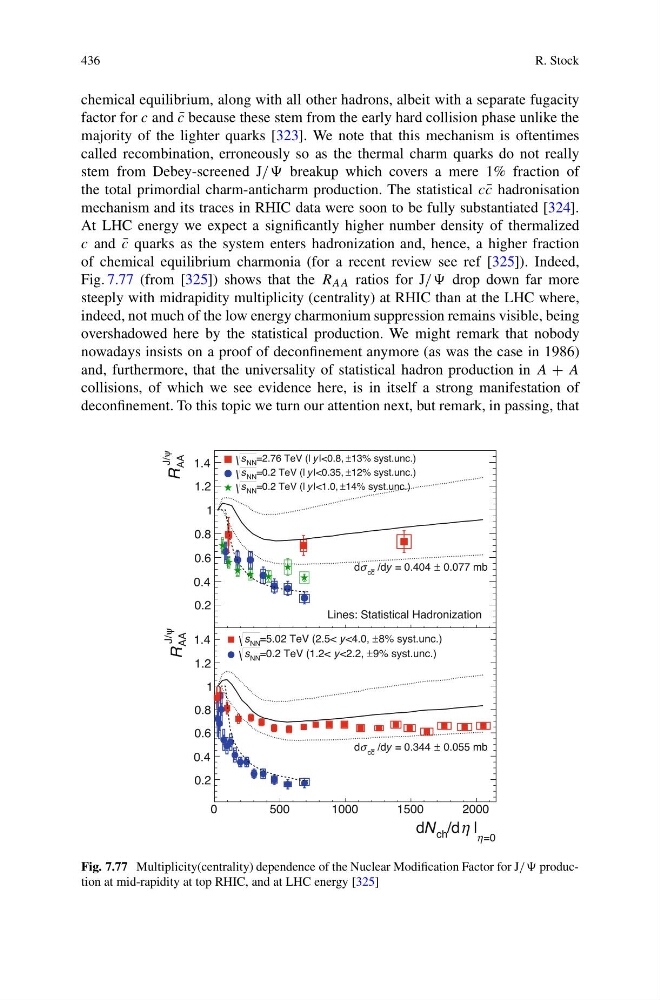
of chemical equilibrium charmonia (for a recent review see ref [325]). Indeed,
Fig. 7.77 (from [325]) shows that the R AA ratios for J// drop down far more
steeply with midrapidity multiplicity (centrality) at RHIC than at the LHC where,
indeed, not much of the low energy charmonium suppression remains visible, being
overshadowed here by the statistical production. We might remark that nobody
nowadays insists on a proof of deconfinement anymore (as was the case in 1986)
and, furthermore, that the universality of statistical hadron production in A + A
collisions, of which we see evidence here, is in itself a strong manifestation of
deconfinement. To this topic we turn our attention next, but remark, in passing, that
Fig. 7.77 Multiplicity(centrality) dependence of the Nuclear Modification Factor for J// production at mid-rapidity at top RHIC, and at LHC energy [325]
R. Stock
chemical equilibrium, along with all other hadrons, albeit with a separate fugacity
factor for c and ¯
c because these stem from the early hard collision phase unlike the
majority of the lighter quarks [323]. We note that this mechanism is oftentimes
called recombination, erroneously so as the thermal charm quarks do not really
stem from Debey-screened J// breakup which covers a mere 1% fraction of
the total primordial charm-anticharm production. The statistical c ¯
c hadronisation
mechanism and its traces in RHIC data were soon to be fully substantiated [324].
At LHC energy we expect a significantly higher number density of thermalized
c and ¯
c quarks as the system enters hadronization and, hence, a higher fraction
of chemical equilibrium charmonia (for a recent review see ref [325]). Indeed,
Fig. 7.77 (from [325]) shows that the R AA ratios for J// drop down far more
steeply with midrapidity multiplicity (centrality) at RHIC than at the LHC where,
indeed, not much of the low energy charmonium suppression remains visible, being
overshadowed here by the statistical production. We might remark that nobody
nowadays insists on a proof of deconfinement anymore (as was the case in 1986)
and, furthermore, that the universality of statistical hadron production in A + A
collisions, of which we see evidence here, is in itself a strong manifestation of
deconfinement. To this topic we turn our attention next, but remark, in passing, that
Fig. 7.77 Multiplicity(centrality) dependence of the Nuclear Modification Factor for J// production at mid-rapidity at top RHIC, and at LHC energy [325]