

418
R. Stock
7.7.4 Bose-Einstein-Correlation
Identical boson pairs exhibit a positive correlation enhancement when
p ij → 0,
an intensity correlation analogous to the historical Hanbury-Brown and Twiss effect
(HBT) of two photon interferometry [286] employed in astrophysics. In nucleusnucleus collisions this is an aspect of the symmetry of the N-pion wave function that
describes pion pairs at the instant of their decoupling from strong interaction. The
momentum space correlation function C(q, K), q = p 1 −p 2 , K =
1
2 (p 1 +p 2 ) is the
Fourier transform of the spatial emission function S(x, K) which can be viewed as
the probability that a meson pair with momentum K is emitted from the space-time
point x in the freezing-out fireball density distribution [96, 287].
The aim of HBT two particle interferometry is to extract from the measured
correlator C(q, K) as much information about S(x, K) as possible. In addition
to the traditional HBT focus on geometrical properties of the source distribution
(“HBT radii”) there occurs information on time and duration of emission, as we have
already employed in Fig. 7.19, illustrating τ f and τ in central Pb+Pb collisions at
top SPS energy [90]. Moreover, even more of dynamical information is accessible
via the effects of collective flow on the emission function. In this respect, the
observations make close contact to the hydrodynamic model freeze-out hypersurface (Sect. 7.3.1) and the contained flow profiles. HBT thus helps to visualize the
end of the collective radial and elliptic flow evolution. This implies that we expect
to gather evidence for the, perhaps, most consequential property of A+A collisions
at high
√
s, namely the primordially imprinted Hubble expansion.
We do not engage here in a detailed exposition of HBT formalism and results as
comprehensive recent reviews are available [96, 287]. Briefly, the measured quantity
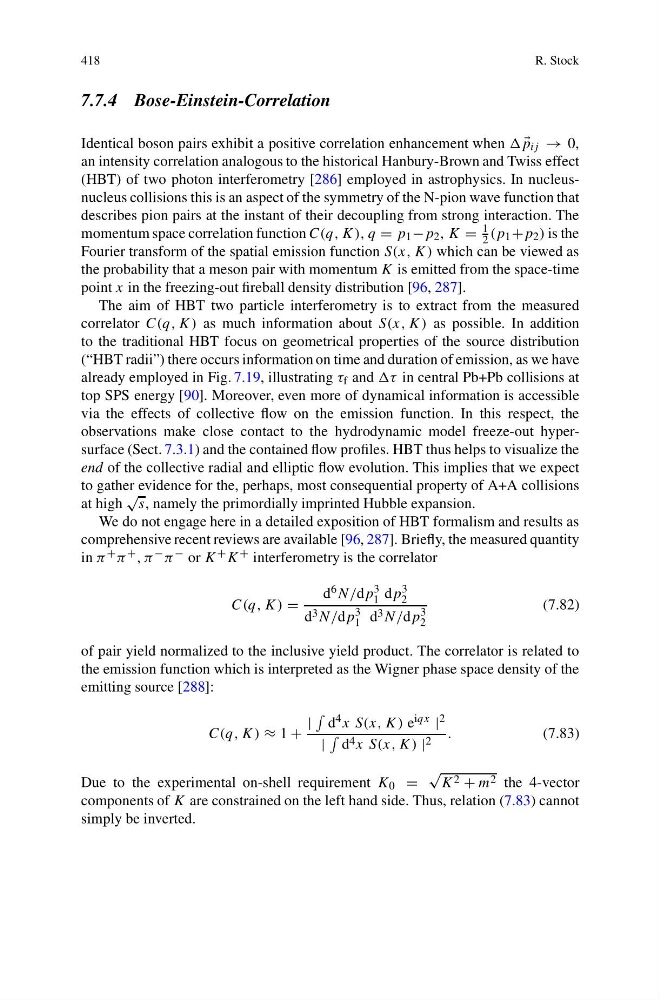
in π + π + , π − π − or K + K + interferometry is the correlator
C(q, K) =
d 6 N/dp 3
1 dp 3
2
d 3 N/dp 3
1 d 3 N/dp 3
2
(7.82)
of pair yield normalized to the inclusive yield product. The correlator is related to
the emission function which is interpreted as the Wigner phase space density of the
emitting source [288]:
C(q, K) ≈ 1 +
|
d 4 x S(x, K) e iqx | 2
|
d 4 x S(x, K) | 2 .
(7.83)
Due to the experimental on-shell requirement K 0 =
√
K 2 + m 2 the 4-vector
components of K are constrained on the left hand side. Thus, relation (7.83) cannot
simply be inverted.
R. Stock
7.7.4 Bose-Einstein-Correlation
Identical boson pairs exhibit a positive correlation enhancement when
p ij → 0,
an intensity correlation analogous to the historical Hanbury-Brown and Twiss effect
(HBT) of two photon interferometry [286] employed in astrophysics. In nucleusnucleus collisions this is an aspect of the symmetry of the N-pion wave function that
describes pion pairs at the instant of their decoupling from strong interaction. The
momentum space correlation function C(q, K), q = p 1 −p 2 , K =
1
2 (p 1 +p 2 ) is the
Fourier transform of the spatial emission function S(x, K) which can be viewed as
the probability that a meson pair with momentum K is emitted from the space-time
point x in the freezing-out fireball density distribution [96, 287].
The aim of HBT two particle interferometry is to extract from the measured
correlator C(q, K) as much information about S(x, K) as possible. In addition
to the traditional HBT focus on geometrical properties of the source distribution
(“HBT radii”) there occurs information on time and duration of emission, as we have
already employed in Fig. 7.19, illustrating τ f and τ in central Pb+Pb collisions at
top SPS energy [90]. Moreover, even more of dynamical information is accessible
via the effects of collective flow on the emission function. In this respect, the
observations make close contact to the hydrodynamic model freeze-out hypersurface (Sect. 7.3.1) and the contained flow profiles. HBT thus helps to visualize the
end of the collective radial and elliptic flow evolution. This implies that we expect
to gather evidence for the, perhaps, most consequential property of A+A collisions
at high
√
s, namely the primordially imprinted Hubble expansion.
We do not engage here in a detailed exposition of HBT formalism and results as
comprehensive recent reviews are available [96, 287]. Briefly, the measured quantity
in π + π + , π − π − or K + K + interferometry is the correlator
C(q, K) =
d 6 N/dp 3
1 dp 3
2
d 3 N/dp 3
1 d 3 N/dp 3
2
(7.82)
of pair yield normalized to the inclusive yield product. The correlator is related to
the emission function which is interpreted as the Wigner phase space density of the
emitting source [288]:
C(q, K) ≈ 1 +
|
d 4 x S(x, K) e iqx | 2
|
d 4 x S(x, K) | 2 .
(7.83)
Due to the experimental on-shell requirement K 0 =
√
K 2 + m 2 the 4-vector
components of K are constrained on the left hand side. Thus, relation (7.83) cannot
simply be inverted.