

7 Relativistic Nucleus-Nucleus Collisions and the QCD Matter Phase Diagram
411
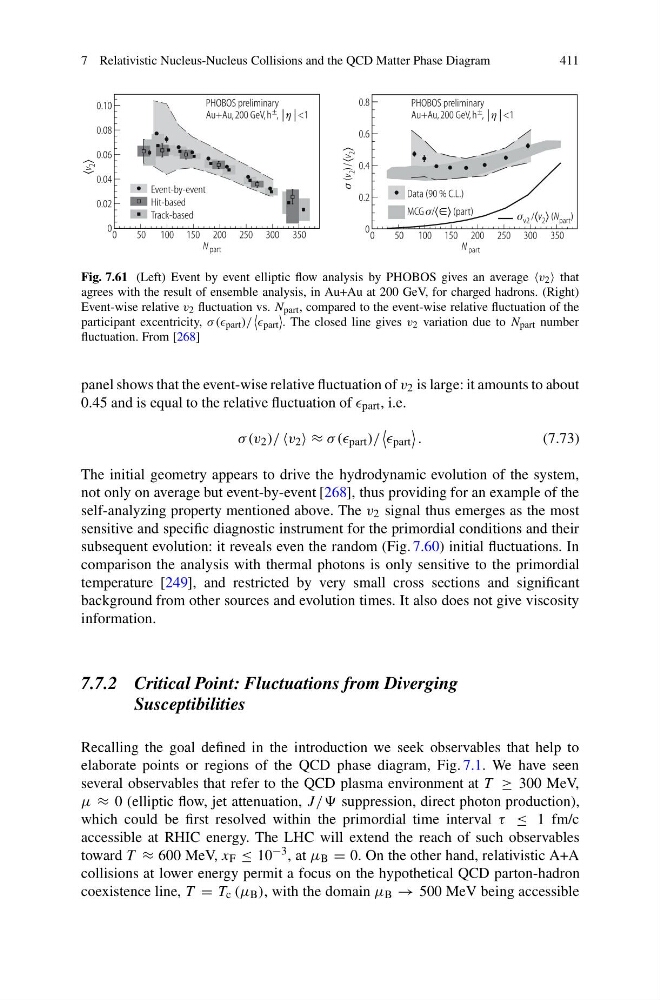
Fig. 7.61 (Left) Event by event elliptic flow analysis by PHOBOS gives an average v 2 that
agrees with the result of ensemble analysis, in Au+Au at 200 GeV, for charged hadrons. (Right)
Event-wise relative v 2 fluctuation vs. N part , compared to the event-wise relative fluctuation of the
participant excentricity, σ (( part )/
part
. The closed line gives v 2 variation due to N part number
fluctuation. From [268]
panel shows that the event-wise relative fluctuation of v 2 is large: it amounts to about
0.45 and is equal to the relative fluctuation of part , i.e.
σ (v 2 )/ v 2 ≈ σ (( part )/
part
.
(7.73)
The initial geometry appears to drive the hydrodynamic evolution of the system,
not only on average but event-by-event [268], thus providing for an example of the
self-analyzing property mentioned above. The v 2 signal thus emerges as the most
sensitive and specific diagnostic instrument for the primordial conditions and their
subsequent evolution: it reveals even the random (Fig. 7.60) initial fluctuations. In
comparison the analysis with thermal photons is only sensitive to the primordial
temperature [249], and restricted by very small cross sections and significant
background from other sources and evolution times. It also does not give viscosity
information.
7.7.2 Critical Point: Fluctuations from Diverging
Susceptibilities
Recalling the goal defined in the introduction we seek observables that help to
elaborate points or regions of the QCD phase diagram, Fig. 7.1. We have seen
several observables that refer to the QCD plasma environment at T ≥ 300 MeV,
μ ≈ 0 (elliptic flow, jet attenuation, J// suppression, direct photon production),
which could be first resolved within the primordial time interval τ ≤ 1 fm/c
accessible at RHIC energy. The LHC will extend the reach of such observables
toward T ≈ 600 MeV, x F ≤ 10 −3 , at μ B = 0. On the other hand, relativistic A+A
collisions at lower energy permit a focus on the hypothetical QCD parton-hadron
coexistence line, T = T c (μ B ), with the domain μ B → 500 MeV being accessible
411
Fig. 7.61 (Left) Event by event elliptic flow analysis by PHOBOS gives an average v 2 that
agrees with the result of ensemble analysis, in Au+Au at 200 GeV, for charged hadrons. (Right)
Event-wise relative v 2 fluctuation vs. N part , compared to the event-wise relative fluctuation of the
participant excentricity, σ (( part )/
part
. The closed line gives v 2 variation due to N part number
fluctuation. From [268]
panel shows that the event-wise relative fluctuation of v 2 is large: it amounts to about
0.45 and is equal to the relative fluctuation of part , i.e.
σ (v 2 )/ v 2 ≈ σ (( part )/
part
.
(7.73)
The initial geometry appears to drive the hydrodynamic evolution of the system,
not only on average but event-by-event [268], thus providing for an example of the
self-analyzing property mentioned above. The v 2 signal thus emerges as the most
sensitive and specific diagnostic instrument for the primordial conditions and their
subsequent evolution: it reveals even the random (Fig. 7.60) initial fluctuations. In
comparison the analysis with thermal photons is only sensitive to the primordial
temperature [249], and restricted by very small cross sections and significant
background from other sources and evolution times. It also does not give viscosity
information.
7.7.2 Critical Point: Fluctuations from Diverging
Susceptibilities
Recalling the goal defined in the introduction we seek observables that help to
elaborate points or regions of the QCD phase diagram, Fig. 7.1. We have seen
several observables that refer to the QCD plasma environment at T ≥ 300 MeV,
μ ≈ 0 (elliptic flow, jet attenuation, J// suppression, direct photon production),
which could be first resolved within the primordial time interval τ ≤ 1 fm/c
accessible at RHIC energy. The LHC will extend the reach of such observables
toward T ≈ 600 MeV, x F ≤ 10 −3 , at μ B = 0. On the other hand, relativistic A+A
collisions at lower energy permit a focus on the hypothetical QCD parton-hadron
coexistence line, T = T c (μ B ), with the domain μ B → 500 MeV being accessible