

410
R. Stock
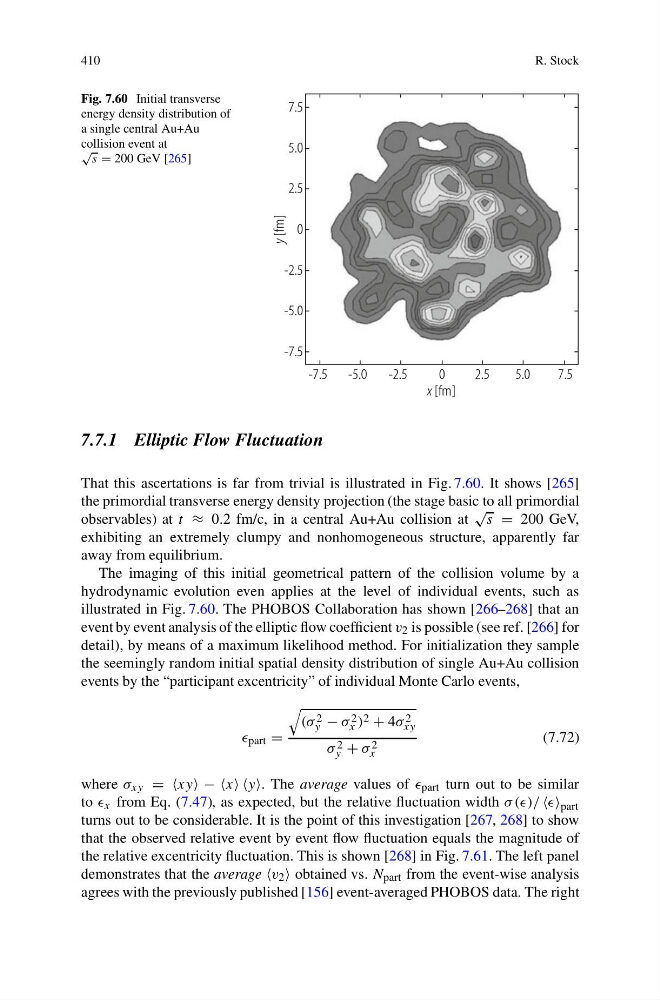
Fig. 7.60 Initial transverse
energy density distribution of
a single central Au+Au
collision event at
√
s = 200 GeV [265]
7.7.1 Elliptic Flow Fluctuation
That this ascertations is far from trivial is illustrated in Fig. 7.60. It shows [265]
the primordial transverse energy density projection (the stage basic to all primordial
observables) at t ≈ 0.2 fm/c, in a central Au+Au collision at
√
s = 200 GeV,
exhibiting an extremely clumpy and nonhomogeneous structure, apparently far
away from equilibrium.
The imaging of this initial geometrical pattern of the collision volume by a
hydrodynamic evolution even applies at the level of individual events, such as
illustrated in Fig. 7.60. The PHOBOS Collaboration has shown [266–268] that an
event by event analysis of the elliptic flow coefficient v 2 is possible (see ref. [266] for
detail), by means of a maximum likelihood method. For initialization they sample
the seemingly random initial spatial density distribution of single Au+Au collision
events by the “participant excentricity” of individual Monte Carlo events,
part =
(σ 2
y − σ 2
x ) 2 + 4σ 2
xy
σ 2
y + σ 2
x
(7.72)
where σ xy = xy − x The average values of part turn out to be similar
to x from Eq. (7.47), as expected, but the relative fluctuation width σ (()/ part
turns out to be considerable. It is the point of this investigation [267, 268] to show
that the observed relative event by event flow fluctuation equals the magnitude of
the relative excentricity fluctuation. This is shown [268] in Fig. 7.61. The left panel
demonstrates that the average v 2 obtained vs. N part from the event-wise analysis
agrees with the previously published [156] event-averaged PHOBOS data. The right
R. Stock
Fig. 7.60 Initial transverse
energy density distribution of
a single central Au+Au
collision event at
√
s = 200 GeV [265]
7.7.1 Elliptic Flow Fluctuation
That this ascertations is far from trivial is illustrated in Fig. 7.60. It shows [265]
the primordial transverse energy density projection (the stage basic to all primordial
observables) at t ≈ 0.2 fm/c, in a central Au+Au collision at
√
s = 200 GeV,
exhibiting an extremely clumpy and nonhomogeneous structure, apparently far
away from equilibrium.
The imaging of this initial geometrical pattern of the collision volume by a
hydrodynamic evolution even applies at the level of individual events, such as
illustrated in Fig. 7.60. The PHOBOS Collaboration has shown [266–268] that an
event by event analysis of the elliptic flow coefficient v 2 is possible (see ref. [266] for
detail), by means of a maximum likelihood method. For initialization they sample
the seemingly random initial spatial density distribution of single Au+Au collision
events by the “participant excentricity” of individual Monte Carlo events,
part =
(σ 2
y − σ 2
x ) 2 + 4σ 2
xy
σ 2
y + σ 2
x
(7.72)
where σ xy = xy − x The average values of part turn out to be similar
to x from Eq. (7.47), as expected, but the relative fluctuation width σ (()/ part
turns out to be considerable. It is the point of this investigation [267, 268] to show
that the observed relative event by event flow fluctuation equals the magnitude of
the relative excentricity fluctuation. This is shown [268] in Fig. 7.61. The left panel
demonstrates that the average v 2 obtained vs. N part from the event-wise analysis
agrees with the previously published [156] event-averaged PHOBOS data. The right