

7 Relativistic Nucleus-Nucleus Collisions and the QCD Matter Phase Diagram
407
π + π − annihilation to dileptons. The latter contribution accounts for the most
obvious deviation between cocktail and data at 0.3 ≤ m ll ≤ 0.7 GeV in Fig. 7.58
(left panel).
The right hand panel of Fig. 7.58 shows the results of various theoretical models
which address the sources of the significant dilepton excess over hadronic (in
vacuum) and Drell-Yan cocktails, labeled “Rapp-Wambach” [133, 135], “dropping
mass” (Brown-Rho [134]) and “Kaempfer” [252]. We shall return to these models
below but note, for now, that the extra yield in central A+A collisions chiefly
derives from π + π − annihilation via the (in medium modified) resonance, and
from modification of the peak itself.
With improved statistics and background control, the A+A specific extra dilepton
yield below M ≈ 1.4 GeV/c 2 can be represented by itself, after cocktail subtraction.
This has been first accomplished by NA60 [136, 253] and, more recently, also by
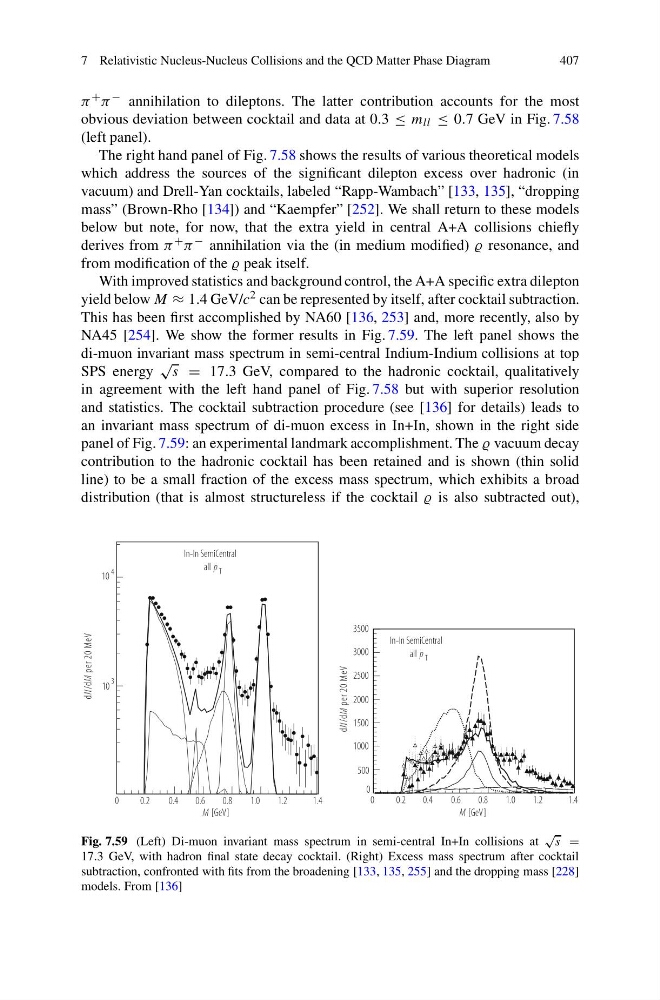
NA45 [254]. We show the former results in Fig. 7.59. The left panel shows the
di-muon invariant mass spectrum in semi-central Indium-Indium collisions at top
SPS energy
√
s = 17.3 GeV, compared to the hadronic cocktail, qualitatively
in agreement with the left hand panel of Fig. 7.58 but with superior resolution
and statistics. The cocktail subtraction procedure (see [136] for details) leads to
an invariant mass spectrum of di-muon excess in In+In, shown in the right side
panel of Fig. 7.59: an experimental landmark accomplishment. The vacuum decay
contribution to the hadronic cocktail has been retained and is shown (thin solid
line) to be a small fraction of the excess mass spectrum, which exhibits a broad
distribution (that is almost structureless if the cocktail is also subtracted out),
0
0.2
0.4
0.6
0.8
1.0
1.2
1.4
3
10
4
10
In-In SemiCentral
T
all p
V
e
M
0
2
r
e
p
d
/
d
M
N
M [GeV]
0
500
1000
1500
2000
2500
3000
3500
0
0.2
0.4
0.6
0.8
1.0
1.2
1.4
In-In SemiCentral
T
all p
V
e
M
0
2
r
e
p
d
/
d
M
N
M [GeV]
Fig. 7.59 (Left) Di-muon invariant mass spectrum in semi-central In+In collisions at
√
s =
17.3 GeV, with hadron final state decay cocktail. (Right) Excess mass spectrum after cocktail
subtraction, confronted with fits from the broadening [133, 135, 255] and the dropping mass [228]
models. From [136]
407
π + π − annihilation to dileptons. The latter contribution accounts for the most
obvious deviation between cocktail and data at 0.3 ≤ m ll ≤ 0.7 GeV in Fig. 7.58
(left panel).
The right hand panel of Fig. 7.58 shows the results of various theoretical models
which address the sources of the significant dilepton excess over hadronic (in
vacuum) and Drell-Yan cocktails, labeled “Rapp-Wambach” [133, 135], “dropping
mass” (Brown-Rho [134]) and “Kaempfer” [252]. We shall return to these models
below but note, for now, that the extra yield in central A+A collisions chiefly
derives from π + π − annihilation via the (in medium modified) resonance, and
from modification of the peak itself.
With improved statistics and background control, the A+A specific extra dilepton
yield below M ≈ 1.4 GeV/c 2 can be represented by itself, after cocktail subtraction.
This has been first accomplished by NA60 [136, 253] and, more recently, also by
NA45 [254]. We show the former results in Fig. 7.59. The left panel shows the
di-muon invariant mass spectrum in semi-central Indium-Indium collisions at top
SPS energy
√
s = 17.3 GeV, compared to the hadronic cocktail, qualitatively
in agreement with the left hand panel of Fig. 7.58 but with superior resolution
and statistics. The cocktail subtraction procedure (see [136] for details) leads to
an invariant mass spectrum of di-muon excess in In+In, shown in the right side
panel of Fig. 7.59: an experimental landmark accomplishment. The vacuum decay
contribution to the hadronic cocktail has been retained and is shown (thin solid
line) to be a small fraction of the excess mass spectrum, which exhibits a broad
distribution (that is almost structureless if the cocktail is also subtracted out),
0
0.2
0.4
0.6
0.8
1.0
1.2
1.4
3
10
4
10
In-In SemiCentral
T
all p
V
e
M
0
2
r
e
p
d
/
d
M
N
M [GeV]
0
500
1000
1500
2000
2500
3000
3500
0
0.2
0.4
0.6
0.8
1.0
1.2
1.4
In-In SemiCentral
T
all p
V
e
M
0
2
r
e
p
d
/
d
M
N
M [GeV]
Fig. 7.59 (Left) Di-muon invariant mass spectrum in semi-central In+In collisions at
√
s =
17.3 GeV, with hadron final state decay cocktail. (Right) Excess mass spectrum after cocktail
subtraction, confronted with fits from the broadening [133, 135, 255] and the dropping mass [228]
models. From [136]