

406
R. Stock
0 0.2 0.4 0.6 0.8 1.0 1.2 1.4 1.6 1.8
10
-8
10
-7
10
-6
10
-5
10
-4
1
-
]
2
>
c
/
V
e
M
0
0
1
[
h
c
<
>/
N
e
e
d
/
m
e
e
<
dN
]
2
[GeV/c
ee
m
CERES/NA45 Pb-Au 158 GeV
A
7 %
tot
s
/
trig
s
>200 MeV/c
t
p
Preliminary
>35 mrad
ee
<2.65
2.1<
ee
0
e
e
0
e e
ee
e
e
e
e
e
e
‘
Rapp-Wambach
dropping mass
Kaempfer
0 0.2 0.4 0.6 0.8 1.0 1.2 1.4 1.6 1.8
10
-8
10
-7
10
-6
10
-5
10
-4
1
-
]
2
>
c
/
V
e
M 0
0
1
[ h
c
<
>/
N e
e
d
/
m e
e
<
dN
]
2
[GeV/c
ee
m
CERES/NA45 Pb-Au 158 GeV
A
7 %
tot
s
/
trig
s
>200 MeV/c
t
p
Preliminary
>35 mrad
ee
<2.65
2.1<
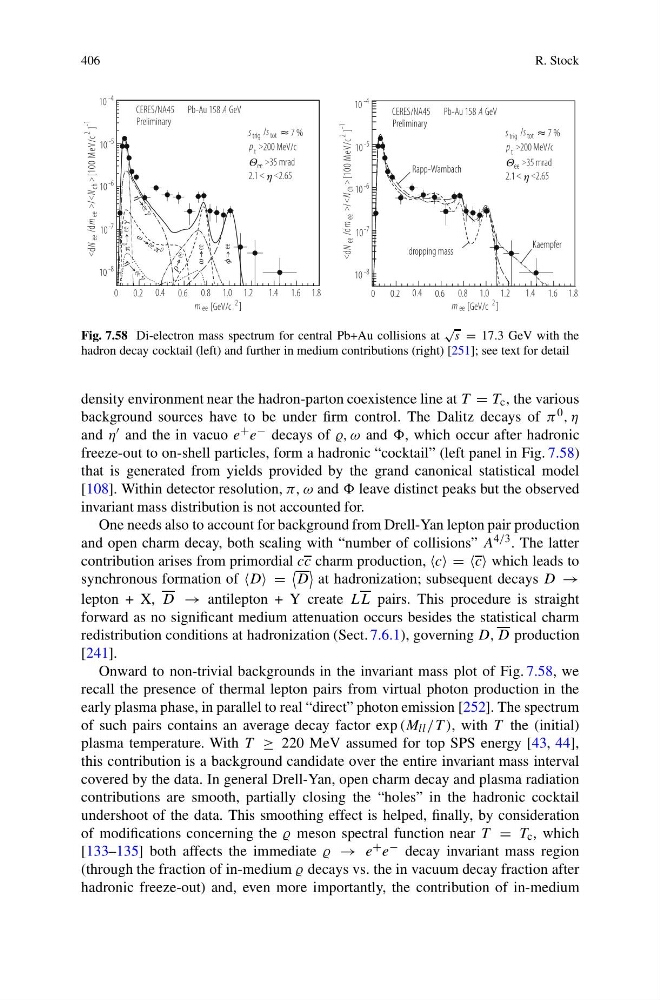
Fig. 7.58 Di-electron mass spectrum for central Pb+Au collisions at
√
s = 17.3 GeV with the
hadron decay cocktail (left) and further in medium contributions (right) [251]; see text for detail
density environment near the hadron-parton coexistence line at T = T c , the various
background sources have to be under firm control. The Dalitz decays of π 0 , η
and η and the in vacuo e + e − decays of , ω and , which occur after hadronic
freeze-out to on-shell particles, form a hadronic “cocktail” (left panel in Fig. 7.58)
that is generated from yields provided by the grand canonical statistical model
[108]. Within detector resolution, π, ω and leave distinct peaks but the observed
invariant mass distribution is not accounted for.
One needs also to account for background from Drell-Yan lepton pair production
and open charm decay, both scaling with “number of collisions” A 4/3 . The latter
contribution arises from primordial cc charm production, c = c which leads to
synchronous formation of D =
D
at hadronization; subsequent decays D →
lepton + X, D → antilepton + Y create LL pairs. This procedure is straight
forward as no significant medium attenuation occurs besides the statistical charm
redistribution conditions at hadronization (Sect. 7.6.1), governing D, D production
[241].
Onward to non-trivial backgrounds in the invariant mass plot of Fig. 7.58, we
recall the presence of thermal lepton pairs from virtual photon production in the
early plasma phase, in parallel to real “direct” photon emission [252]. The spectrum
of such pairs contains an average decay factor exp (M ll /T ), with T the (initial)
plasma temperature. With T ≥ 220 MeV assumed for top SPS energy [43, 44],
this contribution is a background candidate over the entire invariant mass interval
covered by the data. In general Drell-Yan, open charm decay and plasma radiation
contributions are smooth, partially closing the “holes” in the hadronic cocktail
undershoot of the data. This smoothing effect is helped, finally, by consideration
of modifications concerning the meson spectral function near T = T c , which
[133–135] both affects the immediate → e + e − decay invariant mass region
(through the fraction of in-medium decays vs. the in vacuum decay fraction after
hadronic freeze-out) and, even more importantly, the contribution of in-medium
R. Stock
0 0.2 0.4 0.6 0.8 1.0 1.2 1.4 1.6 1.8
10
-8
10
-7
10
-6
10
-5
10
-4
1
-
]
2
>
c
/
V
e
M
0
0
1
[
h
c
<
>/
N
e
e
d
/
m
e
e
<
dN
]
2
[GeV/c
ee
m
CERES/NA45 Pb-Au 158 GeV
A
7 %
tot
s
/
trig
s
>200 MeV/c
t
p
Preliminary
>35 mrad
ee
<2.65
2.1<
ee
0
e
e
0
e e
ee
e
e
e
e
e
e
‘
Rapp-Wambach
dropping mass
Kaempfer
0 0.2 0.4 0.6 0.8 1.0 1.2 1.4 1.6 1.8
10
-8
10
-7
10
-6
10
-5
10
-4
1
-
]
2
>
c
/
V
e
M 0
0
1
[ h
c
<
>/
N e
e
d
/
m e
e
<
dN
]
2
[GeV/c
ee
m
CERES/NA45 Pb-Au 158 GeV
A
7 %
tot
s
/
trig
s
>200 MeV/c
t
p
Preliminary
>35 mrad
ee
<2.65
2.1<
Fig. 7.58 Di-electron mass spectrum for central Pb+Au collisions at
√
s = 17.3 GeV with the
hadron decay cocktail (left) and further in medium contributions (right) [251]; see text for detail
density environment near the hadron-parton coexistence line at T = T c , the various
background sources have to be under firm control. The Dalitz decays of π 0 , η
and η and the in vacuo e + e − decays of , ω and , which occur after hadronic
freeze-out to on-shell particles, form a hadronic “cocktail” (left panel in Fig. 7.58)
that is generated from yields provided by the grand canonical statistical model
[108]. Within detector resolution, π, ω and leave distinct peaks but the observed
invariant mass distribution is not accounted for.
One needs also to account for background from Drell-Yan lepton pair production
and open charm decay, both scaling with “number of collisions” A 4/3 . The latter
contribution arises from primordial cc charm production, c = c which leads to
synchronous formation of D =
D
at hadronization; subsequent decays D →
lepton + X, D → antilepton + Y create LL pairs. This procedure is straight
forward as no significant medium attenuation occurs besides the statistical charm
redistribution conditions at hadronization (Sect. 7.6.1), governing D, D production
[241].
Onward to non-trivial backgrounds in the invariant mass plot of Fig. 7.58, we
recall the presence of thermal lepton pairs from virtual photon production in the
early plasma phase, in parallel to real “direct” photon emission [252]. The spectrum
of such pairs contains an average decay factor exp (M ll /T ), with T the (initial)
plasma temperature. With T ≥ 220 MeV assumed for top SPS energy [43, 44],
this contribution is a background candidate over the entire invariant mass interval
covered by the data. In general Drell-Yan, open charm decay and plasma radiation
contributions are smooth, partially closing the “holes” in the hadronic cocktail
undershoot of the data. This smoothing effect is helped, finally, by consideration
of modifications concerning the meson spectral function near T = T c , which
[133–135] both affects the immediate → e + e − decay invariant mass region
(through the fraction of in-medium decays vs. the in vacuum decay fraction after
hadronic freeze-out) and, even more importantly, the contribution of in-medium