

7 Relativistic Nucleus-Nucleus Collisions and the QCD Matter Phase Diagram
401
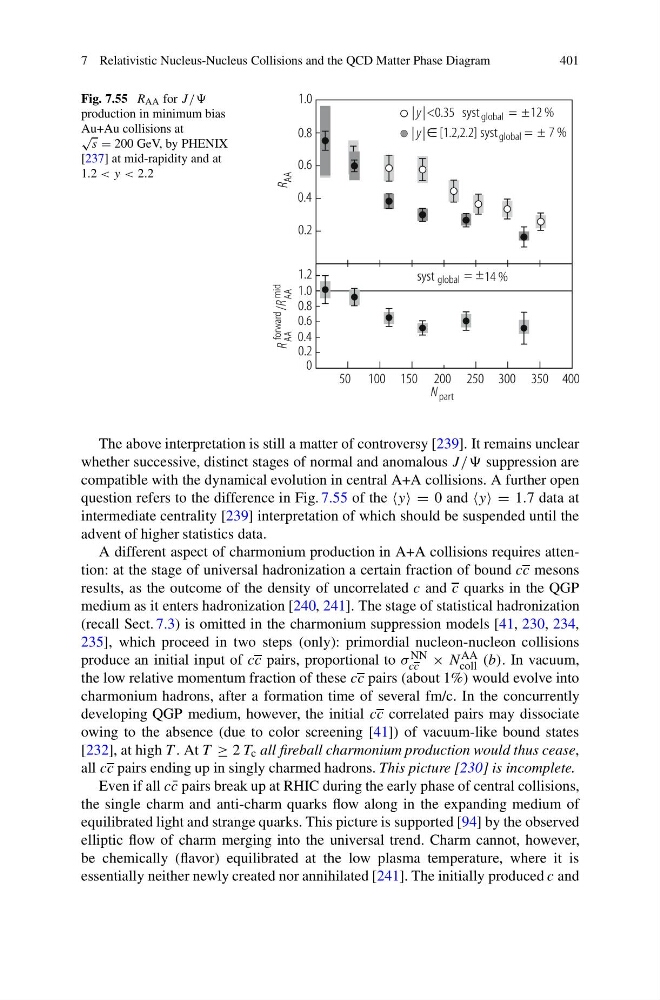
Fig. 7.55 R AA for J //
production in minimum bias
Au+Au collisions at
√
s = 200 GeV, by PHENIX
[237] at mid-rapidity and at
1.2 < y < 2.2
The above interpretation is still a matter of controversy [239]. It remains unclear
whether successive, distinct stages of normal and anomalous J// suppression are
compatible with the dynamical evolution in central A+A collisions. A further open
question refers to the difference in Fig. 7.55 of the y = 0 and y = 1.7 data at
intermediate centrality [239] interpretation of which should be suspended until the
advent of higher statistics data.
A different aspect of charmonium production in A+A collisions requires attention: at the stage of universal hadronization a certain fraction of bound cc mesons
results, as the outcome of the density of uncorrelated c and c quarks in the QGP
medium as it enters hadronization [240, 241]. The stage of statistical hadronization
(recall Sect. 7.3) is omitted in the charmonium suppression models [41, 230, 234,
235], which proceed in two steps (only): primordial nucleon-nucleon collisions
produce an initial input of cc pairs, proportional to σ NN
cc × N AA
coll (b). In vacuum,
the low relative momentum fraction of these cc pairs (about 1%) would evolve into
charmonium hadrons, after a formation time of several fm/c. In the concurrently
developing QGP medium, however, the initial cc correlated pairs may dissociate
owing to the absence (due to color screening [41]) of vacuum-like bound states
[232], at high T . At T ≥ 2 T c all fireball charmonium production would thus cease,
all cc pairs ending up in singly charmed hadrons. This picture [230] is incomplete.
Even if all c ¯
c pairs break up at RHIC during the early phase of central collisions,
the single charm and anti-charm quarks flow along in the expanding medium of
equilibrated light and strange quarks. This picture is supported [94] by the observed
elliptic flow of charm merging into the universal trend. Charm cannot, however,
be chemically (flavor) equilibrated at the low plasma temperature, where it is
essentially neither newly created nor annihilated [241]. The initially produced c and
401
Fig. 7.55 R AA for J //
production in minimum bias
Au+Au collisions at
√
s = 200 GeV, by PHENIX
[237] at mid-rapidity and at
1.2 < y < 2.2
The above interpretation is still a matter of controversy [239]. It remains unclear
whether successive, distinct stages of normal and anomalous J// suppression are
compatible with the dynamical evolution in central A+A collisions. A further open
question refers to the difference in Fig. 7.55 of the y = 0 and y = 1.7 data at
intermediate centrality [239] interpretation of which should be suspended until the
advent of higher statistics data.
A different aspect of charmonium production in A+A collisions requires attention: at the stage of universal hadronization a certain fraction of bound cc mesons
results, as the outcome of the density of uncorrelated c and c quarks in the QGP
medium as it enters hadronization [240, 241]. The stage of statistical hadronization
(recall Sect. 7.3) is omitted in the charmonium suppression models [41, 230, 234,
235], which proceed in two steps (only): primordial nucleon-nucleon collisions
produce an initial input of cc pairs, proportional to σ NN
cc × N AA
coll (b). In vacuum,
the low relative momentum fraction of these cc pairs (about 1%) would evolve into
charmonium hadrons, after a formation time of several fm/c. In the concurrently
developing QGP medium, however, the initial cc correlated pairs may dissociate
owing to the absence (due to color screening [41]) of vacuum-like bound states
[232], at high T . At T ≥ 2 T c all fireball charmonium production would thus cease,
all cc pairs ending up in singly charmed hadrons. This picture [230] is incomplete.
Even if all c ¯
c pairs break up at RHIC during the early phase of central collisions,
the single charm and anti-charm quarks flow along in the expanding medium of
equilibrated light and strange quarks. This picture is supported [94] by the observed
elliptic flow of charm merging into the universal trend. Charm cannot, however,
be chemically (flavor) equilibrated at the low plasma temperature, where it is
essentially neither newly created nor annihilated [241]. The initially produced c and