

400
R. Stock
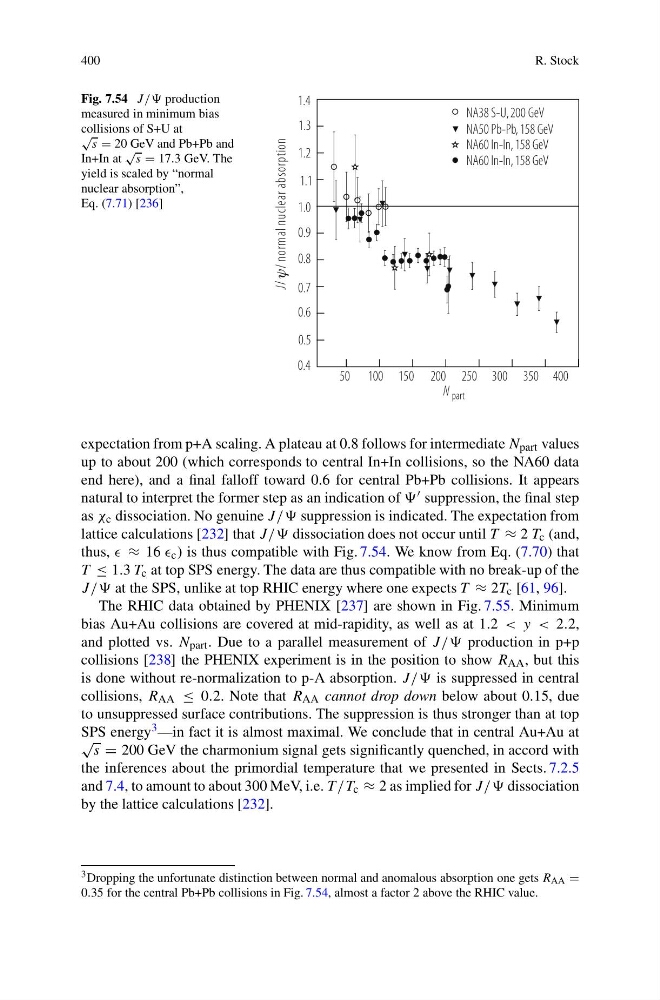
Fig. 7.54 J // production
measured in minimum bias
collisions of S+U at
√
s = 20 GeV and Pb+Pb and
In+In at
√
s = 17.3 GeV. The
yield is scaled by “normal
nuclear absorption”,
Eq. (7.71) [236]
N part
50 100 150 200 250 300 350 400
n
o
i t
p
r
o
s
b
a
r
a
e
l
c
u
n
l
a
m
r
o
n
/
/
J
0.4
0.5
0.6
0.7
0.8
0.9
1.0
1.1
1.2
1.3
1.4
NA38 S-U, 200 GeV
NA50 Pb-Pb, 158 GeV
NA60 In-In, 158 GeV
NA60 In-In, 158 GeV
expectation from p+A scaling. A plateau at 0.8 follows for intermediate N part values
up to about 200 (which corresponds to central In+In collisions, so the NA60 data
end here), and a final falloff toward 0.6 for central Pb+Pb collisions. It appears
natural to interpret the former step as an indication of suppression, the final step
as χ c dissociation. No genuine J// suppression is indicated. The expectation from
lattice calculations [232] that J// dissociation does not occur until T ≈ 2 T c (and,
thus, ≈ 16 c ) is thus compatible with Fig. 7.54. We know from Eq. (7.70) that
T ≤ 1.3 T c at top SPS energy. The data are thus compatible with no break-up of the
J// at the SPS, unlike at top RHIC energy where one expects T ≈ 2T c [61, 96].
The RHIC data obtained by PHENIX [237] are shown in Fig. 7.55. Minimum
bias Au+Au collisions are covered at mid-rapidity, as well as at 1.2 < y < 2.2,
and plotted vs. N part . Due to a parallel measurement of J// production in p+p
collisions [238] the PHENIX experiment is in the position to show R AA , but this
is done without re-normalization to p-A absorption. J// is suppressed in central
collisions, R AA ≤ 0.2. Note that R AA cannot drop down below about 0.15, due
to unsuppressed surface contributions. The suppression is thus stronger than at top
SPS energy 3 —in fact it is almost maximal. We conclude that in central Au+Au at
√
s = 200 GeV the charmonium signal gets significantly quenched, in accord with
the inferences about the primordial temperature that we presented in Sects. 7.2.5
and 7.4, to amount to about 300 MeV, i.e. T /T c ≈ 2 as implied for J// dissociation
by the lattice calculations [232].
3 Dropping the unfortunate distinction between normal and anomalous absorption one gets R AA =
0.35 for the central Pb+Pb collisions in Fig. 7.54, almost a factor 2 above the RHIC value.
R. Stock
Fig. 7.54 J // production
measured in minimum bias
collisions of S+U at
√
s = 20 GeV and Pb+Pb and
In+In at
√
s = 17.3 GeV. The
yield is scaled by “normal
nuclear absorption”,
Eq. (7.71) [236]
N part
50 100 150 200 250 300 350 400
n
o
i t
p
r
o
s
b
a
r
a
e
l
c
u
n
l
a
m
r
o
n
/
/
J
0.4
0.5
0.6
0.7
0.8
0.9
1.0
1.1
1.2
1.3
1.4
NA38 S-U, 200 GeV
NA50 Pb-Pb, 158 GeV
NA60 In-In, 158 GeV
NA60 In-In, 158 GeV
expectation from p+A scaling. A plateau at 0.8 follows for intermediate N part values
up to about 200 (which corresponds to central In+In collisions, so the NA60 data
end here), and a final falloff toward 0.6 for central Pb+Pb collisions. It appears
natural to interpret the former step as an indication of suppression, the final step
as χ c dissociation. No genuine J// suppression is indicated. The expectation from
lattice calculations [232] that J// dissociation does not occur until T ≈ 2 T c (and,
thus, ≈ 16 c ) is thus compatible with Fig. 7.54. We know from Eq. (7.70) that
T ≤ 1.3 T c at top SPS energy. The data are thus compatible with no break-up of the
J// at the SPS, unlike at top RHIC energy where one expects T ≈ 2T c [61, 96].
The RHIC data obtained by PHENIX [237] are shown in Fig. 7.55. Minimum
bias Au+Au collisions are covered at mid-rapidity, as well as at 1.2 < y < 2.2,
and plotted vs. N part . Due to a parallel measurement of J// production in p+p
collisions [238] the PHENIX experiment is in the position to show R AA , but this
is done without re-normalization to p-A absorption. J// is suppressed in central
collisions, R AA ≤ 0.2. Note that R AA cannot drop down below about 0.15, due
to unsuppressed surface contributions. The suppression is thus stronger than at top
SPS energy 3 —in fact it is almost maximal. We conclude that in central Au+Au at
√
s = 200 GeV the charmonium signal gets significantly quenched, in accord with
the inferences about the primordial temperature that we presented in Sects. 7.2.5
and 7.4, to amount to about 300 MeV, i.e. T /T c ≈ 2 as implied for J// dissociation
by the lattice calculations [232].
3 Dropping the unfortunate distinction between normal and anomalous absorption one gets R AA =
0.35 for the central Pb+Pb collisions in Fig. 7.54, almost a factor 2 above the RHIC value.