

396
R. Stock
[rad]
-1
0
2
4
d
/
dN h
c
/
1
N
Au+Au Central 5%
g
i
r
t
3
2
1
0
STAR Preliminary
[rad]
-1
0
2
4
1
3
0.07
0.06
0.05
0.04
0.03
0.02
0.01
0
-0.01
J ( )
2.5 - 4 GeV/c 2 - 3 GeV/c, all charge
×
Centrality: 0 - 10%
Centrality: 30 - 40% 0.33
Centrality: 60 - 92% 0.048
×
×
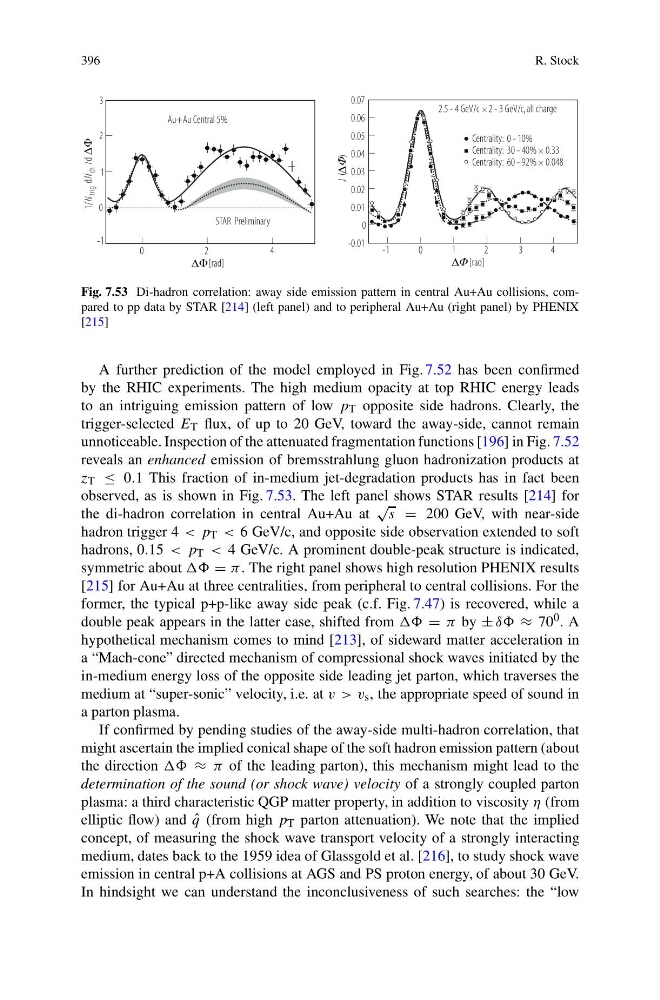
Fig. 7.53 Di-hadron correlation: away side emission pattern in central Au+Au collisions, compared to pp data by STAR [214] (left panel) and to peripheral Au+Au (right panel) by PHENIX
[215]
A further prediction of the model employed in Fig. 7.52 has been confirmed
by the RHIC experiments. The high medium opacity at top RHIC energy leads
to an intriguing emission pattern of low p T opposite side hadrons. Clearly, the
trigger-selected E T flux, of up to 20 GeV, toward the away-side, cannot remain
unnoticeable. Inspection of the attenuated fragmentation functions [196] in Fig. 7.52
reveals an enhanced emission of bremsstrahlung gluon hadronization products at
z T ≤ 0.1 This fraction of in-medium jet-degradation products has in fact been
observed, as is shown in Fig. 7.53. The left panel shows STAR results [214] for
the di-hadron correlation in central Au+Au at
√
s = 200 GeV, with near-side
hadron trigger 4 < p T < 6 GeV/c, and opposite side observation extended to soft
hadrons, 0.15 < p T < 4 GeV/c. A prominent double-peak structure is indicated,
symmetric about = π. The right panel shows high resolution PHENIX results
[215] for Au+Au at three centralities, from peripheral to central collisions. For the
former, the typical p+p-like away side peak (c.f. Fig. 7.47) is recovered, while a
double peak appears in the latter case, shifted from = π by ± δδ ≈ 70 0 . A
hypothetical mechanism comes to mind [213], of sideward matter acceleration in
a “Mach-cone” directed mechanism of compressional shock waves initiated by the
in-medium energy loss of the opposite side leading jet parton, which traverses the
medium at “super-sonic” velocity, i.e. at v > v s , the appropriate speed of sound in
a parton plasma.
If confirmed by pending studies of the away-side multi-hadron correlation, that
might ascertain the implied conical shape of the soft hadron emission pattern (about
the direction ≈ π of the leading parton), this mechanism might lead to the
determination of the sound (or shock wave) velocity of a strongly coupled parton
plasma: a third characteristic QGP matter property, in addition to viscosity η (from
elliptic flow) and ˆ
q (from high p T parton attenuation). We note that the implied
concept, of measuring the shock wave transport velocity of a strongly interacting
medium, dates back to the 1959 idea of Glassgold et al. [216], to study shock wave
emission in central p+A collisions at AGS and PS proton energy, of about 30 GeV.
In hindsight we can understand the inconclusiveness of such searches: the “low
R. Stock
[rad]
-1
0
2
4
d
/
dN h
c
/
1
N
Au+Au Central 5%
g
i
r
t
3
2
1
0
STAR Preliminary
[rad]
-1
0
2
4
1
3
0.07
0.06
0.05
0.04
0.03
0.02
0.01
0
-0.01
J ( )
2.5 - 4 GeV/c 2 - 3 GeV/c, all charge
×
Centrality: 0 - 10%
Centrality: 30 - 40% 0.33
Centrality: 60 - 92% 0.048
×
×
Fig. 7.53 Di-hadron correlation: away side emission pattern in central Au+Au collisions, compared to pp data by STAR [214] (left panel) and to peripheral Au+Au (right panel) by PHENIX
[215]
A further prediction of the model employed in Fig. 7.52 has been confirmed
by the RHIC experiments. The high medium opacity at top RHIC energy leads
to an intriguing emission pattern of low p T opposite side hadrons. Clearly, the
trigger-selected E T flux, of up to 20 GeV, toward the away-side, cannot remain
unnoticeable. Inspection of the attenuated fragmentation functions [196] in Fig. 7.52
reveals an enhanced emission of bremsstrahlung gluon hadronization products at
z T ≤ 0.1 This fraction of in-medium jet-degradation products has in fact been
observed, as is shown in Fig. 7.53. The left panel shows STAR results [214] for
the di-hadron correlation in central Au+Au at
√
s = 200 GeV, with near-side
hadron trigger 4 < p T < 6 GeV/c, and opposite side observation extended to soft
hadrons, 0.15 < p T < 4 GeV/c. A prominent double-peak structure is indicated,
symmetric about = π. The right panel shows high resolution PHENIX results
[215] for Au+Au at three centralities, from peripheral to central collisions. For the
former, the typical p+p-like away side peak (c.f. Fig. 7.47) is recovered, while a
double peak appears in the latter case, shifted from = π by ± δδ ≈ 70 0 . A
hypothetical mechanism comes to mind [213], of sideward matter acceleration in
a “Mach-cone” directed mechanism of compressional shock waves initiated by the
in-medium energy loss of the opposite side leading jet parton, which traverses the
medium at “super-sonic” velocity, i.e. at v > v s , the appropriate speed of sound in
a parton plasma.
If confirmed by pending studies of the away-side multi-hadron correlation, that
might ascertain the implied conical shape of the soft hadron emission pattern (about
the direction ≈ π of the leading parton), this mechanism might lead to the
determination of the sound (or shock wave) velocity of a strongly coupled parton
plasma: a third characteristic QGP matter property, in addition to viscosity η (from
elliptic flow) and ˆ
q (from high p T parton attenuation). We note that the implied
concept, of measuring the shock wave transport velocity of a strongly interacting
medium, dates back to the 1959 idea of Glassgold et al. [216], to study shock wave
emission in central p+A collisions at AGS and PS proton energy, of about 30 GeV.
In hindsight we can understand the inconclusiveness of such searches: the “low