

7 Relativistic Nucleus-Nucleus Collisions and the QCD Matter Phase Diagram
395
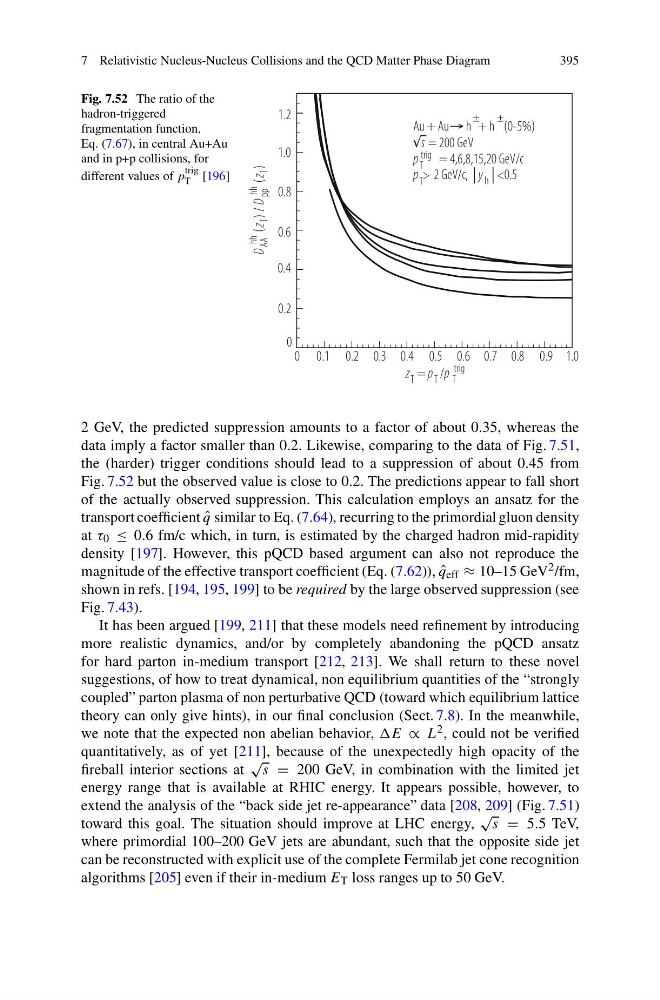
Fig. 7.52 The ratio of the
hadron-triggered
fragmentation function,
Eq. (7.67), in central Au+Au
and in p+p collisions, for
different values of p
trig
T [196]
0
0.2
0.4
0.6
0.8
1.0
1.2
0 0.1 0.2 0.3 0.4 0.5 0.6 0.7 0.8 0.9 1.0
z p p
T
T T
trig
= /
z
D
z
D A
A
hh T p
p
hh T
)
(
/
)
(
Au + Au h + h (0-5%)
= 200 GeV
= 4,6,8,15,20 GeV/c
2 GeV/c,
0.5
±
±
T
trig
T
h
s
p
p
y
>
<
2 GeV, the predicted suppression amounts to a factor of about 0.35, whereas the
data imply a factor smaller than 0.2. Likewise, comparing to the data of Fig. 7.51,
the (harder) trigger conditions should lead to a suppression of about 0.45 from
Fig. 7.52 but the observed value is close to 0.2. The predictions appear to fall short
of the actually observed suppression. This calculation employs an ansatz for the
transport coefficient ˆ
q similar to Eq. (7.64), recurring to the primordial gluon density
at τ 0 ≤ 0.6 fm/c which, in turn, is estimated by the charged hadron mid-rapidity
density [197]. However, this pQCD based argument can also not reproduce the
magnitude of the effective transport coefficient (Eq. (7.62)), ˆ
q eff ≈ 10–15 GeV 2 /fm,
shown in refs. [194, 195, 199] to be required by the large observed suppression (see
Fig. 7.43).
It has been argued [199, 211] that these models need refinement by introducing
more realistic dynamics, and/or by completely abandoning the pQCD ansatz
for hard parton in-medium transport [212, 213]. We shall return to these novel
suggestions, of how to treat dynamical, non equilibrium quantities of the “strongly
coupled” parton plasma of non perturbative QCD (toward which equilibrium lattice
theory can only give hints), in our final conclusion (Sect. 7.8). In the meanwhile,
we note that the expected non abelian behavior, ∝ L 2 , could not be verified
quantitatively, as of yet [211], because of the unexpectedly high opacity of the
fireball interior sections at
√
s = 200 GeV, in combination with the limited jet
energy range that is available at RHIC energy. It appears possible, however, to
extend the analysis of the “back side jet re-appearance” data [208, 209] (Fig. 7.51)
toward this goal. The situation should improve at LHC energy,
√
s = 5.5 TeV,
where primordial 100–200 GeV jets are abundant, such that the opposite side jet
can be reconstructed with explicit use of the complete Fermilab jet cone recognition
algorithms [205] even if their in-medium E T loss ranges up to 50 GeV.
395
Fig. 7.52 The ratio of the
hadron-triggered
fragmentation function,
Eq. (7.67), in central Au+Au
and in p+p collisions, for
different values of p
trig
T [196]
0
0.2
0.4
0.6
0.8
1.0
1.2
0 0.1 0.2 0.3 0.4 0.5 0.6 0.7 0.8 0.9 1.0
z p p
T
T T
trig
= /
z
D
z
D A
A
hh T p
p
hh T
)
(
/
)
(
Au + Au h + h (0-5%)
= 200 GeV
= 4,6,8,15,20 GeV/c
2 GeV/c,
0.5
±
±
T
trig
T
h
s
p
p
y
>
<
2 GeV, the predicted suppression amounts to a factor of about 0.35, whereas the
data imply a factor smaller than 0.2. Likewise, comparing to the data of Fig. 7.51,
the (harder) trigger conditions should lead to a suppression of about 0.45 from
Fig. 7.52 but the observed value is close to 0.2. The predictions appear to fall short
of the actually observed suppression. This calculation employs an ansatz for the
transport coefficient ˆ
q similar to Eq. (7.64), recurring to the primordial gluon density
at τ 0 ≤ 0.6 fm/c which, in turn, is estimated by the charged hadron mid-rapidity
density [197]. However, this pQCD based argument can also not reproduce the
magnitude of the effective transport coefficient (Eq. (7.62)), ˆ
q eff ≈ 10–15 GeV 2 /fm,
shown in refs. [194, 195, 199] to be required by the large observed suppression (see
Fig. 7.43).
It has been argued [199, 211] that these models need refinement by introducing
more realistic dynamics, and/or by completely abandoning the pQCD ansatz
for hard parton in-medium transport [212, 213]. We shall return to these novel
suggestions, of how to treat dynamical, non equilibrium quantities of the “strongly
coupled” parton plasma of non perturbative QCD (toward which equilibrium lattice
theory can only give hints), in our final conclusion (Sect. 7.8). In the meanwhile,
we note that the expected non abelian behavior, ∝ L 2 , could not be verified
quantitatively, as of yet [211], because of the unexpectedly high opacity of the
fireball interior sections at
√
s = 200 GeV, in combination with the limited jet
energy range that is available at RHIC energy. It appears possible, however, to
extend the analysis of the “back side jet re-appearance” data [208, 209] (Fig. 7.51)
toward this goal. The situation should improve at LHC energy,
√
s = 5.5 TeV,
where primordial 100–200 GeV jets are abundant, such that the opposite side jet
can be reconstructed with explicit use of the complete Fermilab jet cone recognition
algorithms [205] even if their in-medium E T loss ranges up to 50 GeV.