

7 Relativistic Nucleus-Nucleus Collisions and the QCD Matter Phase Diagram
393
plane that arises from non-zero impact parameter in semi-central A+A collisions.
We have seen in Fig. 7.34 that such collisions exhibit an elliptical primordial
transverse density profile, with minor axis along the impact vector
b, defining the
reaction plane. Di-jets with axis “in-plane” thus traverse a shorter in-medium path
length as orthogonal “out-of-plane” jets, the difference in average path length being
quantified by the spatial excentricity (b), Eq. (7.47). Figure 7.50 (right) shows the
di-hadron correlation results in semi-peripheral Au+Au collisions, as compared to
the in-vacuum p+p reference. At the 20–60% centrality window employed here, out
of plane jet emission occurs along the major axis, the reaction volume diameter
still of magnitude 2R, as in central collisions. The trigger condition thus again
selects opposite side path lengths L → 2 R, but the energy density should be
lower than in central collisions. Even so, the average opacity along the away side
parton path appears to be high enough to wipe out the correlation signal. In-plane
geometry, however, shows a partially attenuated signal (as compared to the global
p+p reference) at the opposite side, corresponding to path lengths L ≈ R. These
data thus provide for first information concerning the relation of and average
traversed path length [176].
Obviously, one wants to extend the above study to higher di-jet energies, i.e.
to measurement of di-hadron correlations at hadron trigger p T → 20 GeV/c,
conditions sampling the very low primordial cross section, at
√
s = 200 GeV,
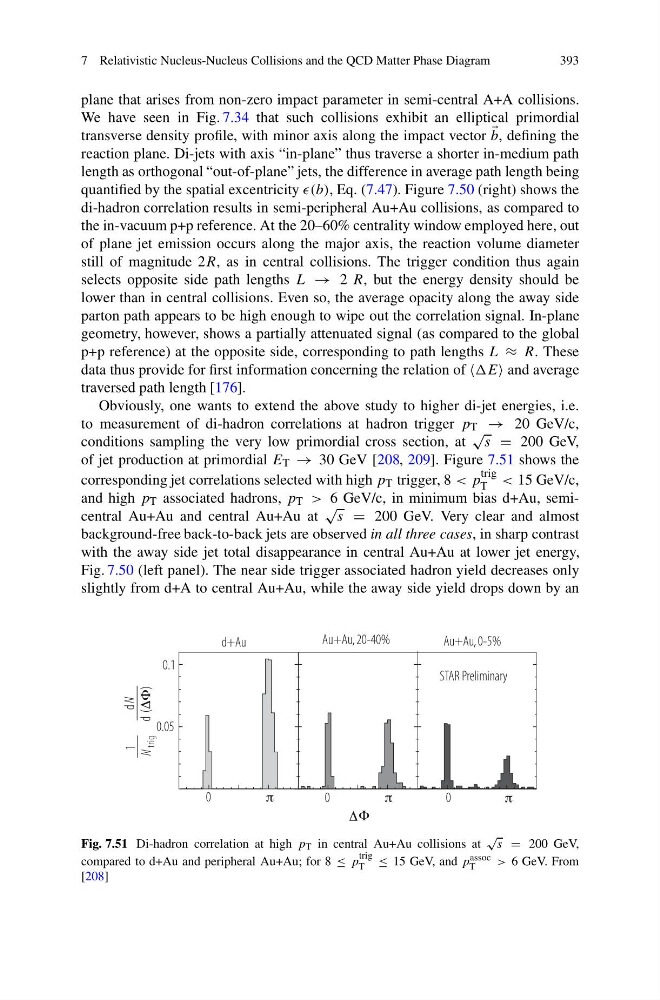
of jet production at primordial E T → 30 GeV [208, 209]. Figure 7.51 shows the
corresponding jet correlations selected with high p T trigger, 8 < p
trig
T < 15 GeV/c,
and high p T associated hadrons, p T > 6 GeV/c, in minimum bias d+Au, semicentral Au+Au and central Au+Au at
√
s = 200 GeV. Very clear and almost
background-free back-to-back jets are observed in all three cases, in sharp contrast
with the away side jet total disappearance in central Au+Au at lower jet energy,
Fig. 7.50 (left panel). The near side trigger associated hadron yield decreases only
slightly from d+A to central Au+Au, while the away side yield drops down by an
STAR Preliminary
0.05
0.1
d
N
g
i
r
t
N
1
0
0
0
d+Au
Au+Au, 20-40%
Au+Au, 0-5%
)
(
d
Fig. 7.51 Di-hadron correlation at high p T in central Au+Au collisions at
√
s = 200 GeV,
compared to d+Au and peripheral Au+Au; for 8 ≤ p
trig
T ≤ 15 GeV, and p
assoc
T
> 6 GeV. From
[208]
393
plane that arises from non-zero impact parameter in semi-central A+A collisions.
We have seen in Fig. 7.34 that such collisions exhibit an elliptical primordial
transverse density profile, with minor axis along the impact vector
b, defining the
reaction plane. Di-jets with axis “in-plane” thus traverse a shorter in-medium path
length as orthogonal “out-of-plane” jets, the difference in average path length being
quantified by the spatial excentricity (b), Eq. (7.47). Figure 7.50 (right) shows the
di-hadron correlation results in semi-peripheral Au+Au collisions, as compared to
the in-vacuum p+p reference. At the 20–60% centrality window employed here, out
of plane jet emission occurs along the major axis, the reaction volume diameter
still of magnitude 2R, as in central collisions. The trigger condition thus again
selects opposite side path lengths L → 2 R, but the energy density should be
lower than in central collisions. Even so, the average opacity along the away side
parton path appears to be high enough to wipe out the correlation signal. In-plane
geometry, however, shows a partially attenuated signal (as compared to the global
p+p reference) at the opposite side, corresponding to path lengths L ≈ R. These
data thus provide for first information concerning the relation of and average
traversed path length [176].
Obviously, one wants to extend the above study to higher di-jet energies, i.e.
to measurement of di-hadron correlations at hadron trigger p T → 20 GeV/c,
conditions sampling the very low primordial cross section, at
√
s = 200 GeV,
of jet production at primordial E T → 30 GeV [208, 209]. Figure 7.51 shows the
corresponding jet correlations selected with high p T trigger, 8 < p
trig
T < 15 GeV/c,
and high p T associated hadrons, p T > 6 GeV/c, in minimum bias d+Au, semicentral Au+Au and central Au+Au at
√
s = 200 GeV. Very clear and almost
background-free back-to-back jets are observed in all three cases, in sharp contrast
with the away side jet total disappearance in central Au+Au at lower jet energy,
Fig. 7.50 (left panel). The near side trigger associated hadron yield decreases only
slightly from d+A to central Au+Au, while the away side yield drops down by an
STAR Preliminary
0.05
0.1
d
N
g
i
r
t
N
1
0
0
0
d+Au
Au+Au, 20-40%
Au+Au, 0-5%
)
(
d
Fig. 7.51 Di-hadron correlation at high p T in central Au+Au collisions at
√
s = 200 GeV,
compared to d+Au and peripheral Au+Au; for 8 ≤ p
trig
T ≤ 15 GeV, and p
assoc
T
> 6 GeV. From
[208]