

392
R. Stock
[rad]
]
[
-1
0
1
2
3
4
d
/
dN
/
1
N
0
0.1
0.2
d+Au FTPC-Au 0 -20%
p+p min.bias
Au+Au Central
g
i
r
t
STAR
5
[rad]
] [
-1
0
1
2
3
4
d
/
dN /
1
N
0
0.1
0.2
g
i r
t
STAR
w
o
l
f
-
data
p+p
Au+Au, in-plane
Au+Au, out-of-plane
{
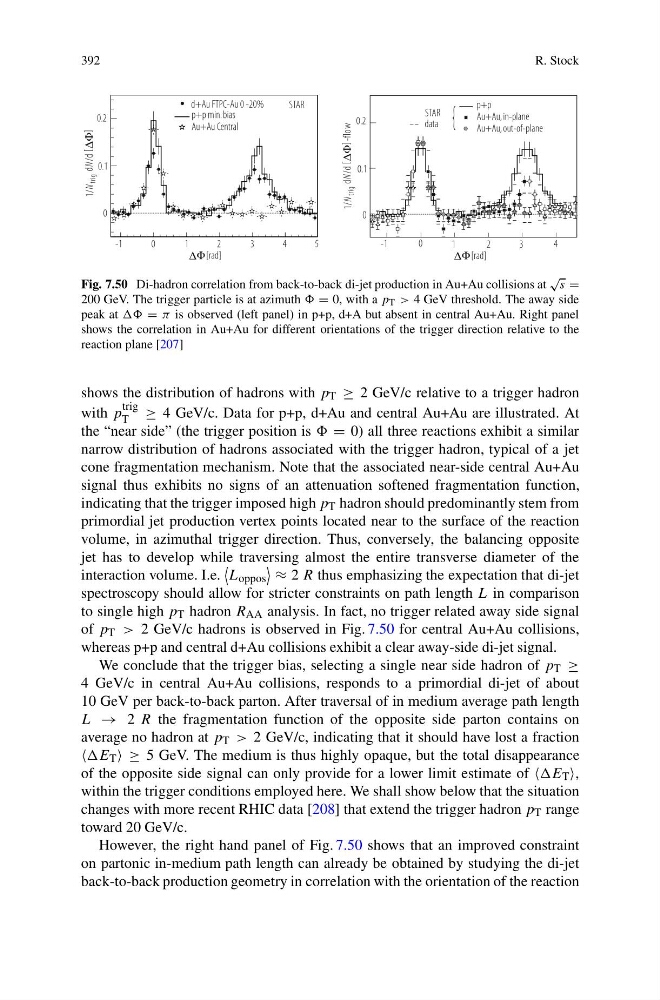
Fig. 7.50 Di-hadron correlation from back-to-back di-jet production in Au+Au collisions at
√
s =
200 GeV. The trigger particle is at azimuth = 0, with a p T > 4 GeV threshold. The away side
peak at = π is observed (left panel) in p+p, d+A but absent in central Au+Au. Right panel
shows the correlation in Au+Au for different orientations of the trigger direction relative to the
reaction plane [207]
shows the distribution of hadrons with p T ≥ 2 GeV/c relative to a trigger hadron
with p
trig
T ≥ 4 GeV/c. Data for p+p, d+Au and central Au+Au are illustrated. At
the “near side” (the trigger position is = 0) all three reactions exhibit a similar
narrow distribution of hadrons associated with the trigger hadron, typical of a jet
cone fragmentation mechanism. Note that the associated near-side central Au+Au
signal thus exhibits no signs of an attenuation softened fragmentation function,
indicating that the trigger imposed high p T hadron should predominantly stem from
primordial jet production vertex points located near to the surface of the reaction
volume, in azimuthal trigger direction. Thus, conversely, the balancing opposite
jet has to develop while traversing almost the entire transverse diameter of the
interaction volume. I.e.
L oppos
≈ 2 R thus emphasizing the expectation that di-jet
spectroscopy should allow for stricter constraints on path length L in comparison
to single high p T hadron R AA analysis. In fact, no trigger related away side signal
of p T > 2 GeV/c hadrons is observed in Fig. 7.50 for central Au+Au collisions,
whereas p+p and central d+Au collisions exhibit a clear away-side di-jet signal.
We conclude that the trigger bias, selecting a single near side hadron of p T ≥
4 GeV/c in central Au+Au collisions, responds to a primordial di-jet of about
10 GeV per back-to-back parton. After traversal of in medium average path length
L → 2 R the fragmentation function of the opposite side parton contains on
average no hadron at p T > 2 GeV/c, indicating that it should have lost a fraction
T ≥ 5 GeV. The medium is thus highly opaque, but the total disappearance
of the opposite side signal can only provide for a lower limit estimate of T
within the trigger conditions employed here. We shall show below that the situation
changes with more recent RHIC data [208] that extend the trigger hadron p T range
toward 20 GeV/c.
However, the right hand panel of Fig. 7.50 shows that an improved constraint
on partonic in-medium path length can already be obtained by studying the di-jet
back-to-back production geometry in correlation with the orientation of the reaction
R. Stock
[rad]
]
[
-1
0
1
2
3
4
d
/
dN
/
1
N
0
0.1
0.2
d+Au FTPC-Au 0 -20%
p+p min.bias
Au+Au Central
g
i
r
t
STAR
5
[rad]
] [
-1
0
1
2
3
4
d
/
dN /
1
N
0
0.1
0.2
g
i r
t
STAR
w
o
l
f
-
data
p+p
Au+Au, in-plane
Au+Au, out-of-plane
{
Fig. 7.50 Di-hadron correlation from back-to-back di-jet production in Au+Au collisions at
√
s =
200 GeV. The trigger particle is at azimuth = 0, with a p T > 4 GeV threshold. The away side
peak at = π is observed (left panel) in p+p, d+A but absent in central Au+Au. Right panel
shows the correlation in Au+Au for different orientations of the trigger direction relative to the
reaction plane [207]
shows the distribution of hadrons with p T ≥ 2 GeV/c relative to a trigger hadron
with p
trig
T ≥ 4 GeV/c. Data for p+p, d+Au and central Au+Au are illustrated. At
the “near side” (the trigger position is = 0) all three reactions exhibit a similar
narrow distribution of hadrons associated with the trigger hadron, typical of a jet
cone fragmentation mechanism. Note that the associated near-side central Au+Au
signal thus exhibits no signs of an attenuation softened fragmentation function,
indicating that the trigger imposed high p T hadron should predominantly stem from
primordial jet production vertex points located near to the surface of the reaction
volume, in azimuthal trigger direction. Thus, conversely, the balancing opposite
jet has to develop while traversing almost the entire transverse diameter of the
interaction volume. I.e.
L oppos
≈ 2 R thus emphasizing the expectation that di-jet
spectroscopy should allow for stricter constraints on path length L in comparison
to single high p T hadron R AA analysis. In fact, no trigger related away side signal
of p T > 2 GeV/c hadrons is observed in Fig. 7.50 for central Au+Au collisions,
whereas p+p and central d+Au collisions exhibit a clear away-side di-jet signal.
We conclude that the trigger bias, selecting a single near side hadron of p T ≥
4 GeV/c in central Au+Au collisions, responds to a primordial di-jet of about
10 GeV per back-to-back parton. After traversal of in medium average path length
L → 2 R the fragmentation function of the opposite side parton contains on
average no hadron at p T > 2 GeV/c, indicating that it should have lost a fraction
T ≥ 5 GeV. The medium is thus highly opaque, but the total disappearance
of the opposite side signal can only provide for a lower limit estimate of T
within the trigger conditions employed here. We shall show below that the situation
changes with more recent RHIC data [208] that extend the trigger hadron p T range
toward 20 GeV/c.
However, the right hand panel of Fig. 7.50 shows that an improved constraint
on partonic in-medium path length can already be obtained by studying the di-jet
back-to-back production geometry in correlation with the orientation of the reaction