

372
R. Stock
7.4 Elliptic Flow
We have up to now mostly stressed the importance of central collisions and midrapidity data because they provide for the highest primordial energy density and
avoid problems caused by emission anisotropy and the presence of cold spectator
sections of target and projectile nuclei. On the other hand, a fundamentally new
window of observation is opened by non-central collisions as the finite impact
parameter breaks cylinder symmetry, defining emission anisotropies with respect
to the orientation of the impact vector
b as we have shown in Eq. (7.20). In a
strongly interacting fireball collision dynamics, the initial geometric anisotropy
of the reaction volume gets transferred to the final momentum spectra and thus
becomes experimentally accessible. Furthermore, the high charged particle multiplicity allows for an event-by-event determination of the reaction plane (direction
of
b), enabling the study of observables at azimuth ϕ, relative to the known reaction
plane. We shall show that this opens a window into the very early stages of A+A
collisions onward from the end of nuclear interpenetration, at τ ≈ 2 R(A)/γ CM .
Our observation thus begins at the extreme energy densities prevailing right at
formation time (Sects. 7.2.4 and 7.2.5), i.e. concurrent with the initialization phase
of relativistic hydrodynamic expansion. We access the phase diagram of Fig. 7.1 in
regions far above the QCD phase boundary.
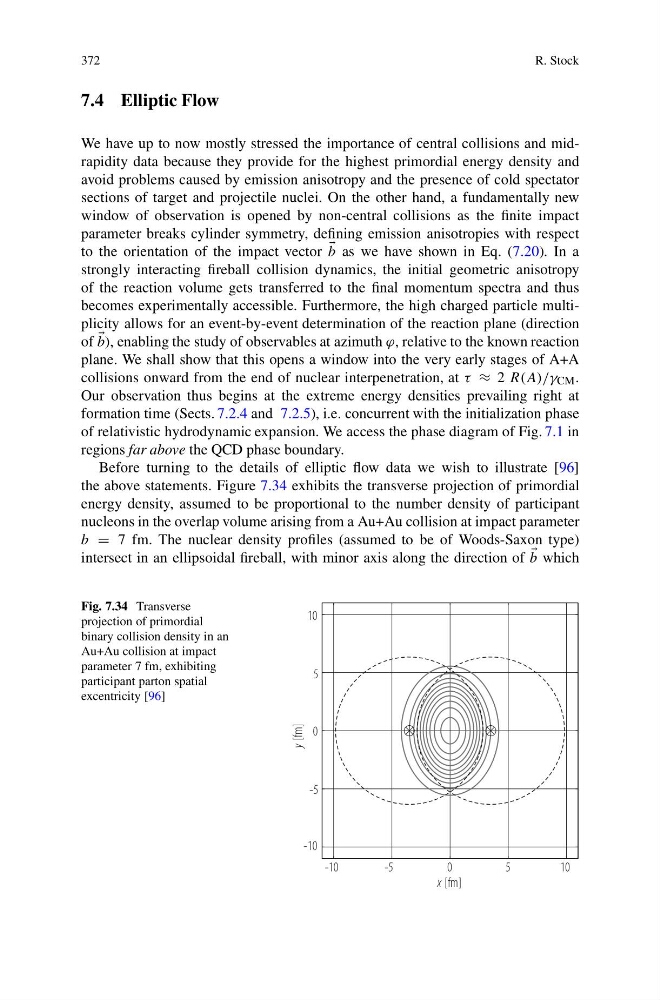
Before turning to the details of elliptic flow data we wish to illustrate [96]
the above statements. Figure 7.34 exhibits the transverse projection of primordial
energy density, assumed to be proportional to the number density of participant
nucleons in the overlap volume arising from a Au+Au collision at impact parameter
b = 7 fm. The nuclear density profiles (assumed to be of Woods-Saxon type)
intersect in an ellipsoidal fireball, with minor axis along the direction of
b which
Fig. 7.34 Transverse
projection of primordial
binary collision density in an
Au+Au collision at impact
parameter 7 fm, exhibiting
participant parton spatial
excentricity [96]
-10
-5
0
5
10
-10
-5
0
5
10
x [fm]
y [fm]
R. Stock
7.4 Elliptic Flow
We have up to now mostly stressed the importance of central collisions and midrapidity data because they provide for the highest primordial energy density and
avoid problems caused by emission anisotropy and the presence of cold spectator
sections of target and projectile nuclei. On the other hand, a fundamentally new
window of observation is opened by non-central collisions as the finite impact
parameter breaks cylinder symmetry, defining emission anisotropies with respect
to the orientation of the impact vector
b as we have shown in Eq. (7.20). In a
strongly interacting fireball collision dynamics, the initial geometric anisotropy
of the reaction volume gets transferred to the final momentum spectra and thus
becomes experimentally accessible. Furthermore, the high charged particle multiplicity allows for an event-by-event determination of the reaction plane (direction
of
b), enabling the study of observables at azimuth ϕ, relative to the known reaction
plane. We shall show that this opens a window into the very early stages of A+A
collisions onward from the end of nuclear interpenetration, at τ ≈ 2 R(A)/γ CM .
Our observation thus begins at the extreme energy densities prevailing right at
formation time (Sects. 7.2.4 and 7.2.5), i.e. concurrent with the initialization phase
of relativistic hydrodynamic expansion. We access the phase diagram of Fig. 7.1 in
regions far above the QCD phase boundary.
Before turning to the details of elliptic flow data we wish to illustrate [96]
the above statements. Figure 7.34 exhibits the transverse projection of primordial
energy density, assumed to be proportional to the number density of participant
nucleons in the overlap volume arising from a Au+Au collision at impact parameter
b = 7 fm. The nuclear density profiles (assumed to be of Woods-Saxon type)
intersect in an ellipsoidal fireball, with minor axis along the direction of
b which
Fig. 7.34 Transverse
projection of primordial
binary collision density in an
Au+Au collision at impact
parameter 7 fm, exhibiting
participant parton spatial
excentricity [96]
-10
-5
0
5
10
-10
-5
0
5
10
x [fm]
y [fm]