

7 Relativistic Nucleus-Nucleus Collisions and the QCD Matter Phase Diagram
355
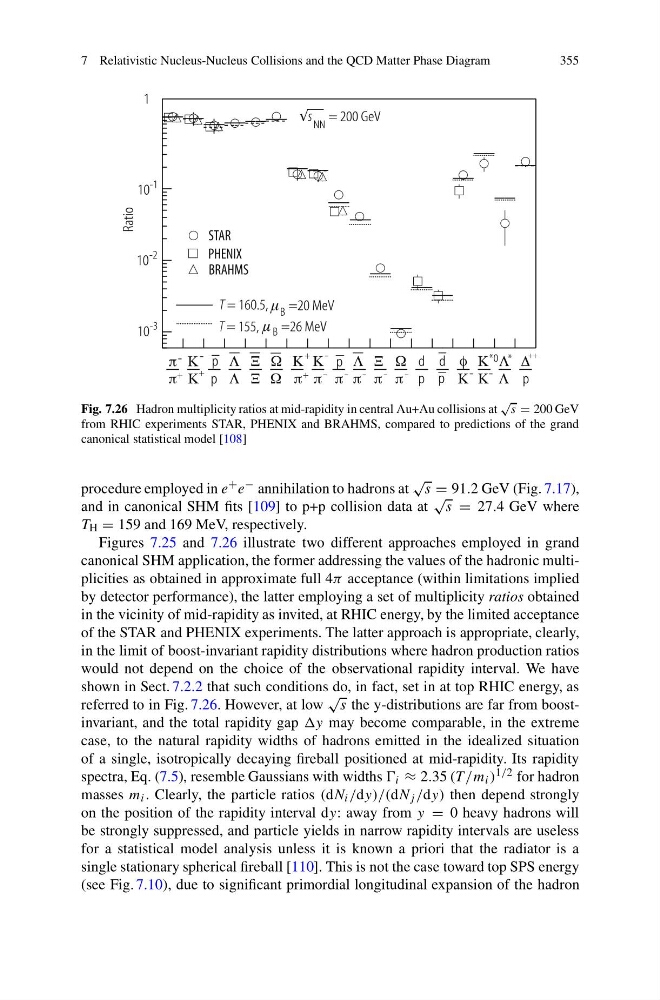
Fig. 7.26 Hadron multiplicity ratios at mid-rapidity in central Au+Au collisions at
√
s = 200 GeV
from RHIC experiments STAR, PHENIX and BRAHMS, compared to predictions of the grand
canonical statistical model [108]
procedure employed in e + e − annihilation to hadrons at
√
s = 91.2 GeV (Fig. 7.17),
and in canonical SHM fits [109] to p+p collision data at
√
s = 27.4 GeV where
T H = 159 and 169 MeV, respectively.
Figures 7.25 and 7.26 illustrate two different approaches employed in grand
canonical SHM application, the former addressing the values of the hadronic multiplicities as obtained in approximate full 4π acceptance (within limitations implied
by detector performance), the latter employing a set of multiplicity ratios obtained
in the vicinity of mid-rapidity as invited, at RHIC energy, by the limited acceptance
of the STAR and PHENIX experiments. The latter approach is appropriate, clearly,
in the limit of boost-invariant rapidity distributions where hadron production ratios
would not depend on the choice of the observational rapidity interval. We have
shown in Sect. 7.2.2 that such conditions do, in fact, set in at top RHIC energy, as
referred to in Fig. 7.26. However, at low
√
s the y-distributions are far from boostinvariant, and the total rapidity gap y may become comparable, in the extreme
case, to the natural rapidity widths of hadrons emitted in the idealized situation
of a single, isotropically decaying fireball positioned at mid-rapidity. Its rapidity
spectra, Eq. (7.5), resemble Gaussians with widths i ≈ 2.35 (T /m i ) 1/2 for hadron
masses m i . Clearly, the particle ratios (dN i /dy)/(dN j /dy) then depend strongly
on the position of the rapidity interval dy: away from y = 0 heavy hadrons will
be strongly suppressed, and particle yields in narrow rapidity intervals are useless
for a statistical model analysis unless it is known a priori that the radiator is a
single stationary spherical fireball [110]. This is not the case toward top SPS energy
(see Fig. 7.10), due to significant primordial longitudinal expansion of the hadron
355
Fig. 7.26 Hadron multiplicity ratios at mid-rapidity in central Au+Au collisions at
√
s = 200 GeV
from RHIC experiments STAR, PHENIX and BRAHMS, compared to predictions of the grand
canonical statistical model [108]
procedure employed in e + e − annihilation to hadrons at
√
s = 91.2 GeV (Fig. 7.17),
and in canonical SHM fits [109] to p+p collision data at
√
s = 27.4 GeV where
T H = 159 and 169 MeV, respectively.
Figures 7.25 and 7.26 illustrate two different approaches employed in grand
canonical SHM application, the former addressing the values of the hadronic multiplicities as obtained in approximate full 4π acceptance (within limitations implied
by detector performance), the latter employing a set of multiplicity ratios obtained
in the vicinity of mid-rapidity as invited, at RHIC energy, by the limited acceptance
of the STAR and PHENIX experiments. The latter approach is appropriate, clearly,
in the limit of boost-invariant rapidity distributions where hadron production ratios
would not depend on the choice of the observational rapidity interval. We have
shown in Sect. 7.2.2 that such conditions do, in fact, set in at top RHIC energy, as
referred to in Fig. 7.26. However, at low
√
s the y-distributions are far from boostinvariant, and the total rapidity gap y may become comparable, in the extreme
case, to the natural rapidity widths of hadrons emitted in the idealized situation
of a single, isotropically decaying fireball positioned at mid-rapidity. Its rapidity
spectra, Eq. (7.5), resemble Gaussians with widths i ≈ 2.35 (T /m i ) 1/2 for hadron
masses m i . Clearly, the particle ratios (dN i /dy)/(dN j /dy) then depend strongly
on the position of the rapidity interval dy: away from y = 0 heavy hadrons will
be strongly suppressed, and particle yields in narrow rapidity intervals are useless
for a statistical model analysis unless it is known a priori that the radiator is a
single stationary spherical fireball [110]. This is not the case toward top SPS energy
(see Fig. 7.10), due to significant primordial longitudinal expansion of the hadron