

354
R. Stock
extended matter that is quantum mechanically coherent must exist at hadronization
[87, 88, 107]. Whether or not it also reflects partonic equilibrium properties
(including flavor equilibrium), that would allow us to claim the direct observation of
a quark gluon plasma state near T c , cannot be decided on the basis of this observation
alone, as the hadronization process somehow generates, by itself, the observed
hadronic equilibrium. This conclusion, however, is still the subject of controversy
[107].
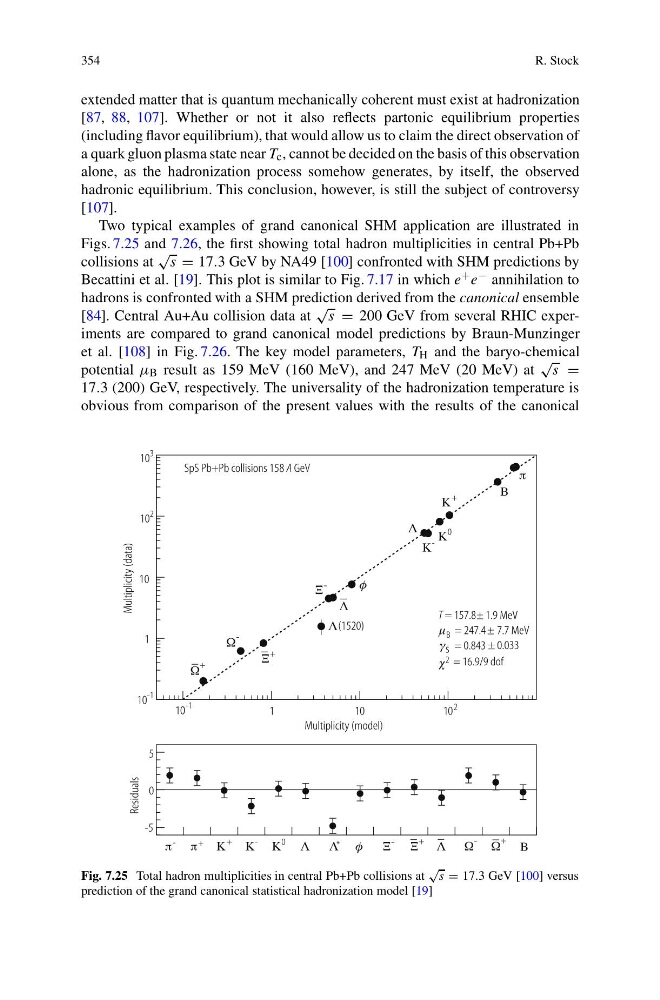
Two typical examples of grand canonical SHM application are illustrated in
Figs. 7.25 and 7.26, the first showing total hadron multiplicities in central Pb+Pb
collisions at
√
s = 17.3 GeV by NA49 [100] confronted with SHM predictions by
Becattini et al. [19]. This plot is similar to Fig. 7.17 in which e + e − annihilation to
hadrons is confronted with a SHM prediction derived from the canonical ensemble
[84]. Central Au+Au collision data at
√
s = 200 GeV from several RHIC experiments are compared to grand canonical model predictions by Braun-Munzinger
et al. [108] in Fig. 7.26. The key model parameters, T H and the baryo-chemical
potential μ B result as 159 MeV (160 MeV), and 247 MeV (20 MeV) at
√
s =
17.3 (200) GeV, respectively. The universality of the hadronization temperature is
obvious from comparison of the present values with the results of the canonical
Fig. 7.25 Total hadron multiplicities in central Pb+Pb collisions at
√
s = 17.3 GeV [100] versus
prediction of the grand canonical statistical hadronization model [19]
R. Stock
extended matter that is quantum mechanically coherent must exist at hadronization
[87, 88, 107]. Whether or not it also reflects partonic equilibrium properties
(including flavor equilibrium), that would allow us to claim the direct observation of
a quark gluon plasma state near T c , cannot be decided on the basis of this observation
alone, as the hadronization process somehow generates, by itself, the observed
hadronic equilibrium. This conclusion, however, is still the subject of controversy
[107].
Two typical examples of grand canonical SHM application are illustrated in
Figs. 7.25 and 7.26, the first showing total hadron multiplicities in central Pb+Pb
collisions at
√
s = 17.3 GeV by NA49 [100] confronted with SHM predictions by
Becattini et al. [19]. This plot is similar to Fig. 7.17 in which e + e − annihilation to
hadrons is confronted with a SHM prediction derived from the canonical ensemble
[84]. Central Au+Au collision data at
√
s = 200 GeV from several RHIC experiments are compared to grand canonical model predictions by Braun-Munzinger
et al. [108] in Fig. 7.26. The key model parameters, T H and the baryo-chemical
potential μ B result as 159 MeV (160 MeV), and 247 MeV (20 MeV) at
√
s =
17.3 (200) GeV, respectively. The universality of the hadronization temperature is
obvious from comparison of the present values with the results of the canonical
Fig. 7.25 Total hadron multiplicities in central Pb+Pb collisions at
√
s = 17.3 GeV [100] versus
prediction of the grand canonical statistical hadronization model [19]