

352
R. Stock
According to our observations with Eq. (7.23) a hydrodynamical ansatz for
the transverse mass spectrum of hadrons should thus contain the variables “true
temperature” T F at decoupling from the flow field, and its average velocity β T
common to all hadrons. This is the case for the blast wave model [104] developed
as an approximation to the full hydrodynamic formalism [96], assuming a common
decoupling or “freeze-out” from flow, for all hadronic species, and a boost-invariant
longitudinal expansion:
dN i
m T dm T dy
= A i m T K 1
m T cosh ρ
T F
I 0
p T sinh ρ
T F
(7.25)
where ρ = tanh −1 β T . In an extended version of this model a function is included
that describes the radial profile of the transverse velocity field, β T (r) = β max
T
r/R,
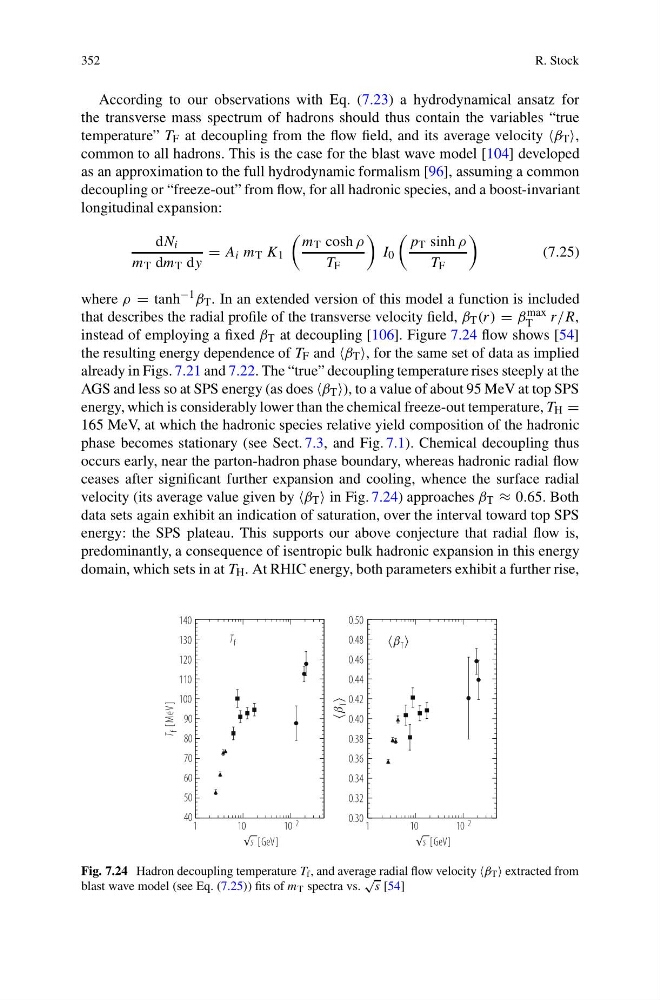
instead of employing a fixed β T at decoupling [106]. Figure 7.24 flow shows [54]
the resulting energy dependence of T F and β T , for the same set of data as implied
already in Figs. 7.21 and 7.22. The “true” decoupling temperature rises steeply at the
AGS and less so at SPS energy (as does β T ), to a value of about 95 MeV at top SPS
energy, which is considerably lower than the chemical freeze-out temperature, T H =
165 MeV, at which the hadronic species relative yield composition of the hadronic
phase becomes stationary (see Sect. 7.3, and Fig. 7.1). Chemical decoupling thus
occurs early, near the parton-hadron phase boundary, whereas hadronic radial flow
ceases after significant further expansion and cooling, whence the surface radial
velocity (its average value given by β T in Fig. 7.24) approaches β T ≈ 0.65. Both
data sets again exhibit an indication of saturation, over the interval toward top SPS
energy: the SPS plateau. This supports our above conjecture that radial flow is,
predominantly, a consequence of isentropic bulk hadronic expansion in this energy
domain, which sets in at T H . At RHIC energy, both parameters exhibit a further rise,
0.50
0.48
0.46
0.44
0.42
0.40
0.38
0.36
0.34
0.32
0.30
140
130
120
110
100
90
80
70
60
50
40
1
1 0
1 0 2
1
1 0
1 0 2
s [GeV]
s [GeV]
T f
T f
]
V
e
M
[
T
T
Fig. 7.24 Hadron decoupling temperature T f , and average radial flow velocity β T extracted from
blast wave model (see Eq. (7.25)) fits of m T spectra vs.
√
s [54]
R. Stock
According to our observations with Eq. (7.23) a hydrodynamical ansatz for
the transverse mass spectrum of hadrons should thus contain the variables “true
temperature” T F at decoupling from the flow field, and its average velocity β T
common to all hadrons. This is the case for the blast wave model [104] developed
as an approximation to the full hydrodynamic formalism [96], assuming a common
decoupling or “freeze-out” from flow, for all hadronic species, and a boost-invariant
longitudinal expansion:
dN i
m T dm T dy
= A i m T K 1
m T cosh ρ
T F
I 0
p T sinh ρ
T F
(7.25)
where ρ = tanh −1 β T . In an extended version of this model a function is included
that describes the radial profile of the transverse velocity field, β T (r) = β max
T
r/R,
instead of employing a fixed β T at decoupling [106]. Figure 7.24 flow shows [54]
the resulting energy dependence of T F and β T , for the same set of data as implied
already in Figs. 7.21 and 7.22. The “true” decoupling temperature rises steeply at the
AGS and less so at SPS energy (as does β T ), to a value of about 95 MeV at top SPS
energy, which is considerably lower than the chemical freeze-out temperature, T H =
165 MeV, at which the hadronic species relative yield composition of the hadronic
phase becomes stationary (see Sect. 7.3, and Fig. 7.1). Chemical decoupling thus
occurs early, near the parton-hadron phase boundary, whereas hadronic radial flow
ceases after significant further expansion and cooling, whence the surface radial
velocity (its average value given by β T in Fig. 7.24) approaches β T ≈ 0.65. Both
data sets again exhibit an indication of saturation, over the interval toward top SPS
energy: the SPS plateau. This supports our above conjecture that radial flow is,
predominantly, a consequence of isentropic bulk hadronic expansion in this energy
domain, which sets in at T H . At RHIC energy, both parameters exhibit a further rise,
0.50
0.48
0.46
0.44
0.42
0.40
0.38
0.36
0.34
0.32
0.30
140
130
120
110
100
90
80
70
60
50
40
1
1 0
1 0 2
1
1 0
1 0 2
s [GeV]
s [GeV]
T f
T f
]
V
e
M
[
T
T
Fig. 7.24 Hadron decoupling temperature T f , and average radial flow velocity β T extracted from
blast wave model (see Eq. (7.25)) fits of m T spectra vs.
√
s [54]