

7 Relativistic Nucleus-Nucleus Collisions and the QCD Matter Phase Diagram
351
preferentially perpendicular to the fireball surface, i.e. radial. The initial thermal
energy, implied by the hadron formation temperature T H = 165 MeV, will thus fall
down to a residual T F at hadronic decoupling from the flow field (“thermal freezeout”) plus a radial transverse kinetic energy term m i β T 2 where m i is the mass of
the considered hadron species and β T the average radial velocity. We thus expect
[103] for the slope of equation (7.22):
T = T F + m i β T
2 , p T ≤ 2 GeV/c
(7.23)
and
T = T F
1 + v T
1 − v T
1/2
, p T m i
(7.24)
the latter expression valid at p T larger than hadron mass scale (T then is the
“blue-shifted temperature” at decoupling [104] and v T the average transverse
velocity). The assumption that radial flow mostly originates from the hadronic
expansion phase is underlined by the proportionality of flow energy to hadron mass
(Eq. (7.23)).
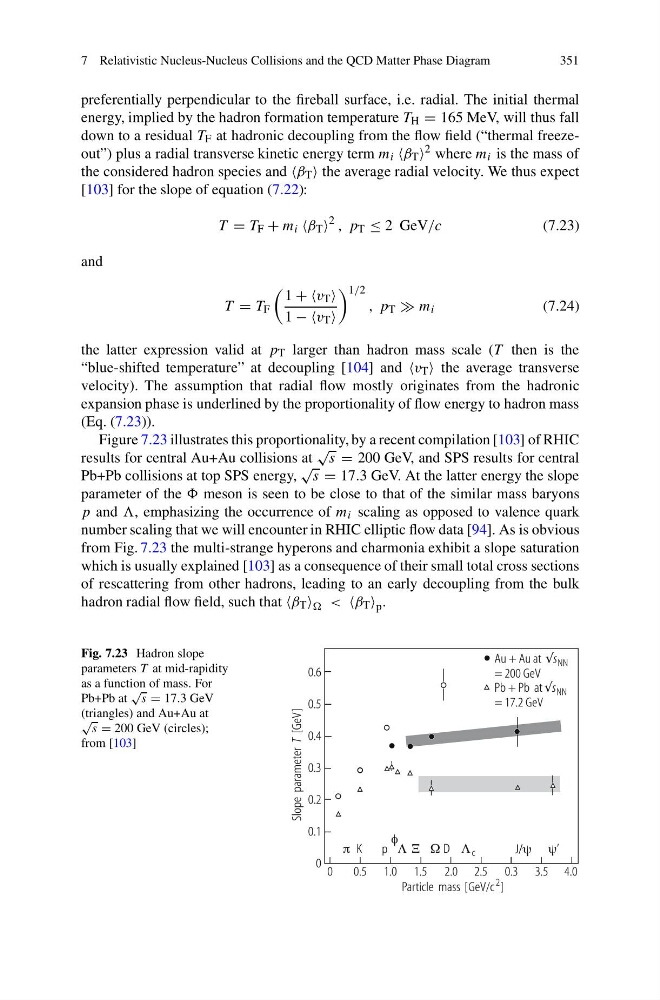
Figure 7.23 illustrates this proportionality, by a recent compilation [103] of RHIC
results for central Au+Au collisions at
√
s = 200 GeV, and SPS results for central
Pb+Pb collisions at top SPS energy,
√
s = 17.3 GeV. At the latter energy the slope
parameter of the meson is seen to be close to that of the similar mass baryons
p and , emphasizing the occurrence of m i scaling as opposed to valence quark
number scaling that we will encounter in RHIC elliptic flow data [94]. As is obvious
from Fig. 7.23 the multi-strange hyperons and charmonia exhibit a slope saturation
which is usually explained [103] as a consequence of their small total cross sections
of rescattering from other hadrons, leading to an early decoupling from the bulk
hadron radial flow field, such that β T < β T p .
Fig. 7.23 Hadron slope
parameters T at mid-rapidity
as a function of mass. For
Pb+Pb at
√
s = 17.3 GeV
(triangles) and Au+Au at
√
s = 200 GeV (circles);
from [103]
351
preferentially perpendicular to the fireball surface, i.e. radial. The initial thermal
energy, implied by the hadron formation temperature T H = 165 MeV, will thus fall
down to a residual T F at hadronic decoupling from the flow field (“thermal freezeout”) plus a radial transverse kinetic energy term m i β T 2 where m i is the mass of
the considered hadron species and β T the average radial velocity. We thus expect
[103] for the slope of equation (7.22):
T = T F + m i β T
2 , p T ≤ 2 GeV/c
(7.23)
and
T = T F
1 + v T
1 − v T
1/2
, p T m i
(7.24)
the latter expression valid at p T larger than hadron mass scale (T then is the
“blue-shifted temperature” at decoupling [104] and v T the average transverse
velocity). The assumption that radial flow mostly originates from the hadronic
expansion phase is underlined by the proportionality of flow energy to hadron mass
(Eq. (7.23)).
Figure 7.23 illustrates this proportionality, by a recent compilation [103] of RHIC
results for central Au+Au collisions at
√
s = 200 GeV, and SPS results for central
Pb+Pb collisions at top SPS energy,
√
s = 17.3 GeV. At the latter energy the slope
parameter of the meson is seen to be close to that of the similar mass baryons
p and , emphasizing the occurrence of m i scaling as opposed to valence quark
number scaling that we will encounter in RHIC elliptic flow data [94]. As is obvious
from Fig. 7.23 the multi-strange hyperons and charmonia exhibit a slope saturation
which is usually explained [103] as a consequence of their small total cross sections
of rescattering from other hadrons, leading to an early decoupling from the bulk
hadron radial flow field, such that β T < β T p .
Fig. 7.23 Hadron slope
parameters T at mid-rapidity
as a function of mass. For
Pb+Pb at
√
s = 17.3 GeV
(triangles) and Au+Au at
√
s = 200 GeV (circles);
from [103]