

348
R. Stock
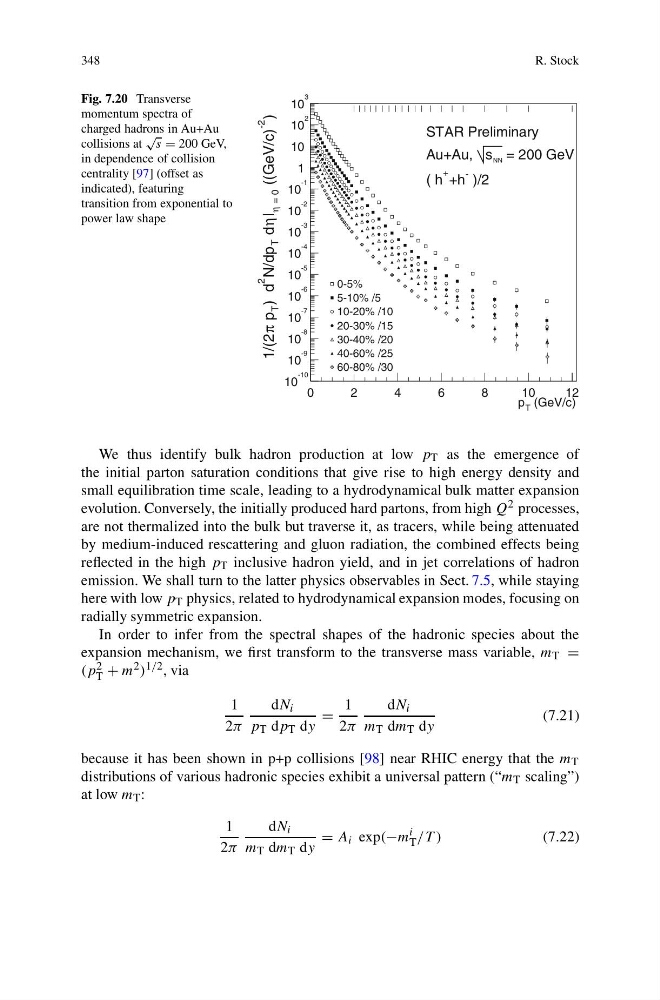
Fig. 7.20 Transverse
momentum spectra of
charged hadrons in Au+Au
collisions at
√
s = 200 GeV,
in dependence of collision
centrality [97] (offset as
indicated), featuring
transition from exponential to
power law shape
(GeV/c)
T
p
0
2
4
6
8
1 0
1 2
10
-10
10
-9
10
-8
10
-7
10
-6
10
-5
10
-4
10
-3
10
-2
10
-1
1
10
10
2
10
3
0-5%
5-10% /5
10-20% /10
20-30% /15
30-40% /20
40-60% /25
60-80% /30
STAR Preliminary
= 200 GeV
NN
s
Au+Au,
)/2
-
+h
+
( h
)
-2
((GeV/c)
= 0
η
|
η
d
T
N/dp
2
) d
T
p
π
1/(2
We thus identify bulk hadron production at low p T as the emergence of
the initial parton saturation conditions that give rise to high energy density and
small equilibration time scale, leading to a hydrodynamical bulk matter expansion
evolution. Conversely, the initially produced hard partons, from high Q 2 processes,
are not thermalized into the bulk but traverse it, as tracers, while being attenuated
by medium-induced rescattering and gluon radiation, the combined effects being
reflected in the high p T inclusive hadron yield, and in jet correlations of hadron
emission. We shall turn to the latter physics observables in Sect. 7.5, while staying
here with low p T physics, related to hydrodynamical expansion modes, focusing on
radially symmetric expansion.
In order to infer from the spectral shapes of the hadronic species about the
expansion mechanism, we first transform to the transverse mass variable, m T =
(p 2
T + m 2 ) 1/2 , via
1
2π
dN i
p T dp T dy
=
1
2π
dN i
m T dm T dy
(7.21)
because it has been shown in p+p collisions [98] near RHIC energy that the m T
distributions of various hadronic species exhibit a universal pattern (“m T scaling”)
at low m T :
1
2π
dN i
m T dm T dy
= A i exp(−m
i
T /T )
(7.22)
R. Stock
Fig. 7.20 Transverse
momentum spectra of
charged hadrons in Au+Au
collisions at
√
s = 200 GeV,
in dependence of collision
centrality [97] (offset as
indicated), featuring
transition from exponential to
power law shape
(GeV/c)
T
p
0
2
4
6
8
1 0
1 2
10
-10
10
-9
10
-8
10
-7
10
-6
10
-5
10
-4
10
-3
10
-2
10
-1
1
10
10
2
10
3
0-5%
5-10% /5
10-20% /10
20-30% /15
30-40% /20
40-60% /25
60-80% /30
STAR Preliminary
= 200 GeV
NN
s
Au+Au,
)/2
-
+h
+
( h
)
-2
((GeV/c)
= 0
η
|
η
d
T
N/dp
2
) d
T
p
π
1/(2
We thus identify bulk hadron production at low p T as the emergence of
the initial parton saturation conditions that give rise to high energy density and
small equilibration time scale, leading to a hydrodynamical bulk matter expansion
evolution. Conversely, the initially produced hard partons, from high Q 2 processes,
are not thermalized into the bulk but traverse it, as tracers, while being attenuated
by medium-induced rescattering and gluon radiation, the combined effects being
reflected in the high p T inclusive hadron yield, and in jet correlations of hadron
emission. We shall turn to the latter physics observables in Sect. 7.5, while staying
here with low p T physics, related to hydrodynamical expansion modes, focusing on
radially symmetric expansion.
In order to infer from the spectral shapes of the hadronic species about the
expansion mechanism, we first transform to the transverse mass variable, m T =
(p 2
T + m 2 ) 1/2 , via
1
2π
dN i
p T dp T dy
=
1
2π
dN i
m T dm T dy
(7.21)
because it has been shown in p+p collisions [98] near RHIC energy that the m T
distributions of various hadronic species exhibit a universal pattern (“m T scaling”)
at low m T :
1
2π
dN i
m T dm T dy
= A i exp(−m
i
T /T )
(7.22)