

7 Relativistic Nucleus-Nucleus Collisions and the QCD Matter Phase Diagram
331
Its width σ defines the resolution (b) of impact parameter b determination within
this scheme via the relation
1
(b)
σ (b) ≈
d
N part (b)
db
(7.7)
which, at A = 200, leads to the expectation to determine b with about 1.5 fm
resolution [66], by measuring N part .
How to measure N part ? In fixed target experiments one can calorimetrically
count all particles with beam momentum per nucleon and superimposed Fermi
momentum distributions of nucleons, i.e. one looks for particles in the beam
fragmentation domain y beam ± 0.5, p T ≤ 0.25 GeV/c. These are identified as
spectator nucleons, and N
proj
part = A − N
proj
spec . For identical nuclear collision systems
N
proj
part
=
N
targ
part
, and thus N part gets approximated by 2N
proj
part . This scheme was
employed in the CERN experiments NA49 and WA80, and generalized [67] in a
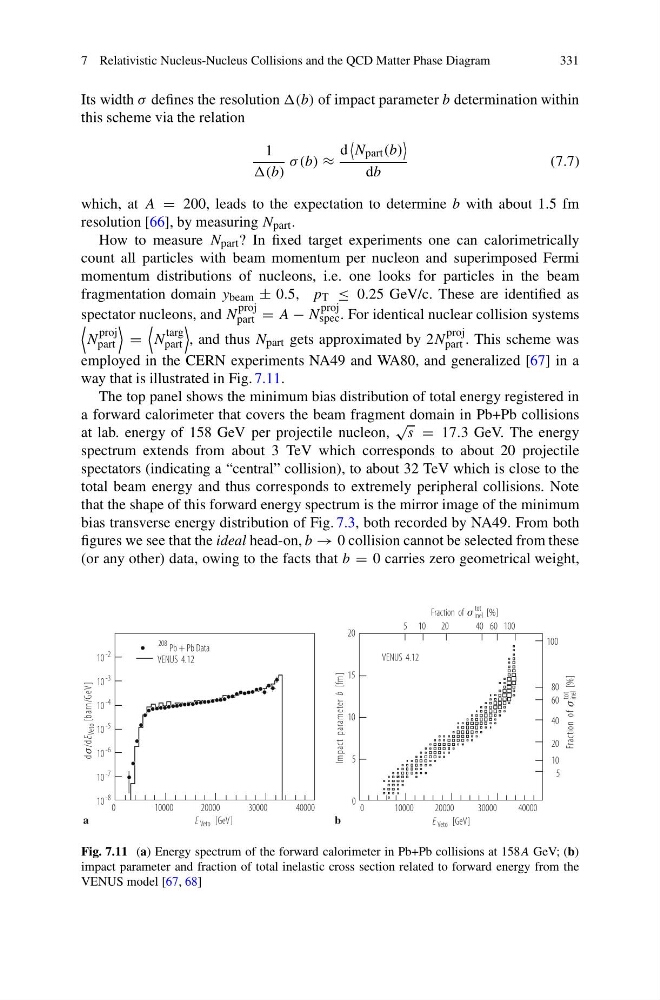
way that is illustrated in Fig. 7.11.
The top panel shows the minimum bias distribution of total energy registered in
a forward calorimeter that covers the beam fragment domain in Pb+Pb collisions
at lab. energy of 158 GeV per projectile nucleon,
√
s = 17.3 GeV. The energy
spectrum extends from about 3 TeV which corresponds to about 20 projectile
spectators (indicating a “central” collision), to about 32 TeV which is close to the
total beam energy and thus corresponds to extremely peripheral collisions. Note
that the shape of this forward energy spectrum is the mirror image of the minimum
bias transverse energy distribution of Fig. 7.3, both recorded by NA49. From both
figures we see that the ideal head-on, b → 0 collision cannot be selected from these
(or any other) data, owing to the facts that b = 0 carries zero geometrical weight,
10
10
10
10
10
10
10
-2
-3
-4
-5
-6
-7
-8
0
10000
20000
30000
40000
E Veto [GeV]
208 Pb + Pb Data
VENUS 4.12
]
V
e
G
/
n
r
a
b
[
d
/
d
E o
t
e
V
a
0
10000
20000
30000
40000
E Veto [GeV]
VENUS 4.12
b
20
15
10
5
0
5 10 20
40 60 100
100
80
60
40
20
10
5
]
m
f
[
r
e
t
e
m
a
r
a
p
t
c
a
p
m
I
b
Fraction of
[%]
tot
inel
]
%
[
f
o
n
o
i
t
c
a
r
F
t
o
t l
e
n
i
Fig. 7.11 (a) Energy spectrum of the forward calorimeter in Pb+Pb collisions at 158A GeV; (b)
impact parameter and fraction of total inelastic cross section related to forward energy from the
VENUS model [67, 68]
331
Its width σ defines the resolution (b) of impact parameter b determination within
this scheme via the relation
1
(b)
σ (b) ≈
d
N part (b)
db
(7.7)
which, at A = 200, leads to the expectation to determine b with about 1.5 fm
resolution [66], by measuring N part .
How to measure N part ? In fixed target experiments one can calorimetrically
count all particles with beam momentum per nucleon and superimposed Fermi
momentum distributions of nucleons, i.e. one looks for particles in the beam
fragmentation domain y beam ± 0.5, p T ≤ 0.25 GeV/c. These are identified as
spectator nucleons, and N
proj
part = A − N
proj
spec . For identical nuclear collision systems
N
proj
part
=
N
targ
part
, and thus N part gets approximated by 2N
proj
part . This scheme was
employed in the CERN experiments NA49 and WA80, and generalized [67] in a
way that is illustrated in Fig. 7.11.
The top panel shows the minimum bias distribution of total energy registered in
a forward calorimeter that covers the beam fragment domain in Pb+Pb collisions
at lab. energy of 158 GeV per projectile nucleon,
√
s = 17.3 GeV. The energy
spectrum extends from about 3 TeV which corresponds to about 20 projectile
spectators (indicating a “central” collision), to about 32 TeV which is close to the
total beam energy and thus corresponds to extremely peripheral collisions. Note
that the shape of this forward energy spectrum is the mirror image of the minimum
bias transverse energy distribution of Fig. 7.3, both recorded by NA49. From both
figures we see that the ideal head-on, b → 0 collision cannot be selected from these
(or any other) data, owing to the facts that b = 0 carries zero geometrical weight,
10
10
10
10
10
10
10
-2
-3
-4
-5
-6
-7
-8
0
10000
20000
30000
40000
E Veto [GeV]
208 Pb + Pb Data
VENUS 4.12
]
V
e
G
/
n
r
a
b
[
d
/
d
E o
t
e
V
a
0
10000
20000
30000
40000
E Veto [GeV]
VENUS 4.12
b
20
15
10
5
0
5 10 20
40 60 100
100
80
60
40
20
10
5
]
m
f
[
r
e
t
e
m
a
r
a
p
t
c
a
p
m
I
b
Fraction of
[%]
tot
inel
]
%
[
f
o
n
o
i
t
c
a
r
F
t
o
t l
e
n
i
Fig. 7.11 (a) Energy spectrum of the forward calorimeter in Pb+Pb collisions at 158A GeV; (b)
impact parameter and fraction of total inelastic cross section related to forward energy from the
VENUS model [67, 68]