

306
P. Jenni and T. S. Virdee
VBF
WH
ZH
ggF
ATLAS Preliminary
CMS
ttH
0.12
0.1
0.08
0.06
0.04
0.02
0
0.14
0.2
0.04 (Stat); 0.06 (S2); 0.07 (S1)
0.05 (Stat); 0.06 (S2); 0.08 (S1)
0.03 (Stat); 0.04 (S2); 0.05 (S1)
0.01 (Stat); 0.03 (S2); 0.06 (S1)
w/ Run 2 syst. uncert. (S1)
w/ YR18 syst. uncert. (S2)
w/ stat. uncert. only
0.02 (Stat); 0.05 (S2); 0.09 (S1)
0.1
0
0.3
Expected uncertainty
Expected uncertainty
ggH
VBF
WH
ZH
ttH
Projection from Run 2 data
Projection
Total(S1)
Total(S2)
s = 14 TeV, 3000 fb –1
3000 fb –1 (14 TeV)
(a)
(b)
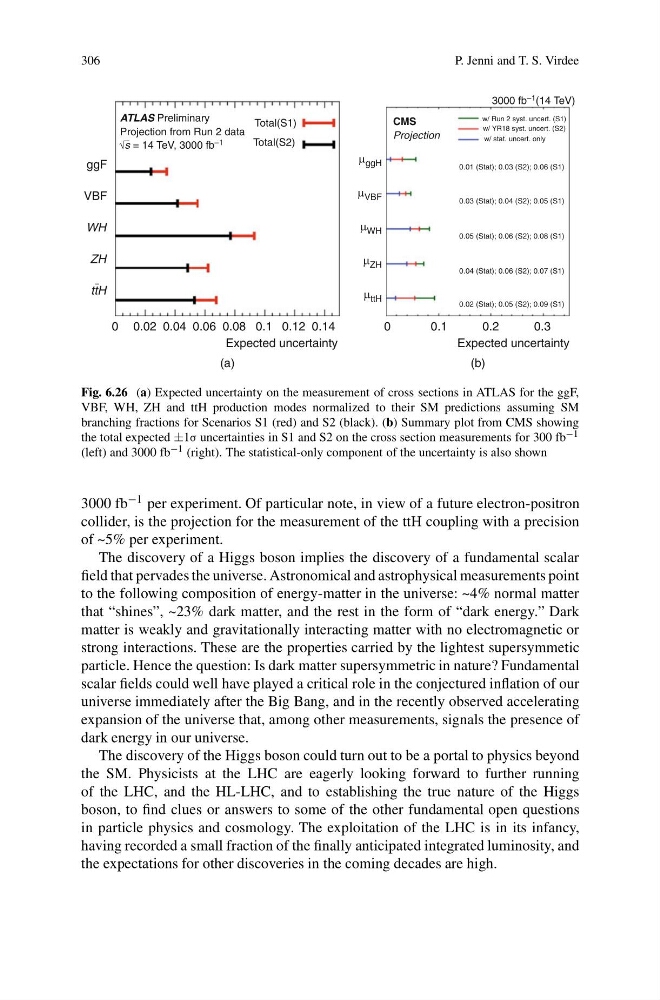
Fig. 6.26 (a) Expected uncertainty on the measurement of cross sections in ATLAS for the ggF,
VBF, WH, ZH and ttH production modes normalized to their SM predictions assuming SM
branching fractions for Scenarios S1 (red) and S2 (black). (b) Summary plot from CMS showing
the total expected ±1σ uncertainties in S1 and S2 on the cross section measurements for 300 fb −1
(left) and 3000 fb −1 (right). The statistical-only component of the uncertainty is also shown
3000 fb −1 per experiment. Of particular note, in view of a future electron-positron
collider, is the projection for the measurement of the ttH coupling with a precision
of ~5% per experiment.
The discovery of a Higgs boson implies the discovery of a fundamental scalar
field that pervades the universe. Astronomical and astrophysical measurements point
to the following composition of energy-matter in the universe: ~4% normal matter
that “shines”, ~23% dark matter, and the rest in the form of “dark energy.” Dark
matter is weakly and gravitationally interacting matter with no electromagnetic or
strong interactions. These are the properties carried by the lightest supersymmetic
particle. Hence the question: Is dark matter supersymmetric in nature? Fundamental
scalar fields could well have played a critical role in the conjectured inflation of our
universe immediately after the Big Bang, and in the recently observed accelerating
expansion of the universe that, among other measurements, signals the presence of
dark energy in our universe.
The discovery of the Higgs boson could turn out to be a portal to physics beyond
the SM. Physicists at the LHC are eagerly looking forward to further running
of the LHC, and the HL-LHC, and to establishing the true nature of the Higgs
boson, to find clues or answers to some of the other fundamental open questions
in particle physics and cosmology. The exploitation of the LHC is in its infancy,
having recorded a small fraction of the finally anticipated integrated luminosity, and
the expectations for other discoveries in the coming decades are high.
P. Jenni and T. S. Virdee
VBF
WH
ZH
ggF
ATLAS Preliminary
CMS
ttH
0.12
0.1
0.08
0.06
0.04
0.02
0
0.14
0.2
0.04 (Stat); 0.06 (S2); 0.07 (S1)
0.05 (Stat); 0.06 (S2); 0.08 (S1)
0.03 (Stat); 0.04 (S2); 0.05 (S1)
0.01 (Stat); 0.03 (S2); 0.06 (S1)
w/ Run 2 syst. uncert. (S1)
w/ YR18 syst. uncert. (S2)
w/ stat. uncert. only
0.02 (Stat); 0.05 (S2); 0.09 (S1)
0.1
0
0.3
Expected uncertainty
Expected uncertainty
ggH
VBF
WH
ZH
ttH
Projection from Run 2 data
Projection
Total(S1)
Total(S2)
s = 14 TeV, 3000 fb –1
3000 fb –1 (14 TeV)
(a)
(b)
Fig. 6.26 (a) Expected uncertainty on the measurement of cross sections in ATLAS for the ggF,
VBF, WH, ZH and ttH production modes normalized to their SM predictions assuming SM
branching fractions for Scenarios S1 (red) and S2 (black). (b) Summary plot from CMS showing
the total expected ±1σ uncertainties in S1 and S2 on the cross section measurements for 300 fb −1
(left) and 3000 fb −1 (right). The statistical-only component of the uncertainty is also shown
3000 fb −1 per experiment. Of particular note, in view of a future electron-positron
collider, is the projection for the measurement of the ttH coupling with a precision
of ~5% per experiment.
The discovery of a Higgs boson implies the discovery of a fundamental scalar
field that pervades the universe. Astronomical and astrophysical measurements point
to the following composition of energy-matter in the universe: ~4% normal matter
that “shines”, ~23% dark matter, and the rest in the form of “dark energy.” Dark
matter is weakly and gravitationally interacting matter with no electromagnetic or
strong interactions. These are the properties carried by the lightest supersymmetic
particle. Hence the question: Is dark matter supersymmetric in nature? Fundamental
scalar fields could well have played a critical role in the conjectured inflation of our
universe immediately after the Big Bang, and in the recently observed accelerating
expansion of the universe that, among other measurements, signals the presence of
dark energy in our universe.
The discovery of the Higgs boson could turn out to be a portal to physics beyond
the SM. Physicists at the LHC are eagerly looking forward to further running
of the LHC, and the HL-LHC, and to establishing the true nature of the Higgs
boson, to find clues or answers to some of the other fundamental open questions
in particle physics and cosmology. The exploitation of the LHC is in its infancy,
having recorded a small fraction of the finally anticipated integrated luminosity, and
the expectations for other discoveries in the coming decades are high.