

292
P. Jenni and T. S. Virdee
ATLAS
ATLAS
Events / 10 GeV
VBF ·
B
H WW · [pb]
ggF · B H WW · [pb]
Data-Bkg.
s = 13 TeV, 36.1 fb –1
H WW* e
, N jet 1
s = 13 TeV, 36.1 fb –1
1800
1600
1400
1200
1000
800
600
400
200
2000
Data
Uncertainty
Mis-ld
H ggF
H VBF
WW
VV
tt/Wt
Z/ *
0
200
100
300
0
200
m T [GeV]
150
(a)
(b)
100
50
250
20
15
10
5
0
–5
1.5
1.0
0.5
0.0
–0.5
2.0
25
68% CL
95% CL
Best fit
SM
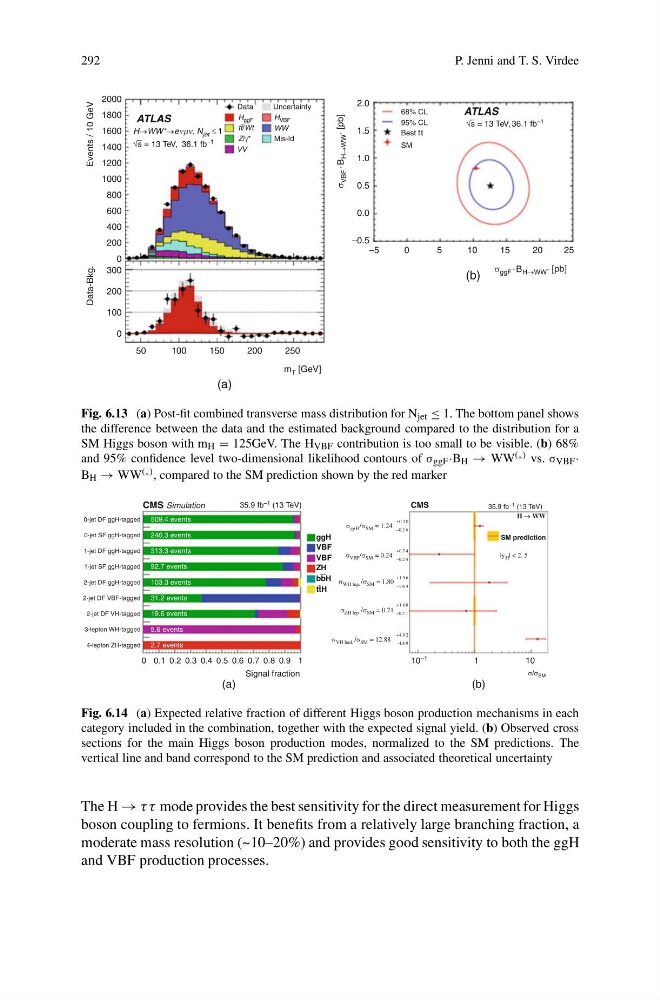
Fig. 6.13 (a) Post-fit combined transverse mass distribution for N jet ≤ 1. The bottom panel shows
the difference between the data and the estimated background compared to the distribution for a
SM Higgs boson with m H = 125GeV. The H VBF contribution is too small to be visible. (b) 68%
and 95% confidence level two-dimensional likelihood contours of σ ggF ·B H → WW (∗) vs. σ VBF ·
B H → WW (∗) , compared to the SM prediction shown by the red marker
CMS Simulation
CMS
35.9 fb –1 (13 TeV)
35.9 fb –1 (13 TeV)
SM prediction
240.3 events
313.3 events
92.7 events
103.3 events
31.2 events
19.6 events
5.6 events
509.4 events
ggH
VBF
VBF
ZH
bbH
ttH
2.7 events
0.9
Signal fraction
0-jet SF ggH-tagged
1-jet DF ggH-tagged
1-jet SF ggH-tagged
2-jet DF ggH-tagged
2-jet DF VBF-tagged
2-jet DF VH-tagged
3-lepton WH-tagged
0-jet DF ggH-tagged
4-lepton ZH-tagged
0.8
0.7
0.6
0.5
(a)
(b)
0.4
0.3
0.2
10 –1
1
1 0
0.1
1
0
/ SM
|y H | < 2. 5
H WW
gg H / SM = 1.24
VBF / SM = 0.24
WH lep. / SM = 1.80
ZH lep . / SM = 0.71
VH had. / SM = 12.88
+4.9 2
–4.8 9
+1.6 8
–0.7 1
+1.9 6
–1.6 4
+0.7 4
–0.2 4
+0.2 0
–0.2 6
Fig. 6.14 (a) Expected relative fraction of different Higgs boson production mechanisms in each
category included in the combination, together with the expected signal yield. (b) Observed cross
sections for the main Higgs boson production modes, normalized to the SM predictions. The
vertical line and band correspond to the SM prediction and associated theoretical uncertainty
The H → τ τ mode provides the best sensitivity for the direct measurement for Higgs
boson coupling to fermions. It benefits from a relatively large branching fraction, a
moderate mass resolution (~10–20%) and provides good sensitivity to both the ggH
and VBF production processes.
P. Jenni and T. S. Virdee
ATLAS
ATLAS
Events / 10 GeV
VBF ·
B
H WW · [pb]
ggF · B H WW · [pb]
Data-Bkg.
s = 13 TeV, 36.1 fb –1
H WW* e
, N jet 1
s = 13 TeV, 36.1 fb –1
1800
1600
1400
1200
1000
800
600
400
200
2000
Data
Uncertainty
Mis-ld
H ggF
H VBF
WW
VV
tt/Wt
Z/ *
0
200
100
300
0
200
m T [GeV]
150
(a)
(b)
100
50
250
20
15
10
5
0
–5
1.5
1.0
0.5
0.0
–0.5
2.0
25
68% CL
95% CL
Best fit
SM
Fig. 6.13 (a) Post-fit combined transverse mass distribution for N jet ≤ 1. The bottom panel shows
the difference between the data and the estimated background compared to the distribution for a
SM Higgs boson with m H = 125GeV. The H VBF contribution is too small to be visible. (b) 68%
and 95% confidence level two-dimensional likelihood contours of σ ggF ·B H → WW (∗) vs. σ VBF ·
B H → WW (∗) , compared to the SM prediction shown by the red marker
CMS Simulation
CMS
35.9 fb –1 (13 TeV)
35.9 fb –1 (13 TeV)
SM prediction
240.3 events
313.3 events
92.7 events
103.3 events
31.2 events
19.6 events
5.6 events
509.4 events
ggH
VBF
VBF
ZH
bbH
ttH
2.7 events
0.9
Signal fraction
0-jet SF ggH-tagged
1-jet DF ggH-tagged
1-jet SF ggH-tagged
2-jet DF ggH-tagged
2-jet DF VBF-tagged
2-jet DF VH-tagged
3-lepton WH-tagged
0-jet DF ggH-tagged
4-lepton ZH-tagged
0.8
0.7
0.6
0.5
(a)
(b)
0.4
0.3
0.2
10 –1
1
1 0
0.1
1
0
/ SM
|y H | < 2. 5
H WW
gg H / SM = 1.24
VBF / SM = 0.24
WH lep. / SM = 1.80
ZH lep . / SM = 0.71
VH had. / SM = 12.88
+4.9 2
–4.8 9
+1.6 8
–0.7 1
+1.9 6
–1.6 4
+0.7 4
–0.2 4
+0.2 0
–0.2 6
Fig. 6.14 (a) Expected relative fraction of different Higgs boson production mechanisms in each
category included in the combination, together with the expected signal yield. (b) Observed cross
sections for the main Higgs boson production modes, normalized to the SM predictions. The
vertical line and band correspond to the SM prediction and associated theoretical uncertainty
The H → τ τ mode provides the best sensitivity for the direct measurement for Higgs
boson coupling to fermions. It benefits from a relatively large branching fraction, a
moderate mass resolution (~10–20%) and provides good sensitivity to both the ggH
and VBF production processes.