

6 The Discovery of the Higgs Boson at the LHC
289
CMS
VBF
ttH
WH leptonic
ZH leptonic
ggH
VH hadronic
35.9 fb –1 (13 TeV)
1.02
Per process 68% CL
SM Prediction
m H profiled
+0.19
–0.18
0.8
+0.8
–0.5
2.0
+0.8
–0.7
3.0
+1.5
–1.3
0.0
+0.9
–0.0
5.1
6
4
2
0
–2
8
proc / theo
+2.5
–2.3
H
(a)
(b)
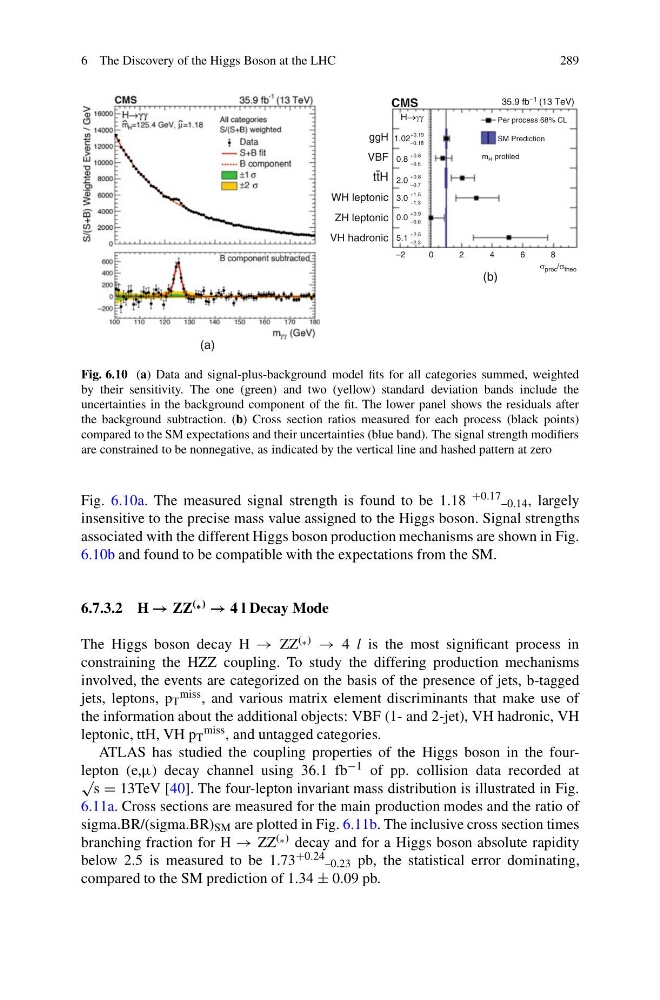
Fig. 6.10 (a) Data and signal-plus-background model fits for all categories summed, weighted
by their sensitivity. The one (green) and two (yellow) standard deviation bands include the
uncertainties in the background component of the fit. The lower panel shows the residuals after
the background subtraction. (b) Cross section ratios measured for each process (black points)
compared to the SM expectations and their uncertainties (blue band). The signal strength modifiers
are constrained to be nonnegative, as indicated by the vertical line and hashed pattern at zero
Fig. 6.10a. The measured signal strength is found to be 1.18 +0.17 –0.14 , largely
insensitive to the precise mass value assigned to the Higgs boson. Signal strengths
associated with the different Higgs boson production mechanisms are shown in Fig.
6.10b and found to be compatible with the expectations from the SM.
6.7.3.2 H → ZZ ( ∗ ) → 4 l Decay Mode
The Higgs boson decay H → ZZ ( ∗ ) → 4 l is the most significant process in
constraining the HZZ coupling. To study the differing production mechanisms
involved, the events are categorized on the basis of the presence of jets, b-tagged
jets, leptons, p T
miss , and various matrix element discriminants that make use of
the information about the additional objects: VBF (1- and 2-jet), VH hadronic, VH
leptonic, ttH, VH p T
miss , and untagged categories.
ATLAS has studied the coupling properties of the Higgs boson in the fourlepton (e,μ) decay channel using 36.1 fb −1 of pp. collision data recorded at
√
s = 13TeV [40]. The four-lepton invariant mass distribution is illustrated in Fig.
6.11a. Cross sections are measured for the main production modes and the ratio of
sigma.BR/(sigma.BR) SM are plotted in Fig. 6.11b. The inclusive cross section times
branching fraction for H → ZZ ( ∗ ) decay and for a Higgs boson absolute rapidity
below 2.5 is measured to be 1.73 +0.24 –0.23 pb, the statistical error dominating,
compared to the SM prediction of 1.34 ± 0.09 pb.
289
CMS
VBF
ttH
WH leptonic
ZH leptonic
ggH
VH hadronic
35.9 fb –1 (13 TeV)
1.02
Per process 68% CL
SM Prediction
m H profiled
+0.19
–0.18
0.8
+0.8
–0.5
2.0
+0.8
–0.7
3.0
+1.5
–1.3
0.0
+0.9
–0.0
5.1
6
4
2
0
–2
8
proc / theo
+2.5
–2.3
H
(a)
(b)
Fig. 6.10 (a) Data and signal-plus-background model fits for all categories summed, weighted
by their sensitivity. The one (green) and two (yellow) standard deviation bands include the
uncertainties in the background component of the fit. The lower panel shows the residuals after
the background subtraction. (b) Cross section ratios measured for each process (black points)
compared to the SM expectations and their uncertainties (blue band). The signal strength modifiers
are constrained to be nonnegative, as indicated by the vertical line and hashed pattern at zero
Fig. 6.10a. The measured signal strength is found to be 1.18 +0.17 –0.14 , largely
insensitive to the precise mass value assigned to the Higgs boson. Signal strengths
associated with the different Higgs boson production mechanisms are shown in Fig.
6.10b and found to be compatible with the expectations from the SM.
6.7.3.2 H → ZZ ( ∗ ) → 4 l Decay Mode
The Higgs boson decay H → ZZ ( ∗ ) → 4 l is the most significant process in
constraining the HZZ coupling. To study the differing production mechanisms
involved, the events are categorized on the basis of the presence of jets, b-tagged
jets, leptons, p T
miss , and various matrix element discriminants that make use of
the information about the additional objects: VBF (1- and 2-jet), VH hadronic, VH
leptonic, ttH, VH p T
miss , and untagged categories.
ATLAS has studied the coupling properties of the Higgs boson in the fourlepton (e,μ) decay channel using 36.1 fb −1 of pp. collision data recorded at
√
s = 13TeV [40]. The four-lepton invariant mass distribution is illustrated in Fig.
6.11a. Cross sections are measured for the main production modes and the ratio of
sigma.BR/(sigma.BR) SM are plotted in Fig. 6.11b. The inclusive cross section times
branching fraction for H → ZZ ( ∗ ) decay and for a Higgs boson absolute rapidity
below 2.5 is measured to be 1.73 +0.24 –0.23 pb, the statistical error dominating,
compared to the SM prediction of 1.34 ± 0.09 pb.