

6 The Discovery of the Higgs Boson at the LHC
269
6.3 The Large Hadron Collider
6.3.1 The Road to the LHC
With the prospect of ground-breaking physics at the LHC, several workshops
and conferences followed, where the formidable experimental challenges started
to appear manageable, provided that enough R&D work on detectors could be
carried out. In 1987 the workshop in La Thuile of the so-called “Rubbia LongRange Planning Committee” resulted in the recommendation of a proton-proton
collider, labeled the Large Hadron Collider (LHC), as the next accelerator for
CERN. Meetings of note were the ECFA LHC Workshop in Aachen in 1990
[31], and “Towards the LHC Experimental Programme” [32] which took place
in Evian-les-Bains, France in March 1992. At Evian several proto-collaborations
presented their designs in “Expressions of Interest”. In addition, from the early
1990s, CERN’s LHC Detector R&D Committee (DRDC), which reviewed and
steered R&D groupings, greatly stimulated innovative developments in detector
technology.
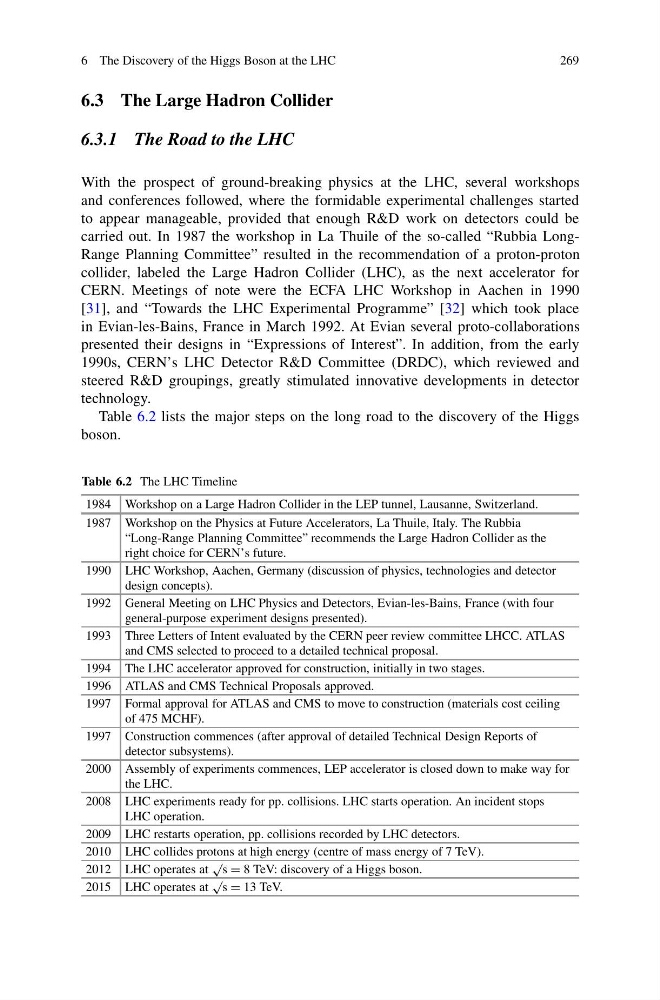
Table 6.2 lists the major steps on the long road to the discovery of the Higgs
boson.
Table 6.2 The LHC Timeline
1984 Workshop on a Large Hadron Collider in the LEP tunnel, Lausanne, Switzerland.
1987 Workshop on the Physics at Future Accelerators, La Thuile, Italy. The Rubbia
“Long-Range Planning Committee” recommends the Large Hadron Collider as the
right choice for CERN’s future.
1990 LHC Workshop, Aachen, Germany (discussion of physics, technologies and detector
design concepts).
1992 General Meeting on LHC Physics and Detectors, Evian-les-Bains, France (with four
general-purpose experiment designs presented).
1993 Three Letters of Intent evaluated by the CERN peer review committee LHCC. ATLAS
and CMS selected to proceed to a detailed technical proposal.
1994 The LHC accelerator approved for construction, initially in two stages.
1996 ATLAS and CMS Technical Proposals approved.
1997 Formal approval for ATLAS and CMS to move to construction (materials cost ceiling
of 475 MCHF).
1997 Construction commences (after approval of detailed Technical Design Reports of
detector subsystems).
2000 Assembly of experiments commences, LEP accelerator is closed down to make way for
the LHC.
2008 LHC experiments ready for pp. collisions. LHC starts operation. An incident stops
LHC operation.
2009 LHC restarts operation, pp. collisions recorded by LHC detectors.
2010 LHC collides protons at high energy (centre of mass energy of 7 TeV).
2012 LHC operates at
√
s = 8 TeV: discovery of a Higgs boson.
2015 LHC operates at
√
s = 13 TeV.
269
6.3 The Large Hadron Collider
6.3.1 The Road to the LHC
With the prospect of ground-breaking physics at the LHC, several workshops
and conferences followed, where the formidable experimental challenges started
to appear manageable, provided that enough R&D work on detectors could be
carried out. In 1987 the workshop in La Thuile of the so-called “Rubbia LongRange Planning Committee” resulted in the recommendation of a proton-proton
collider, labeled the Large Hadron Collider (LHC), as the next accelerator for
CERN. Meetings of note were the ECFA LHC Workshop in Aachen in 1990
[31], and “Towards the LHC Experimental Programme” [32] which took place
in Evian-les-Bains, France in March 1992. At Evian several proto-collaborations
presented their designs in “Expressions of Interest”. In addition, from the early
1990s, CERN’s LHC Detector R&D Committee (DRDC), which reviewed and
steered R&D groupings, greatly stimulated innovative developments in detector
technology.
Table 6.2 lists the major steps on the long road to the discovery of the Higgs
boson.
Table 6.2 The LHC Timeline
1984 Workshop on a Large Hadron Collider in the LEP tunnel, Lausanne, Switzerland.
1987 Workshop on the Physics at Future Accelerators, La Thuile, Italy. The Rubbia
“Long-Range Planning Committee” recommends the Large Hadron Collider as the
right choice for CERN’s future.
1990 LHC Workshop, Aachen, Germany (discussion of physics, technologies and detector
design concepts).
1992 General Meeting on LHC Physics and Detectors, Evian-les-Bains, France (with four
general-purpose experiment designs presented).
1993 Three Letters of Intent evaluated by the CERN peer review committee LHCC. ATLAS
and CMS selected to proceed to a detailed technical proposal.
1994 The LHC accelerator approved for construction, initially in two stages.
1996 ATLAS and CMS Technical Proposals approved.
1997 Formal approval for ATLAS and CMS to move to construction (materials cost ceiling
of 475 MCHF).
1997 Construction commences (after approval of detailed Technical Design Reports of
detector subsystems).
2000 Assembly of experiments commences, LEP accelerator is closed down to make way for
the LHC.
2008 LHC experiments ready for pp. collisions. LHC starts operation. An incident stops
LHC operation.
2009 LHC restarts operation, pp. collisions recorded by LHC detectors.
2010 LHC collides protons at high energy (centre of mass energy of 7 TeV).
2012 LHC operates at
√
s = 8 TeV: discovery of a Higgs boson.
2015 LHC operates at
√
s = 13 TeV.