

268
P. Jenni and T. S. Virdee
Table 6.1 The Production cross sections and decay branching fractions at
√
s = 14 TeV
Production process
Cross section (pb)
Decay Mode H→
Branching fraction (%)
gg fusion (pp → H)
54.67
bb
58.24
qqH (VBF)
4.28
WW (∗)
21.37
WH (associated)
1.51
ττ
6.27
ZH (associated)
0.99
ZZ (∗)
2.62
ttH
0.61
γγ
2.27 × 10 −1
μμ
2.18 × 10 −2
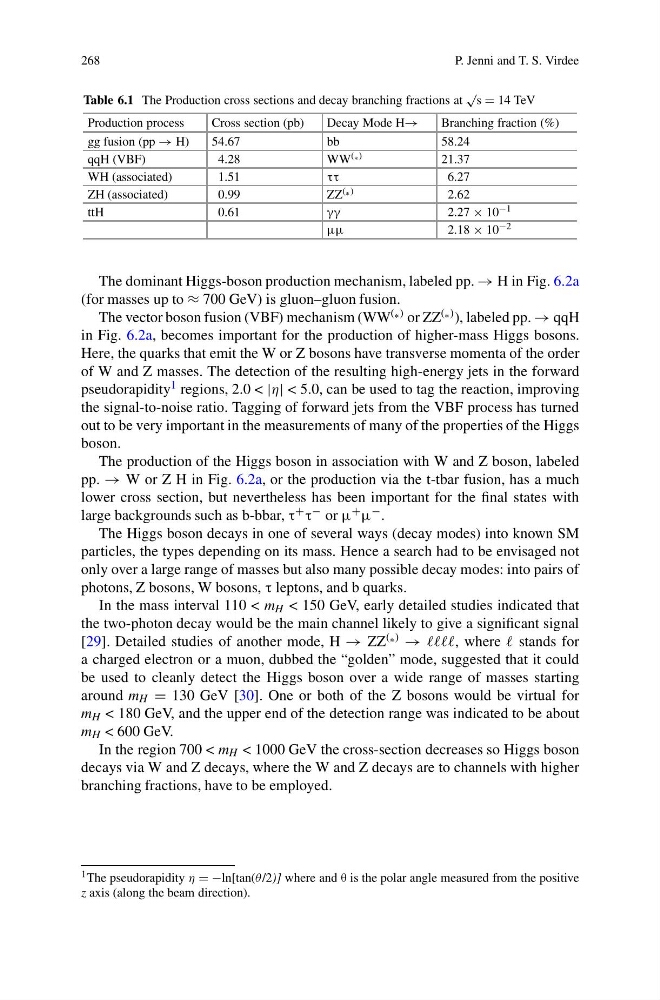
The dominant Higgs-boson production mechanism, labeled pp. → H in Fig. 6.2a
(for masses up to ≈ 700 GeV) is gluon–gluon fusion.
The vector boson fusion (VBF) mechanism (WW ( ∗ ) or ZZ ( ∗ ) ), labeled pp. → qqH
in Fig. 6.2a, becomes important for the production of higher-mass Higgs bosons.
Here, the quarks that emit the W or Z bosons have transverse momenta of the order
of W and Z masses. The detection of the resulting high-energy jets in the forward
pseudorapidity 1 regions, 2.0 < |η| < 5.0, can be used to tag the reaction, improving
the signal-to-noise ratio. Tagging of forward jets from the VBF process has turned
out to be very important in the measurements of many of the properties of the Higgs
boson.
The production of the Higgs boson in association with W and Z boson, labeled
pp. → W or Z H in Fig. 6.2a, or the production via the t-tbar fusion, has a much
lower cross section, but nevertheless has been important for the final states with
large backgrounds such as b-bbar, τ + τ − or μ + μ − .
The Higgs boson decays in one of several ways (decay modes) into known SM
particles, the types depending on its mass. Hence a search had to be envisaged not
only over a large range of masses but also many possible decay modes: into pairs of
photons, Z bosons, W bosons, τ leptons, and b quarks.
In the mass interval 110 < m H < 150 GeV, early detailed studies indicated that
the two-photon decay would be the main channel likely to give a significant signal
[29]. Detailed studies of another mode, H → ZZ ( ∗ ) → , where stands for
a charged electron or a muon, dubbed the “golden” mode, suggested that it could
be used to cleanly detect the Higgs boson over a wide range of masses starting
around m H = 130 GeV [30]. One or both of the Z bosons would be virtual for
m H < 180 GeV, and the upper end of the detection range was indicated to be about
m H < 600 GeV.
In the region 700 < m H < 1000 GeV the cross-section decreases so Higgs boson
decays via W and Z decays, where the W and Z decays are to channels with higher
branching fractions, have to be employed.
1 The pseudorapidity η = −ln[tan(θ/2)] where and θ is the polar angle measured from the positive
z axis (along the beam direction).
P. Jenni and T. S. Virdee
Table 6.1 The Production cross sections and decay branching fractions at
√
s = 14 TeV
Production process
Cross section (pb)
Decay Mode H→
Branching fraction (%)
gg fusion (pp → H)
54.67
bb
58.24
qqH (VBF)
4.28
WW (∗)
21.37
WH (associated)
1.51
ττ
6.27
ZH (associated)
0.99
ZZ (∗)
2.62
ttH
0.61
γγ
2.27 × 10 −1
μμ
2.18 × 10 −2
The dominant Higgs-boson production mechanism, labeled pp. → H in Fig. 6.2a
(for masses up to ≈ 700 GeV) is gluon–gluon fusion.
The vector boson fusion (VBF) mechanism (WW ( ∗ ) or ZZ ( ∗ ) ), labeled pp. → qqH
in Fig. 6.2a, becomes important for the production of higher-mass Higgs bosons.
Here, the quarks that emit the W or Z bosons have transverse momenta of the order
of W and Z masses. The detection of the resulting high-energy jets in the forward
pseudorapidity 1 regions, 2.0 < |η| < 5.0, can be used to tag the reaction, improving
the signal-to-noise ratio. Tagging of forward jets from the VBF process has turned
out to be very important in the measurements of many of the properties of the Higgs
boson.
The production of the Higgs boson in association with W and Z boson, labeled
pp. → W or Z H in Fig. 6.2a, or the production via the t-tbar fusion, has a much
lower cross section, but nevertheless has been important for the final states with
large backgrounds such as b-bbar, τ + τ − or μ + μ − .
The Higgs boson decays in one of several ways (decay modes) into known SM
particles, the types depending on its mass. Hence a search had to be envisaged not
only over a large range of masses but also many possible decay modes: into pairs of
photons, Z bosons, W bosons, τ leptons, and b quarks.
In the mass interval 110 < m H < 150 GeV, early detailed studies indicated that
the two-photon decay would be the main channel likely to give a significant signal
[29]. Detailed studies of another mode, H → ZZ ( ∗ ) → , where stands for
a charged electron or a muon, dubbed the “golden” mode, suggested that it could
be used to cleanly detect the Higgs boson over a wide range of masses starting
around m H = 130 GeV [30]. One or both of the Z bosons would be virtual for
m H < 180 GeV, and the upper end of the detection range was indicated to be about
m H < 600 GeV.
In the region 700 < m H < 1000 GeV the cross-section decreases so Higgs boson
decays via W and Z decays, where the W and Z decays are to channels with higher
branching fractions, have to be employed.
1 The pseudorapidity η = −ln[tan(θ/2)] where and θ is the polar angle measured from the positive
z axis (along the beam direction).